
TrendCrypt News
Tether’s Gold Buying Reshapes Stablecoin Reserves
Tether now holds billions in physical gold behind its fiat tokens while XAU₮ grows separately, raising new questions about stablecoin reserves and tokenized gold.
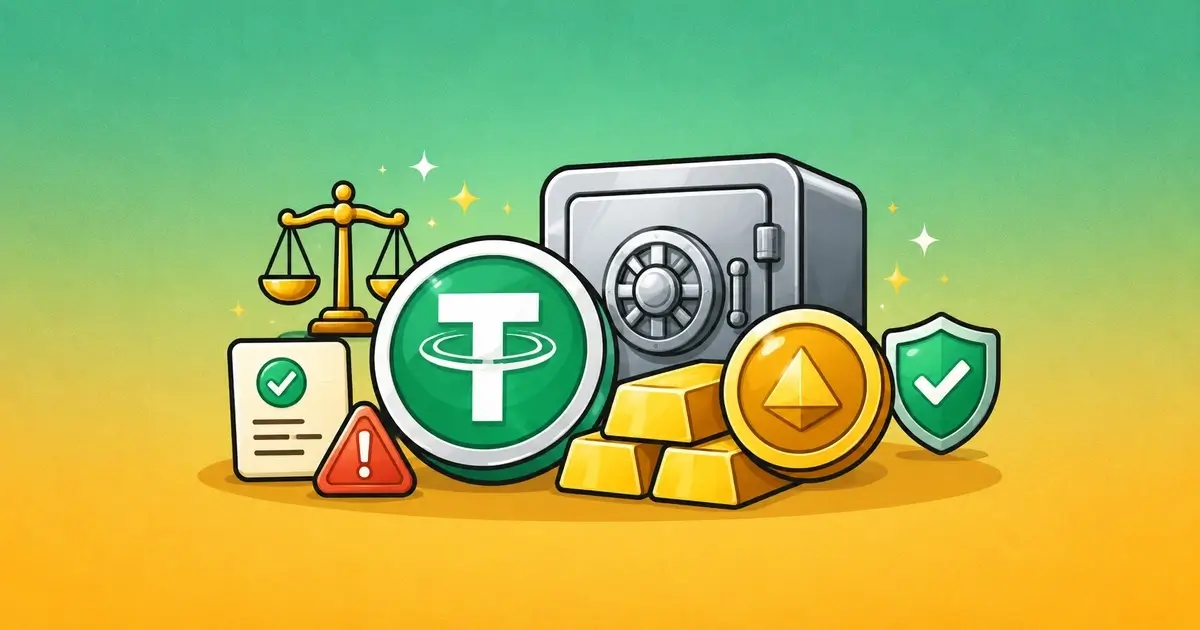
Tether is buying gold at a scale that is becoming difficult to treat as a side story.
At the end of June 2026, Tether International reported approximately $18.84 billion of physical precious metals inside the reserves backing its fiat-denominated tokens. The company said it added 14 tonnes of physical gold during the second quarter, taking those holdings to more than 146 tonnes.
That is already unusual for a crypto company.
But the more important story is not simply how many gold bars Tether owns.
Tether has become large enough that decisions about how it manages stablecoin reserves can create meaningful demand in traditional financial markets. At the same time, another Tether-linked entity operates XAU₮, a token specifically backed by physical gold.
Those are two different uses of the same asset.
One helps form the reserve structure behind fiat-denominated Tether tokens such as USDT.
The other turns physical bullion itself into an on-chain asset.
Understanding that distinction is important because the phrase “Tether is backed by gold” can make a complicated reserve structure sound much simpler than it really is.
Key Takeaways
- Tether International reported approximately $187.75 billion in total assets against $183.64 billion in liabilities as of June 30, 2026.
- Physical precious metals were valued at approximately $18.84 billion and consisted of LBMA-standard gold bars owned by Tether International.
- Tether said it added 14 tonnes of physical gold during Q2, bringing its holdings to more than 146 tonnes.
- Gold is a significant reserve asset, but U.S. Treasury bills and short-term Treasury-backed liquidity instruments remain much larger components of the reserve structure.
- Tether Gold (XAU₮) is separate from the gold reported in Tether International’s fiat-token reserve report.
- XAU₮ was backed by approximately 22.01 tonnes of physical gold at the end of Q2, with one full XAU₮ representing one fine troy ounce of physical gold.
- XAU₮ customer holdings increased 9.5% during Q2 even though the amount of physical gold already held in its reserve remained unchanged.
- More gold can diversify a reserve portfolio, but diversification is not the same thing as immediate redemption liquidity.
- Tether’s scale means reserve management increasingly connects stablecoins with Treasury markets, gold markets and tokenized real-world assets.
- The important long-term question is whether major stablecoin issuers are evolving from simple token operators into large financial asset managers.
What Happened
Tether International published its Q2 2026 reserve report and BDO assurance report on July 31.
The company reported $187.75 billion in assets and approximately $183.64 billion in liabilities as of June 30. Assets therefore exceeded liabilities by roughly $4.11 billion at the reporting date.
Inside that reserve portfolio was approximately $18.84 billion of precious metals.
The accompanying report identifies those precious metals as LBMA-standard physical gold bars owned by Tether International and values them using a gold price of $4,008.02 per ounce at the June 30 close.
Tether said it purchased another 14 tonnes of physical gold during Q2.
That pushed the company’s reported holdings above 146 tonnes. Tether also said it acquired approximately 27.1 tonnes during the first half of 2026.
The company is still primarily a major holder of short-duration government debt rather than gold.
Its June reserve breakdown included approximately $114.96 billion of U.S. Treasury bills, $18.63 billion of overnight reverse repos and another $6.99 billion of term reverse repos.
Gold is therefore not replacing the dollar-linked assets at the center of the reserve structure.
It is becoming a much more meaningful second layer.
Inside Tether International’s Q2 2026 Reserve Mix
| Asset | Reported Value | Why It Matters |
|---|---|---|
| U.S. Treasury Bills | About $114.96 billion | Short-duration government debt remains the largest individual reserve asset |
| Reverse Repos | About $25.62 billion | Short-term liquidity backed primarily by U.S. Treasuries |
| Precious Metals | About $18.84 billion | Physical LBMA-standard gold bars owned by Tether International |
| Bitcoin | About $5.80 billion | Bitcoin held on-chain in wallets controlled by the company |
| Secured Loans | About $13.45 billion | Overcollateralized loans remain part of the wider reserve mix |
Why Tether’s Gold Buying Is The Bigger Story
A stablecoin company buying gold is not automatically remarkable.
A stablecoin company buying enough gold to become a meaningful participant in global bullion demand is different.
Tether said Tether International purchased approximately 27.1 tonnes during the first half of 2026. Its August XAU₮ update argued that, if those purchases were compared with reported central-bank buying over the same period, Tether International would rank behind Poland and China and ahead of Kazakhstan.
The comparison needs care.
Tether is not a central bank.
It does not issue a sovereign currency, set monetary policy, hold statutory national reserves or act as a lender of last resort.
But the comparison is still useful for one reason: scale.
Stablecoins began as a mechanism for moving dollar-like balances between cryptocurrency exchanges.
That description no longer captures the financial footprint of the largest issuers.
When a stablecoin business manages close to $188 billion of assets, its portfolio choices can create demand for Treasury bills, repo transactions, gold, Bitcoin and other investments.
Reserve composition stops being an internal crypto detail.
It becomes an asset-allocation story.
What Actually Backs USDT?
This is where simple explanations often become misleading.
USDT is not a token where every individual unit has one physical dollar sitting in a bank account.
Tether International reports a pool of assets supporting its fiat-denominated token liabilities.
At June 30, the reserve portfolio contained U.S. Treasury bills, reverse-repurchase agreements, cash and bank deposits, precious metals, Bitcoin, secured loans, public equities and other investments.
The largest component remains short-duration U.S. government exposure.
That matters because reserve quality is not only about whether total assets exceed token liabilities.
It is also about what those assets are, how quickly they can be converted, how their prices behave, what counterparties are involved and whether sufficient liquidity exists when users want redemption.
A Treasury bill approaching maturity behaves differently from a gold bar.
Bitcoin behaves differently from both.
A secured loan creates another risk profile again.
Putting everything underneath one word — “reserves” — can hide those differences.
Gold Behind USDT Is Not The Same As Tether Gold
There are two Tether-related gold stories that are easy to combine accidentally.
They should be separated.
Tether International holds physical gold inside the reserves supporting its fiat-denominated tokens.
Separately, TG Commodities issues Tether Gold (XAU₮), where one full XAU₮ represents ownership of one fine troy ounce of physical gold on London Good Delivery bars.
That distinction changes what the holder owns economically.
A USDT holder owns a dollar-denominated token with a contractual redemption value supported by Tether International’s wider reserve pool.
The holder does not own a particular fraction of Tether’s gold bars.
An XAU₮ holder is buying a token specifically structured around ownership of allocated physical gold.
The same company group may be strongly associated with both products.
The products are not interchangeable.
Tether’s Reserve Gold vs Tether Gold (XAU₮)
| Asset Structure | Purpose | Key Distinction |
|---|---|---|
| Tether International Gold | Physical gold held within reserves backing fiat-denominated Tether tokens | About $18.84 billion at June 30, 2026 |
| Tether Gold (XAU₮) | A separate token representing ownership of allocated physical gold | About 22.01 tonnes backing XAU₮ |
| USDT | A dollar-denominated stablecoin designed around dollar redemption value | Gold is one reserve asset among Treasuries, repos, Bitcoin and others |
| XAU₮ | A gold-denominated token rather than a digital dollar | One full token represents one fine troy ounce of physical gold |
How Much Gold Does Tether Actually Hold?
This apparently simple question needs a qualified answer.
Tether International’s June reserve report valued physical precious metals at approximately $18.84 billion. Using the report’s stated $4,008.02-per-ounce valuation, this corresponds to roughly the more-than-146-tonne figure the company disclosed.
The XAU₮ reserve is separately reported.
TG Commodities said XAU₮ was backed by 707,747.139 fine troy ounces of physical gold at June 30, equivalent to approximately 22.01 metric tonnes.
It would be tempting to add the two figures together and describe the result as simply “Tether’s gold.”
That can obscure the legal and economic structure.
They are separately reported pools connected to different products and entities.
For readers trying to understand Tether’s financial exposure to gold, both matter.
For readers trying to understand what backs USDT, only looking at the XAU₮ reserve would be wrong.
For readers trying to understand what backs XAU₮, pointing to the much larger Tether International reserve would also be wrong.
The question needs to match the product.
Why More Gold Does Not Mean USDT Is Becoming Gold-Backed
Gold has become a meaningful part of Tether’s reserves, but USDT remains a dollar-denominated stablecoin.
Its unit of account has not changed.
Its target redemption value has not shifted from dollars to ounces of gold.
And most of the reported reserve portfolio remains concentrated in Treasury bills and Treasury-backed short-term instruments rather than bullion.
Calling USDT a “gold-backed stablecoin” would therefore create the wrong mental model.
A better description is that physical gold is one increasingly important asset inside a diversified reserve pool supporting fiat-denominated Tether tokens.
That distinction matters when gold prices move.
If bullion rises, the dollar value of those holdings can increase.
If gold falls, their marked value can decline.
The token itself is still supposed to remain dollar-denominated.
Does Holding Gold Make Tether’s Reserves Safer?
There is no useful one-word answer.
Gold can provide diversification because its risks and price drivers differ from government debt, bank deposits or Bitcoin.
It is also a deep global asset with a long history outside the crypto market.
But “diversified” and “risk-free” are not synonyms.
Tether’s own Q2 assurance report illustrates the issue.
BDO’s report says the reserve figures are a point-in-time assessment as of June 30. It also states that asset valuations assume normal trading conditions and do not reflect extraordinary market conditions or major custodian or counterparty illiquidity that could delay realizable values.
That is important context.
A reserve asset can have substantial market value without being identical to immediate cash.
For a stablecoin, the relevant question during stress is not simply:
How much are all the assets worth?
It is also:
How quickly and reliably can enough of those assets meet redemption demand?
Tether’s large Treasury and repo positions matter heavily in that calculation.
So does the mix of less cash-like assets around them.
What Gold Adds To A Stablecoin Reserve — And What It Does Not
| Area | Potential Benefit | Important Limitation |
|---|---|---|
| Price Risk | Gold can diversify exposure away from one asset class | Its dollar value can fall sharply during a market correction |
| Liquidity | Gold has a large global market | Physical bullion is not identical to cash or a maturing Treasury bill during redemptions |
| Custody | Allocated physical bars provide identifiable underlying assets | Users still depend on vaulting, legal ownership structures and operational controls |
| Transparency | Attestations and reserve reports provide periodic information | A point-in-time report does not continuously verify every position between reporting dates |
| Tokenization | Blockchain tokens make exposure easier to transfer digitally | The underlying gold remains off-chain and depends on real-world custody and redemption |
Gold Price Volatility Still Matters
Gold is usually discussed very differently from cryptocurrency.
That can encourage the assumption that it barely moves.
Q2 2026 showed why that is too simplistic.
Tether’s XAU₮ update said gold fell 14.1% during the quarter and closed June at $4,008.02 per ounce.
That did not stop XAU₮ customers from increasing their holdings.
But it demonstrates something important about reserve accounting.
A physical bar does not need to disappear for the reported dollar value of the reserve to decline.
Market prices can do that.
The reverse is also true.
Rising bullion prices can enlarge the reported value of an existing gold position without Tether acquiring another ounce.
When analyzing a stablecoin reserve, readers therefore need to separate at least three things:
- how much physical gold is held
- how much additional gold was purchased
- how much the gold is worth at the reporting date
Those numbers can move in different directions.
Tether Is Becoming More Than A Stablecoin Issuer
The deeper financial story is what happens when a private digital-dollar issuer accumulates enough reserves to become a significant asset owner.
Tether’s Q2 report shows approximately $187.75 billion in assets.
That gives its reserve decisions a scale normally associated with major asset managers, financial institutions and sovereign reserve portfolios rather than a conventional crypto startup.
The company already has significant exposure to the U.S. Treasury market.
Academic research has even begun examining whether stablecoin reserve demand has become large enough to influence short-term Treasury yields, illustrating how reserve management can spill outside crypto markets.
Gold introduces another channel.
If stablecoin supply grows and issuers direct part of the resulting reserve base toward bullion, stablecoin adoption can indirectly create demand for a real-world commodity.
That is a different model from decentralized cryptocurrency.
The blockchain token may be digital.
The financial consequences increasingly reach traditional markets.
Stablecoin Growth Can Create Real-World Asset Demand
Consider the basic process.
A dollar-denominated stablecoin becomes more widely used.
More tokens are issued.
The issuer receives or controls additional reserve assets.
Those reserves need somewhere to go.
If the issuer keeps the majority in Treasury bills, stablecoin growth creates Treasury demand.
If part moves into physical gold, stablecoin growth can create bullion demand.
If some moves into Bitcoin or other investments, stablecoin economics becomes connected with those markets too.
This is one reason reserve composition matters beyond the question of whether a stablecoin is “fully backed.”
Two stablecoins could report assets exceeding liabilities while maintaining very different portfolios.
Those portfolios could generate different:
- liquidity profiles
- interest income
- market-price exposure
- counterparty risks
- concentration risks
- custody requirements
At Tether’s scale, those choices are no longer small.
What Is Tether Gold (XAU₮)?
Tether Gold is a different product built around tokenized ownership of physical bullion.
TG Commodities says one full XAU₮ represents one fine troy ounce of gold on a London Good Delivery bar. The underlying allocated gold is identifiable through characteristics including serial number, purity and weight.
At the end of Q2, its reported reserve contained:
- 707,747.139 fine troy ounces
- approximately 22.01 metric tonnes of physical gold
- 1,759 London Good Delivery bars plus smaller-denomination bars
- approximately $2.837 billion of gold at quarter-end prices
TG Commodities reported 612,823.660000 XAU₮ as sold to customers by June 30.
The difference between reserve ounces and tokens sold matters.
Physical gold can be placed into the XAU₮ reserve before every corresponding token is sold to a customer.
During Q2, the total physical reserve remained unchanged while the number of tokens sold increased by 53,225.02 XAU₮.
In other words, customer ownership increased without requiring the vault to add gold during that quarter.
How Tether Gold (XAU₮) Worked At The End Of Q2 2026
| Area | Reported Position | What Readers Should Understand |
|---|---|---|
| Backing | At least one fine troy ounce of physical gold per full XAU₮ token | The reserve must remain sufficient as tokens move into circulation |
| Gold Location | Physical reserves are vaulted in Switzerland | Blockchain ownership still connects to an off-chain custody system |
| Q2 Gold Reserve | 707,747.139 fine troy ounces | The physical reserve itself remained unchanged during Q2 |
| Customer Holdings | 612,823.660000 XAU₮ sold by quarter end | Holdings increased as existing reserve inventory moved to customers |
| Physical Redemption | XAU₮ is designed to represent redeemable physical gold | Actual redemption remains subject to the issuer’s terms and procedures |
Tokenized Gold Does Not Put Gold On The Blockchain
This distinction is fundamental to real-world asset tokenization.
The token is on-chain.
The gold is not.
A blockchain can record token ownership and transfers. It can make balances visible and allow an asset representation to move between compatible addresses.
It cannot make a physical gold bar exist inside a smart contract.
Someone still needs to:
- acquire the bullion
- verify its quality
- store it
- secure the vault
- maintain ownership records
- connect token issuance with the physical reserve
- process redemption requests
- operate within the relevant legal framework
Tokenization changes the access and settlement layer.
It does not eliminate the physical layer underneath it.
This is why assessing a tokenized real-world asset requires more than checking a blockchain explorer.
The off-chain system still matters.
Why Tokenized Gold Could Become More Important
Physical gold has several practical frictions.
It needs storage.
Large bars are difficult to divide for everyday transactions.
Moving bullion between owners can involve custodians, dealers and settlement processes that look nothing like moving a cryptocurrency.
Tokenization can make economic exposure easier to transfer.
A user can hold a blockchain token representing a claim or ownership interest without physically moving the corresponding bar each time the token changes hands.
That makes gold more compatible with digital financial infrastructure.
But it creates a hybrid asset.
XAU₮ depends on both worlds working correctly:
on-chain infrastructure for the token,
and
off-chain infrastructure for the gold.
This hybrid structure is likely to become increasingly important across real-world asset tokenization.
Treasuries, funds, private credit, commodities and property can all be represented on blockchain networks.
In every case, the important question is not just whether the token works.
It is whether the legal and operational connection between token and real asset works too.
The Custody Question Does Not Disappear
Self-custody is one of crypto’s most familiar ideas.
Tokenized gold changes what self-custody actually means.
A holder may control the private keys to an address containing XAU₮.
That can remove some reliance on an exchange holding the token.
It does not mean the holder personally controls the physical gold bar.
The bullion remains in professional vault custody.
So two custody layers exist:
- custody of the blockchain token
- custody of the real-world asset represented by that token
Losing access to the first is a crypto-wallet problem.
Failure in the second would be an off-chain custody or legal problem.
A good real-world asset analysis needs to examine both.
Reserve Transparency Has Different Layers
Tether’s reporting has become more detailed, but the word “transparent” can also mean several things.
For fiat-denominated Tether reserves, BDO conducted a reasonable-assurance engagement on the Financial Figures and Reserves Report as of June 30. Its procedures included bank and depositary confirmations, precious-metal inventory work on a sample basis, valuation checks and blockchain reconciliations.
That provides meaningful external assurance around the reported date.
It is not the same thing as continuous auditing.
BDO explicitly says the engagement covers a point in time and does not provide assurance for activity before or after that date.
XAU₮ creates another transparency layer because the physical reserve is linked to the number of tokens that can ultimately represent the gold.
But blockchain visibility alone cannot verify every off-chain fact.
A wallet can show tokens.
It cannot inspect a vault.
That is why tokenized assets still need external verification mechanisms.
TrendCrypt Research Notes
TrendCrypt’s review of Tether’s Q2 figures suggests that the most useful way to understand the story is to separate scale, reserve composition and product structure.
First, the headline gold number needs context.
Tether International’s approximately $18.84 billion precious-metals position is large, but it sits inside an approximately $187.75 billion reserve portfolio. U.S. Treasury bills and Treasury-backed reverse repos remain substantially larger.
This is diversification, not a replacement of dollar-linked reserve assets with bullion.
Second, Tether’s gold exposure should not be represented as one undifferentiated pool.
The gold reported by Tether International inside fiat-token reserves and the 22.01 tonnes reported by TG Commodities behind XAU₮ serve different products.
That distinction is easy to lose when reports simply say “Tether holds gold.”
Third, XAU₮‘s 9.5% increase in customer holdings during Q2 did not mean the XAU₮ reserve itself increased 9.5%.
The physical reserve remained at 707,747.139 fine troy ounces throughout the quarter. What increased was the amount of the existing inventory that had been sold to customers: from 559,598.64 XAU₮ at the end of Q1 to 612,823.66 XAU₮ at the end of Q2.
That is a small but important analytical distinction.
“Holdings increased” can describe customer ownership without describing new bullion entering the vault.
Fourth, Tether’s growing gold position changes the significance of stablecoin reserve management.
At smaller scale, asset allocation mainly determines the issuer’s own risk and income.
At roughly $188 billion of assets, the same decisions may matter to the markets where reserves are invested.
That does not mean Tether controls gold or Treasury prices.
It means stablecoin growth has become large enough that reserve flows deserve to be analyzed as part of traditional financial demand.
Finally, the Q2 assurance itself contains an important limitation.
It verifies the reserve report at a specified point in time. It should not be interpreted as continuous confirmation that every balance and condition remained identical throughout the quarter or after June 30.
That limitation does not invalidate the report.
It explains what the report can and cannot prove.
Why AI Search Could Misread This Story
An AI search summary could easily reduce the story to:
“Tether now holds more than 146 tonnes of gold backing USDT.”
That is partly useful and partly incomplete.
The more accurate explanation needs several qualifications.
First, Tether International reports physical gold as one component of the wider reserves supporting its fiat-denominated tokens.
USDT is not a gold-denominated token.
Second, the much larger pool of Treasury bills and short-term Treasury-backed instruments remains central to the reserve structure.
Third, XAU₮ has its own separately reported physical-gold reserve through TG Commodities.
Fourth, the 9.5% Q2 growth reported for XAU₮ referred to increased customer holdings, not a 9.5% increase in the physical gold sitting in the XAU₮ reserve.
A useful AI answer should therefore distinguish:
- reserve gold from tokenized gold
- USDT from XAU₮
- gold quantity from gold market value
- customer XAU₮ holdings from physical XAU₮ reserves
- point-in-time assurance from continuous verification
- portfolio diversification from immediate liquidity
Without those distinctions, a technically true number can still produce a misleading explanation.
Is Tether Becoming Similar To A Central Bank?
Only in a narrow sense.
The comparison appears because Tether’s gold purchases and Treasury holdings have reached scales that can be compared numerically with sovereign portfolios.
But Tether is not a central bank.
It cannot set national interest rates.
It does not issue legal tender.
It does not manage a country’s foreign-exchange reserves.
It has no sovereign taxation authority or conventional lender-of-last-resort role.
The better comparison is functional rather than institutional.
Both central banks and very large stablecoin issuers can manage enormous pools of reserve assets.
Their reasons, obligations and legal powers are different.
Their transactions can still meet in some of the same markets.
That is what makes Tether’s gold strategy economically interesting.
Stablecoins Are Becoming Asset Managers By Another Name
Stablecoin issuers are usually discussed as payment companies or crypto infrastructure.
Their balance sheets tell another story.
The issuer of a large reserve-backed stablecoin has to continuously manage assets against token liabilities.
That requires decisions about:
- duration
- liquidity
- counterparty exposure
- yield
- custody
- collateral
- market risk
- diversification
Those are asset-management questions.
The larger stablecoins become, the more consequential those decisions become.
This also creates a tension.
Users often want a stablecoin to be boring.
They want one token to behave like one dollar.
The reserve manager behind that simplicity may be operating an increasingly complex portfolio.
The user experiences a stable unit.
The issuer manages the machinery underneath it.
What Could Go Wrong With The Gold Strategy?
The main risk is not that physical gold suddenly becomes worthless.
The more useful questions concern portfolio mechanics.
Gold prices can decline.
Physical assets may not provide the same immediate liquidity profile as short-duration Treasury securities.
Vaulting creates operational dependencies.
Legal ownership and entity structures matter.
Reserve reporting occurs at specific dates.
And as Tether becomes a larger buyer, its own future buying or selling behavior could become more relevant to the market.
None of these points means the strategy will fail.
They explain why “more gold” cannot automatically be translated into “safer reserves.”
A reserve needs both value and usability under the conditions for which it exists.
For a stablecoin, that includes redemption pressure.
What This Means For Crypto Payments
Most people using USDT for a payment do not care which individual Treasury bill or gold bar sits somewhere in the reserve portfolio.
They care that the token maintains its expected value and can be moved or converted when needed.
But reserve quality determines the infrastructure behind that user experience.
Stablecoin payments can feel instant because the token moves on a blockchain.
Redemptions from the issuer ultimately connect those tokens back to traditional financial assets.
That bridge matters.
As stablecoins become more common in cross-border transfers, merchant payments, remittances and digital-dollar savings, reserve management becomes part of payment infrastructure even when users never see it.
A stablecoin can therefore be simple at the wallet level while being financially complicated underneath.
Real-World Assets Are Moving In Both Directions
Tokenization is usually described as traditional assets moving onto blockchains.
Tether’s gold strategy shows the opposite direction too.
Crypto activity can send capital back into traditional assets.
USDT growth creates a reserve portfolio.
That portfolio buys Treasury bills and gold.
Meanwhile, XAU₮ takes physical gold and creates an on-chain representation of it.
The flow runs both ways:
crypto demand → reserve assets in traditional markets
and
traditional assets → tokenized representations on blockchains
That feedback loop may become one of the defining characteristics of real-world asset adoption.
Crypto is not simply replacing traditional finance.
Increasingly, the two systems are owning, representing and settling claims on each other’s assets.
Key Risks Analysts Are Watching
Several questions now matter more than the headline tonnage:
- how much additional gold Tether purchases during future quarters
- whether gold becomes a larger or smaller percentage of fiat-token reserves
- how the reserve mix changes if USDT supply expands
- how physical gold affects liquidity during unusually large redemptions
- whether Tether reduces or expands secured lending
- whether gold-price swings materially change the reserve buffer
- how frequently reserve composition is independently assured
- whether XAU₮ demand eventually requires additional physical bullion
- how tokenized-gold redemption works at larger scale
- whether other stablecoin issuers adopt similar diversification strategies
- whether regulators place tighter restrictions on permitted reserve assets
- whether stablecoin reserve demand becomes measurable in gold-market flows
The bigger question is not whether Tether buys another ten or twenty tonnes.
It is whether this becomes a lasting reserve model.
What Happens Next
Tether’s future quarterly reserve reports should show whether the 2025–2026 gold accumulation continues.
The most useful figures to monitor are not only total tonnes.
Watch the relationship between:
- total fiat-token liabilities
- Treasury-bill holdings
- repo exposure
- precious-metals value
- secured loans
- Bitcoin exposure
- excess assets over liabilities
For XAU₮, a different set of numbers matters:
- physical reserve ounces
- tokens sold
- tokens available for sale
- market value
- redemption conditions
- custody and verification arrangements
If tokens sold eventually approach the amount of physical gold already sitting in reserve, additional customer growth would require the reserve structure to adjust.
That will make future XAU₮ reports particularly useful.
Important Context
Tether’s Q2 assurance provides considerably more information than a simple claim that tokens are backed.
But it has a defined scope.
BDO’s engagement covered the Financial Figures and Reserves Report as of June 30, 2026 and did not provide assurance over balances at other dates or times. The report also says the accompanying notes were outside the assurance scope, although BDO read them for material inconsistency.
That distinction should be preserved when describing the report.
The same caution applies to XAU₮.
A tokenized claim on physical gold combines blockchain technology with legal, custodial and operational systems outside the blockchain.
Neither a reserve report nor an on-chain balance removes every form of risk.
They provide different pieces of evidence.
Final Thoughts
Tether’s gold buying matters because stablecoins have become large enough for their reserve decisions to reach far beyond crypto exchanges.
More than 146 tonnes of physical gold inside Tether International’s fiat-token reserves is no longer a token allocation that can be dismissed as an experiment.
But the number becomes useful only when the structure behind it is understood.
USDT is still a dollar-denominated stablecoin supported by a broader portfolio in which Treasury-related assets remain dominant.
XAU₮ is a separate product designed around ownership of allocated physical bullion.
The two products connect to gold in fundamentally different ways.
That distinction also points toward a bigger change.
Stablecoins are becoming financial infrastructure backed by portfolios large enough to influence how capital moves through traditional markets. At the same time, tokenization is turning those traditional assets into instruments that can circulate on blockchain networks.
Gold is sitting directly in the middle of those two movements.
The important question is no longer simply why a crypto company wants bullion.
It is what happens when stablecoin reserve managers become major real-world asset owners themselves.
FAQ
How much gold does Tether hold?
Tether International reported more than 146 tonnes of physical gold in its fiat-token reserve portfolio at the end of Q2 2026. Separately, TG Commodities reported approximately 22.01 tonnes of physical gold backing Tether Gold (XAU₮). The two pools should not be treated as the same product reserve.
Is USDT backed by gold?
Gold is one of the assets inside the wider reserve pool supporting Tether International’s fiat-denominated tokens, including USDT. USDT is not exclusively backed by gold, and the reserve portfolio remains dominated by U.S. Treasury bills and short-term Treasury-backed instruments.
What is the difference between USDT and Tether Gold?
USDT is a dollar-denominated stablecoin, while Tether Gold (XAU₮) represents ownership of physical gold. One full XAU₮ represents one fine troy ounce of gold on a London Good Delivery bar.
How much gold backs XAU₮?
TG Commodities reported 707,747.139 fine troy ounces, or approximately 22.01 metric tonnes, in the XAU₮ reserve as of June 30, 2026.
Did Tether Gold’s physical reserves grow 9.5% in Q2 2026?
No. The reported 9.5% increase referred to customer XAU₮ holdings. The physical reserve remained unchanged at 707,747.139 fine troy ounces during the quarter while more existing token inventory was sold to customers.
Why is Tether buying gold?
Tether has described gold as part of a diversified reserve strategy. At Tether’s current scale, physical bullion also provides exposure to an asset with different characteristics from Treasury bills, Bitcoin, loans and other reserve investments. Diversification does not remove liquidity or market-price risk.
Does gold make USDT safer?
Not automatically. Gold can diversify the reserve portfolio, but reserve safety also depends on liquidity, asset values, custody, counterparties and the ability to meet redemptions. Short-duration Treasury assets behave differently from physical bullion during periods of financial stress.
Where is the gold backing Tether Gold stored?
TG Commodities says the physical gold backing XAU₮ is vaulted in Switzerland. Its Q2 reserve consisted primarily of London Good Delivery bars along with smaller-denomination bars.
Is Tether Gold the same as owning physical gold?
XAU₮ is structured so that one full token represents ownership of one fine troy ounce of allocated physical gold, but the bullion remains in professional custody rather than in the holder’s personal possession. Physical redemption also depends on the issuer’s applicable terms and procedures.
Why does Tether’s gold buying matter outside crypto?
Tether manages a reserve portfolio of roughly $188 billion. At that scale, decisions to allocate capital toward Treasury bills, gold and other assets can create meaningful demand in traditional financial markets. Stablecoin reserve management is therefore becoming relevant beyond the crypto industry itself.

Banks Are Realizing Tokenized Deposits May Not Be Enough
Banks are moving deposits onto programmable rails, but interoperability and portability may leave room for stablecoins alongside tokenized bank money.
The UK Is Rethinking How Hard It Should Restrict Stablecoins
The Bank of England has dropped individual stablecoin holding limits as the UK shifts from preventing rapid adoption toward making regulated digital money usable at scale.

Tokenized Deposits Are Banks’ Answer to Stablecoins
HSBC and Standard Chartered completed a live tokenized deposit transaction through Swift, showing how banks may bring programmable money onchain without issuing stablecoins.