
TrendCrypt News
Bitcoin Miners Are Becoming AI Power Companies
Hut 8’s role in Anthropic’s huge AI expansion shows why grid connections, land and power infrastructure may become more valuable than Bitcoin mining itself.
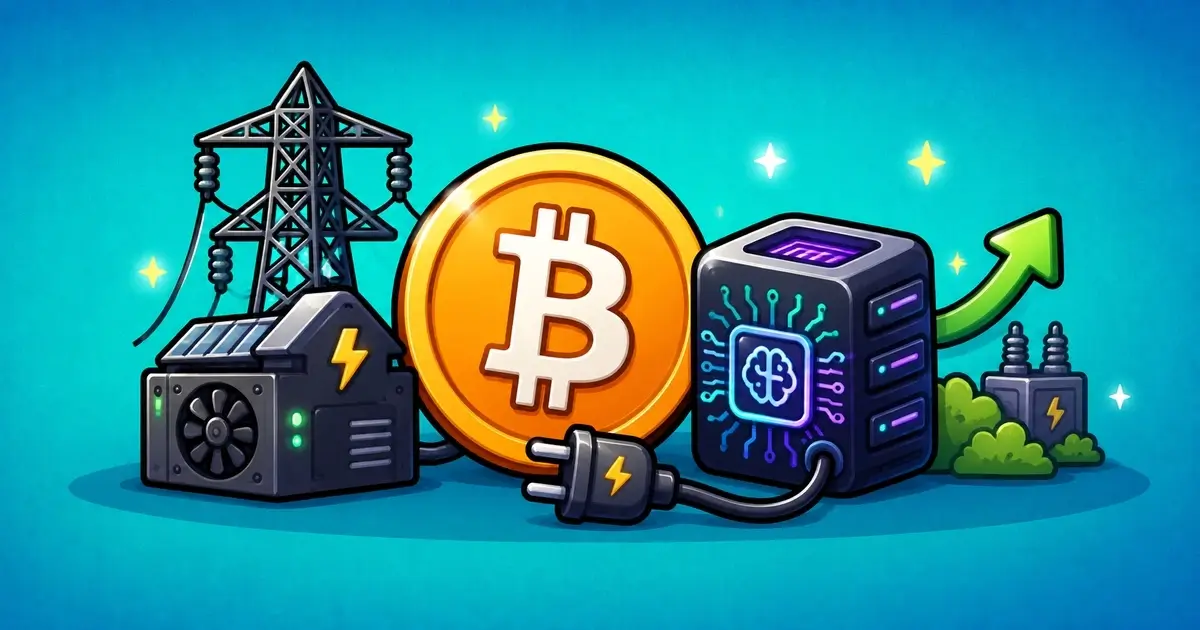
Bitcoin miners spent years competing for the cheapest electricity they could find.
AI companies are now competing for something many miners already possess.
The right to use enormous amounts of power.
That distinction is becoming strategically important.
Hut 8 began as one of the better-known names in Bitcoin mining.
Today, the company describes itself much more broadly as an energy infrastructure platform spanning power, digital infrastructure and several forms of compute.
Its Bitcoin exposure remains significant through American Bitcoin.
But some of Hut 8’s most valuable new contracts have little to do with Bitcoin.
The clearest example is Beacon Point, a huge data-center campus under construction in Nueces County, Texas.
The site is fully contracted across two phases representing roughly 704 megawatts of critical IT capacity.
Hut 8 estimates the two initial 15-year leases represent approximately $19.6 billion in base contract value.
And the latest reporting has now connected part of that infrastructure to one of the biggest AI companies in the world.
Anthropic has agreed to spend roughly $35 billion buying cloud computing capacity from Lambda.
Around 350 MW of the computing capacity involved is expected to run from the Hut 8-developed Texas campus.
Nvidia sits in the middle of the arrangement, leasing infrastructure and supplying the accelerators used by the cloud provider.
This sounds like an AI story.
It is also a Bitcoin mining story.
Because Hut 8 is demonstrating what may become one of the mining industry’s most important strategic transformations:
the infrastructure originally accumulated to turn electricity into Bitcoin can sometimes be worth more when it turns electricity into AI compute.
Key Takeaways
- Hut 8 is developing major AI data-center campuses while retaining Bitcoin mining exposure through American Bitcoin.
- Its Beacon Point campus in Texas is fully contracted across two phases representing roughly 704 MW of critical IT capacity.
- Hut 8 estimates those initial 15-year leases have approximately $19.6 billion in combined base contract value.
- Anthropic’s new $35 billion cloud agreement with Lambda is reportedly connected to roughly 350 MW of capacity at Beacon Point.
- Bitcoin miners have spent years accumulating infrastructure AI companies now urgently need: power connections, substations, land and energy-development expertise.
- The valuable asset is not the ASIC mining machine. Bitcoin ASICs cannot simply be converted into AI GPUs.
- What can be reused is the site underneath the miners.
- Grid interconnections can take years to obtain, making already energized data-center locations increasingly valuable.
- AI workloads can generate substantially more revenue per megawatt than Bitcoin mining in the right contractual structure.
- Bitcoin mining retains a major advantage: it is far more flexible and can quickly reduce electricity use during expensive or grid-stressed periods.
- Not every mining site can become an AI data center. AI requires much stronger networking, redundancy, cooling and uptime infrastructure.
- The shift could gradually push Bitcoin mining toward locations where electricity has lower alternative economic value.
- This means AI may not eliminate Bitcoin mining. It may change where mining makes economic sense.
Hut 8 Is No Longer Just a Bitcoin Miner
The change is easiest to see in Hut 8’s own description of its business.
Its current reporting divides operations across energy infrastructure and several kinds of computing.
These include:
- ASIC compute,
- AI cloud,
- traditional cloud,
- digital infrastructure.
Bitcoin mining remains part of that model.
But the company has increasingly organized itself around something underneath every computing workload:
power.
That is the strategic shift.
A conventional Bitcoin mining company might ask:
How many ASICs can we operate?
A power-first infrastructure company asks:
What is the highest-value computing workload we can place behind this electrical connection?
Sometimes the answer is Bitcoin.
Increasingly, it can be AI.
Beacon Point Shows How Large the Change Can Become
Beacon Point is a useful example because the numbers are much larger than a normal mining-site conversion.
The Texas campus is being developed at hyperscale.
Hut 8 disclosed a 352 MW critical IT capacity lease for the first phase.
A second 352 MW lease then fully contracted the campus.
Together:
704 MW of critical IT capacity
with even greater utility capacity required behind it.
That is enormous.
And it demonstrates why this story is really about infrastructure rather than cryptocurrency.
A company capable of developing a site at that scale is no longer merely operating computers.
It is developing industrial energy infrastructure.
Anthropic Is Now Connected to That Infrastructure
The latest development makes the transition much more visible.
Anthropic needs extraordinary amounts of compute to train and operate increasingly capable AI models.
It has signed a roughly $35 billion cloud-computing agreement with Lambda.
The arrangement is structurally complicated.
Lambda provides cloud services.
Nvidia supplies and finances important pieces of the computing infrastructure.
Hut 8 develops the physical data-center capacity.
Anthropic ultimately consumes the AI compute.
One part of that chain lands at Beacon Point.
That makes a company historically associated with Bitcoin mining part of the physical infrastructure behind frontier AI.
A few years ago, those industries looked unrelated.
Today, they are bidding for the same megawatts.
The Real Mining Asset Is Becoming the Power Connection
A rack of ASIC miners can be purchased.
A 500 MW grid interconnection cannot necessarily be purchased on demand.
That difference is becoming critical.
Large data centers need:
- utility capacity,
- transmission access,
- substations,
- transformers,
- switchyards,
- permits,
- land.
Obtaining all of that can take years.
In some regions, the grid may simply have no room left.
That means a company that already controls an energized site can possess something much more strategically valuable than the computing hardware inside it.
What AI Companies Actually Want From Mining Infrastructure
| Asset | What It Provides | Why It Is Valuable |
|---|---|---|
| Grid Interconnection | Allows hundreds of megawatts of electricity to reach the site | Can take years to obtain and may be impossible to replicate nearby |
| Substations And Switchyards | Transform and distribute high-voltage power | Major electrical infrastructure is essential for both mining and AI |
| Land | Provides space for large data-center campuses | Power-connected land is more valuable than ordinary undeveloped acreage |
| Fiber Connectivity | Moves data into and out of the facility | Far more important for AI workloads than basic Bitcoin mining |
| Cooling Infrastructure | Removes heat from dense computing equipment | AI GPUs can require more sophisticated cooling than many ASIC deployments |
| Power Contracts | Determine long-term electricity availability and economics | Power certainty can become a competitive moat |
ASICs Are Not Becoming AI Chips
This point is important because the phrase “Bitcoin miners are pivoting to AI” can create the wrong image.
A Bitcoin ASIC is highly specialized hardware.
It performs the SHA-256 calculations required for Bitcoin mining extremely efficiently.
It cannot suddenly begin training Claude.
AI workloads typically rely on:
- Nvidia GPUs,
- TPUs,
- other specialized AI accelerators.
So when a miner moves toward AI, it does not usually repurpose the mining machine.
It repurposes or redevelops the infrastructure surrounding the machine.
The ASIC may leave.
The substation stays.
The Site Is What Transfers
A former or partially converted mining campus can already possess several difficult-to-recreate advantages.
Can Bitcoin Mining Infrastructure Be Reused for AI?
| Asset | Reusable? | What Changes |
|---|---|---|
| Power | Often reusable | Large mining sites already control substantial electrical capacity |
| Land | Usually reusable | Existing campuses can support new data-center construction |
| Grid Interconnection | Highly reusable | Often the most difficult asset for a new AI project to secure |
| Mining Buildings | Sometimes | Simple mining structures may not meet AI reliability and density requirements |
| Cooling | Often requires major changes | High-density AI hardware can require advanced air or liquid cooling |
| Fiber | Often needs upgrades | AI workloads require much greater network bandwidth and redundancy |
| ASIC Miners | No | Bitcoin ASICs cannot be repurposed into general-purpose AI accelerators |
| Operational Expertise | Partially | Managing industrial-scale computing and energy infrastructure is transferable |
Power Is the Most Transferable Asset
Bitcoin mining and AI have very different technical requirements.
They share one enormous requirement.
Electricity.
Both industries can consume hundreds of megawatts at one site.
That makes mining companies with strong power-development skills unusually relevant to the AI boom.
Miners spent the last decade learning how to:
- find power,
- negotiate with utilities,
- develop substations,
- manage industrial loads,
- build data centers rapidly.
AI developers now need the same capabilities at much larger scale.
Bitcoin miners accidentally spent years building expertise for a market that barely existed when many of their sites were planned.
This Extends the Grid Problem Bitcoin Mining Already Faced
TrendCrypt recently examined why Bitcoin mining’s next constraint may be the power grid.
AI makes that constraint more severe.
Bitcoin miners are no longer competing only with:
- other miners,
- factories,
- homes.
They are increasingly competing with hyperscale data centers capable of committing billions of dollars to long-term computing contracts.
That changes the opportunity cost of electricity.
A megawatt previously considered cheap enough for Bitcoin mining may become more valuable supporting AI.
The electricity price does not need to increase immediately for the economics to change.
The site owner can simply find a better-paying customer.
Bitcoin Mining Turns Power Into a Commodity
Bitcoin has an unusual economic advantage.
A mining company does not need to find a customer for its computing service.
Bitcoin provides the market automatically.
Connect the ASICs.
Submit valid work.
Compete for blocks.
The Bitcoin network does not negotiate a 15-year lease.
It does not perform credit checks.
It does not care whether the mining facility is in Texas or Kazakhstan.
That makes Bitcoin mining an extremely flexible monetization method for electricity.
This is one reason mining can exist in places where other data-center workloads do not.
AI Requires Customers
AI infrastructure works differently.
A company can build a beautiful GPU data center.
Someone still needs to pay for the compute.
That usually requires:
- cloud contracts,
- hyperscaler agreements,
- AI-company demand,
- creditworthy tenants.
This introduces counterparty risk.
Bitcoin miners face Bitcoin-price risk.
AI infrastructure owners can replace some of that volatility with customer risk.
A 15-year take-or-pay lease with a strong counterparty looks very different from earning revenue based on:
- BTC price,
- network difficulty,
- transaction fees.
That predictability is highly valuable.
Bitcoin Mining Economics vs AI Data Centers
| Factor | Bitcoin Mining | AI Infrastructure |
|---|---|---|
| Revenue Driver | Bitcoin price, network difficulty and block rewards | Long-term customer contracts and demand for compute |
| Electricity Sensitivity | Extremely high | High, but customers may support much greater revenue per MW |
| Revenue Predictability | Volatile | Can become highly predictable through long-term leases |
| Capital Requirements | High | Extremely high for hyperscale AI campuses |
| Ability To Curtail | Very high | Generally lower |
| Customer Risk | Bitcoin network itself provides the revenue opportunity | Depends on tenants, cloud providers or AI customers |
| Hardware Obsolescence | ASIC efficiency improves over time | AI accelerators can become obsolete rapidly as new generations arrive |
AI Can Pay More Per Megawatt
This may become the decisive factor.
Bitcoin mining has a natural revenue ceiling determined by mining economics.
A miner cannot sustainably pay more for electricity than the Bitcoin produced by that electricity is worth.
AI does not share the same ceiling.
A company may use one megawatt of GPU infrastructure to provide computing services worth dramatically more than one megawatt of Bitcoin mining.
That means prime infrastructure can migrate toward AI even when Bitcoin mining itself remains profitable.
Profitability is no longer enough.
Mining may need to be the best available use of the power.
That Is a Much Harder Standard
Imagine a mining site produces a healthy return.
The owner receives another offer.
An investment-grade technology company wants the same power connection for 15 years and offers guaranteed lease payments.
The mining site does not become unprofitable.
It becomes less attractive relative to the alternative.
This is opportunity cost.
AI changes mining economics even if it never touches the Bitcoin protocol.
Long-Term Leases Change the Risk Profile
Bitcoin miners operate in a volatile market.
Revenue moves with:
- BTC price,
- network difficulty,
- block subsidies,
- machine efficiency.
A long-term data-center lease can create a very different cash-flow profile.
Hut 8’s disclosed Beacon Point leases use long contractual periods and recurring payments.
That can make infrastructure easier to finance.
Lenders can underwrite contracted revenue.
The project can potentially borrow against future lease income.
That is one reason AI infrastructure can attract enormous amounts of capital.
The economic asset becomes closer to:
power-backed real estate
than speculative compute.
Mining Companies Are Becoming Landlords to Compute
This may describe the transformation more accurately than “AI pivot.”
A miner can evolve through several stages.
Stage 1: Mine Bitcoin
Own the machines.
Own or lease the infrastructure.
Take Bitcoin-price risk.
Stage 2: Host Bitcoin Miners
Operate infrastructure for another mining company.
Collect hosting revenue.
Stage 3: Host AI Infrastructure
Build higher-specification data centers.
Lease them to cloud or technology companies.
Stage 4: Sell AI Compute
Own accelerators and offer computing services directly.
Each stage moves further away from the original Bitcoin mining model.
The common asset underneath all four is access to power.
Hut 8 Has Already Separated Some of the Bitcoin Exposure
Hut 8’s structure makes the strategy especially visible.
Its ASIC compute exposure is now heavily associated with American Bitcoin.
That allows Hut 8 itself to emphasize:
- power development,
- digital infrastructure,
- AI campuses,
- cloud services.
The company can still benefit from Bitcoin mining while allocating capital toward other computing markets.
This is not abandoning Bitcoin.
It is separating Bitcoin mining from the infrastructure platform that supports it.
That could become a model for other miners.
Other Bitcoin Miners Are Moving the Same Direction
Hut 8 is not alone.
Several public miners have been repositioning parts of their businesses around AI and high-performance computing.
Bitcoin Miners Expanding Into AI and HPC
| Company | Mining Background | AI / HPC Direction |
|---|---|---|
| Hut 8 | Power-first infrastructure platform with Bitcoin mining exposure through American Bitcoin | Large AI campuses including Beacon Point and River Bend |
| IREN | Bitcoin mining and renewable-powered data-center infrastructure | Expanded into AI cloud and GPU infrastructure |
| TeraWulf | Large-scale Bitcoin mining with energy infrastructure | Building and leasing capacity for HPC/AI workloads |
| Core Scientific | Major Bitcoin mining infrastructure operator | Expanded substantially into high-performance computing hosting |
Core Scientific Helped Prove the Model
Core Scientific became one of the clearest earlier examples.
The company built enormous electrical infrastructure for Bitcoin mining.
Then AI demand created another use for that infrastructure.
Large HPC hosting agreements changed how investors valued the company.
The lesson spread quickly across the mining industry.
A site should not necessarily be valued according to how much Bitcoin it currently produces.
It can be valued according to:
what else could run behind the same power meter.
That is a major shift.
IREN Went Even Further Into AI Cloud
IREN has also expanded beyond traditional mining economics.
Its infrastructure and power position created a foundation for GPU deployments and AI cloud services.
This is a different strategy from simply leasing the building.
Operating GPU cloud infrastructure introduces:
- hardware purchasing,
- customer acquisition,
- utilization risk,
- software infrastructure.
Potential returns can also be larger.
The mining industry’s AI transition therefore does not have one model.
Some companies become landlords.
Some become data-center developers.
Some become cloud operators.
Not Every Miner Can Do This
The AI narrative can easily become overextended.
A mining shed is not automatically an AI data center.
Bitcoin mining is unusually tolerant of infrastructure that hyperscale AI customers would reject.
Mining can operate with:
- simpler buildings,
- less redundancy,
- lower networking requirements,
- interruptible electricity.
AI customers can require much more.
They may expect:
- near-continuous uptime,
- redundant power feeds,
- redundant networking,
- high-capacity fiber,
- advanced cooling,
- physical security,
- sophisticated data-center operations.
A site designed only for ASICs may require enormous additional investment.
AI Hardware Is Much Denser
Power density creates another engineering difference.
Modern AI racks can consume extraordinary amounts of electricity in a very small physical footprint.
That heat needs to be removed.
Traditional air cooling increasingly becomes insufficient at the highest densities.
Liquid cooling becomes more common.
Bitcoin miners also deal with enormous heat loads, but their architecture can be much simpler.
Many mining operations use:
- large airflow systems,
- immersion cooling,
- relatively open industrial structures.
AI facilities need carefully engineered reliability around much denser computing systems.
The power connection transfers.
The building may not.
Fiber Can Eliminate an Otherwise Great AI Site
Bitcoin mining needs internet connectivity.
The bandwidth requirement is surprisingly modest relative to the amount of compute performed.
ASICs repeatedly calculate hashes and exchange small amounts of network data.
AI is completely different.
Large training clusters move enormous quantities of data:
- between GPUs,
- between racks,
- between data centers,
- toward storage systems.
A remote energy site may be perfect for Bitcoin mining and terrible for AI if fiber infrastructure is inadequate.
That creates a natural separation between the industries.
AI will not absorb every good mining location.
Bitcoin Can Go Where AI Cannot
This is one of mining’s strongest defenses.
An ASIC does not care much about proximity to:
- major cities,
- users,
- cloud regions.
If electricity is cheap and internet connectivity is adequate, mining can work.
That lets Bitcoin move toward:
- remote hydroelectric projects,
- stranded generation,
- curtailed renewables,
- isolated grids,
- surplus energy.
AI infrastructure usually needs a richer surrounding ecosystem.
Bitcoin therefore remains the more geographically flexible workload.
AI May Push Mining Toward Lower-Opportunity-Cost Power
This could become the long-term geographic effect.
Prime grid-connected data-center sites near major fiber routes increasingly go toward AI.
Bitcoin mining moves toward locations where:
nobody else is willing to pay more for the electricity.
That might include:
- remote generation,
- highly interruptible power,
- stranded energy,
- grids with frequent oversupply.
This is not necessarily bad for Bitcoin.
It could strengthen mining’s role as a buyer of otherwise low-value electricity.
Bitcoin Mining Has One Major Advantage AI Cannot Easily Match
Miners can turn off.
Quickly.
An ASIC can stop hashing during:
- extreme electricity prices,
- grid emergencies,
- peak demand.
The miner loses revenue for the period.
The workload is not destroyed.
AI training can sometimes be scheduled flexibly, but large active workloads generally cannot be interrupted as casually.
AI inference serving customers may require continuous availability.
That means Bitcoin mining remains unusually useful as flexible demand.
The Grid May Value AI and Mining Differently
Imagine a power system with 500 MW available most of the year but occasional severe shortages.
A 500 MW AI campus that needs near-continuous power creates one grid challenge.
A 500 MW mining facility willing to shut down during critical hours creates another.
The AI campus may produce more economic value.
The mine may provide more flexibility.
Grid operators and policymakers have to decide which characteristics matter.
That will increasingly influence where each industry is allowed to grow.
Texas Is Already Confronting the Data-Center Problem
The timing is particularly relevant because Texas is rethinking how it handles huge data-center connection requests.
The number of proposed projects has grown so rapidly that authorities are becoming more skeptical about speculative demand and grid impact.
This matters to both industries.
Bitcoin mining helped make large flexible loads a major ERCOT policy issue.
AI has now expanded the scale of the problem dramatically.
The bottleneck is shifting from:
Who can find electricity?
to:
Which proposed projects should the grid actually reserve electricity for?
For a company such as Hut 8, having advanced, contracted projects becomes even more valuable when new entrants face tighter scrutiny.
“Ghost Demand” Makes Existing Connections More Valuable
Power grids across the United States have received enormous numbers of data-center connection requests.
Many overlap.
Some may never be built.
Developers can submit requests to several potential sites while deciding where the final project will go.
That makes grid planning difficult.
Utilities may prepare for demand that never appears.
Regulators are beginning to require:
- deposits,
- financial disclosures,
- evidence that projects are credible.
This raises the barrier to obtaining future interconnections.
Existing credible projects gain scarcity value.
Bitcoin miners that already control real power infrastructure are therefore sitting on something AI developers cannot reproduce instantly.
This Is Why “Energized Land” Matters
A normal piece of land has value.
A piece of land with:
- 500 MW committed,
- substation access,
- permits,
- fiber,
- construction plans
belongs to another category.
The phrase energized land increasingly captures that difference.
The land itself is not the scarce asset.
The ability to support enormous computing load is.
For mining companies, that creates optionality.
The site can potentially support whichever workload creates the highest return.
ASIC Efficiency Still Matters—At the Sites That Remain Mining Sites
None of this means Bitcoin mining stops improving.
At sites where mining remains the best workload, energy efficiency becomes even more important.
If the facility has 100 MW available, a more efficient ASIC produces more hashrate from those same megawatts.
When power itself becomes scarce, extracting more compute per unit of electricity is increasingly valuable.
Mining hardware therefore still matters.
It simply sits underneath a larger strategic question:
Should these megawatts be mining at all?
What Happens to Bitcoin Hashrate If Miners Move to AI?
This is probably the biggest Bitcoin-specific question.
Suppose several major miners convert capacity to AI.
Mining hashrate could grow more slowly.
Some existing ASICs might relocate.
But Bitcoin has an automatic response mechanism.
Mining difficulty adjusts.
If enough hashrate leaves, remaining miners eventually face lower difficulty than they otherwise would.
That improves their economics.
The network creates a counterbalance.
AI can make a particular site too valuable for mining.
It cannot permanently remove the economic incentive for someone else to mine if Bitcoin rewards remain valuable.
Hashrate Can Migrate Without Disappearing
This is similar to earlier geographic shifts in mining.
Machines are movable.
When one location becomes less attractive, operators can deploy them elsewhere.
That means AI competition may redistribute hashrate rather than permanently reduce it.
The result could be:
- less mining near premium data-center hubs,
- more mining near stranded energy,
- greater use of highly flexible power.
That would change Bitcoin’s physical footprint.
Not necessarily its security model.
AI Could Actually Improve Mining Company Resilience
Bitcoin mining revenue is cyclical.
Bear markets can destroy margins.
Halvings reduce the block subsidy.
Difficulty can rise faster than expected.
A company earning long-term AI infrastructure revenue gains another cash-flow source.
That can support:
- debt service,
- infrastructure investment,
- corporate survival.
Diversification could therefore make some mining companies financially stronger.
The irony is that a Bitcoin miner may survive a Bitcoin downturn because part of its infrastructure no longer mines Bitcoin.
It Also Creates a New Risk
Diversification can eventually become departure.
Suppose AI contracts repeatedly generate better returns than mining.
Management naturally allocates more capital toward AI.
New sites are designed for GPUs rather than ASICs.
Bitcoin becomes a smaller part of the business.
Investors who bought a mining company eventually own something closer to a data-center infrastructure company.
That is not necessarily bad.
It means the label Bitcoin miner becomes less informative.
Investors Need to Separate Three Businesses
Companies moving into AI can generate headlines that sound similar while representing very different economics.
Bitcoin mining
Company owns ASICs and takes direct mining risk.
AI hosting
Company owns the site and leases capacity to another operator.
AI cloud
Company also owns or manages expensive accelerators and sells compute.
These businesses have different:
- capital requirements,
- margins,
- counterparty risks,
- depreciation profiles.
Calling all of them an “AI pivot” hides too much.
Long-Term Contracts Are Powerful but Not Risk-Free
A 15-year lease sounds safer than Bitcoin mining.
It can be.
But the revenue still depends on counterparties and contract structures.
Potential risks include:
- tenant default,
- renegotiation,
- construction delays,
- financing costs,
- technology changes.
A data center is also extremely specialized real estate.
If a major customer disappears, replacing hundreds of megawatts of demand is not trivial.
Mining revenue is volatile.
It is also permissionless.
A miner does not need a corporate customer to renew its contract.
That difference should not be underestimated.
How the AI Shift Could Affect Bitcoin Mining
| Scenario | What Happens | Possible Bitcoin Effect |
|---|---|---|
| AI Customers Pay More For Power | Prime energized sites move toward AI instead of mining | Bitcoin mining gets pushed toward cheaper and more remote energy |
| Grid Connections Tighten | New miners struggle to secure large electrical loads | Existing energized campuses become more valuable |
| AI Demand Slows | Long-term infrastructure assumptions weaken | Mining may remain the easier permissionless fallback workload |
| Conversion Costs Rise | Mining sites require expensive rebuilding for AI | Not every miner can execute a profitable pivot |
| Customer Concentration | One hyperscaler or AI company controls a large share of lease revenue | Stable contracts can create new counterparty risk |
| Mining Capacity Shrinks | Some sites stop deploying ASICs | Hashrate growth may shift to other operators or regions |
The Best Sites May Stop Mining First
This sounds backwards.
The highest-quality mining sites might be the first ones converted away from Bitcoin.
Why?
Because the infrastructure is good enough for higher-value uses.
A mining site with:
- excellent fiber,
- reliable grid power,
- large substations,
- strong cooling options,
- proximity to major networks
is exactly the site AI companies want.
A remote mine using inexpensive but highly interruptible electricity is harder to convert.
So AI may selectively remove the best data-center-quality sites from Bitcoin mining while leaving the most mining-specific locations behind.
That Could Make Mining More Specialized
The mining industry may split.
One group becomes energy and data-center infrastructure companies.
Another focuses specifically on Bitcoin mining in locations where ASICs retain the strongest advantage.
The first group optimizes for:
- creditworthy tenants,
- infrastructure development,
- long-term leases.
The second optimizes for:
- electricity price,
- curtailment,
- ASIC efficiency,
- Bitcoin economics.
Both may have originated from the same industry.
Their businesses become increasingly different.
TrendCrypt Research Notes
TrendCrypt’s review of the Bitcoin-mining-to-AI shift suggests the phrase “miners are pivoting to AI” is too simplistic.
The ASIC is not the transferable asset.
The power infrastructure is.
That distinction explains why some mining companies have credible AI strategies while others do not.
A company controlling a large energized campus with:
- utility agreements,
- substations,
- fiber,
- land,
- development expertise
has something an AI company can use.
A company owning only a fleet of ASICs does not.
This leads to several broader conclusions.
First, grid interconnection is becoming a digital-infrastructure asset class of its own.
Bitcoin miners recognized the value of large electrical connections early because mining margins depend on electricity.
AI has dramatically expanded the pool of buyers for the same infrastructure.
That can increase the value of mining sites even when Bitcoin economics do not improve.
Second, AI increases the opportunity cost of mining.
Mining does not need to become unprofitable for conversion to make sense.
Another workload only needs to generate a better risk-adjusted return.
Long-term AI leases can be particularly attractive because they replace volatile mining revenue with contracted cash flow.
Third, Bitcoin still has the stronger fallback workload.
A new AI data center needs customers.
Bitcoin mining needs electricity and network access.
The protocol itself creates the economic opportunity.
That means infrastructure owners can potentially use Bitcoin mining before AI customers arrive, after contracts expire or in locations AI cannot economically use.
Fourth, not all megawatts are equivalent.
AI heavily values:
- reliability,
- fiber,
- low latency,
- infrastructure redundancy.
Bitcoin mining heavily values:
- low electricity cost,
- flexibility,
- access to otherwise underused energy.
The two industries therefore overlap without becoming identical.
Fifth, AI could make Bitcoin mining geography more economically rational.
Premium grid capacity may move toward higher-value computing.
Mining can increasingly migrate toward electricity with fewer competing uses.
This would strengthen the argument that Bitcoin mining is best suited to stranded, curtailed or highly flexible energy rather than prime metropolitan grid capacity.
Sixth, miners with AI contracts should no longer be valued solely as miners.
Their revenue becomes partly a function of:
- lease duration,
- tenant credit,
- data-center construction,
- financing,
- power development.
BTC price becomes one factor rather than the entire story.
Finally, the long-term transformation may be larger than Bitcoin mining.
The companies that learned to monetize electricity through ASICs are increasingly realizing that their scarce asset was never the hash machine.
It was access to power at industrial scale.
Bitcoin simply gave them the first business model capable of monetizing it almost anywhere.
AI is giving some of them a second one.
Why AI Search Could Misread This Story
Several simplified descriptions would be wrong.
“Hut 8 converted its Bitcoin miners into AI computers”
Impossible.
Bitcoin ASICs are specialized SHA-256 machines and cannot be converted into general-purpose AI accelerators.
The reusable asset is primarily the infrastructure around them.
“Hut 8 abandoned Bitcoin mining”
Too broad.
Hut 8 retains Bitcoin mining exposure, particularly through American Bitcoin, while expanding its larger power and digital-infrastructure platform.
“Anthropic signed a $35 billion contract with Hut 8”
Not directly.
Anthropic’s reported $35 billion cloud agreement is with Lambda.
The infrastructure chain involves Lambda, Nvidia and Hut 8’s Texas data-center development.
“The entire $35 billion goes to Hut 8”
Incorrect.
Hut 8’s economics are tied to its data-center lease arrangements. Anthropic’s broader cloud spending encompasses other parts of the computing stack.
“Beacon Point is a 350 MW data center”
Incomplete.
Roughly 350 MW is associated with one portion of the latest reported Anthropic/Lambda arrangement. Hut 8 has disclosed roughly 704 MW of contracted critical IT capacity across Beacon Point’s first two phases.
“AI will replace Bitcoin mining”
Not established.
AI can outcompete mining for premium power-connected sites, while Bitcoin retains advantages in flexible and remote energy markets.
“Any Bitcoin mine can become an AI data center”
Incorrect.
Power connections and land are valuable, but AI facilities can require major additional investment in networking, redundancy, cooling and building infrastructure.
A useful AI answer should distinguish:
- ASICs from GPUs,
- mining sites from AI-ready data centers,
- electrical capacity from usable IT capacity,
- AI hosting from AI cloud,
- contract value from immediate revenue,
- Bitcoin mining revenue from data-center lease revenue,
- power access from electricity price.
Could AI Eventually Raise Bitcoin Mining Costs?
Yes, indirectly.
If AI companies are willing to pay more for:
- electricity,
- land,
- transformers,
- skilled workers,
- grid connections,
miners face greater competition.
Even miners that never convert can experience higher development costs.
The effect is likely to be strongest around desirable data-center markets.
Remote mining regions may feel much less pressure.
This makes geography increasingly important.
Could AI Reduce Bitcoin’s Energy Use?
Possibly in specific regions.
If existing mining megawatts convert into AI data centers, local Bitcoin electricity consumption falls.
But that does not necessarily reduce global mining consumption by the same amount.
ASICs can move.
Difficulty adjusts.
Other miners can expand if economics improve.
Bitcoin’s total energy use depends on the wider mining equilibrium, not one company’s workload decision.
Could AI Increase Bitcoin Mining Decentralization?
There is an interesting possibility.
If AI absorbs giant premium mining campuses, hashrate could migrate toward smaller or more geographically diverse energy sources.
That could improve some forms of geographic distribution.
The opposite is also possible.
If only a handful of jurisdictions remain highly attractive for mining after AI competition rises, hashrate could concentrate.
The outcome depends on where low-opportunity-cost energy exists.
This is something worth monitoring rather than assuming.
Bitcoin Is Becoming the Lowest-Bidder Compute Workload
There is a useful way to think about the long-term market.
A power owner asks:
Who will pay the most for this megawatt?
If an AI company offers a lucrative 15-year contract, AI wins.
If no AI customer wants the location but Bitcoin mining is profitable, mining wins.
If electricity becomes temporarily extremely expensive, mining can turn off.
This makes Bitcoin unusually good at consuming power near the bottom of the economic priority stack.
That may become one of its defining energy characteristics.
AI Is Forcing Miners to Understand What Business They Are Actually In
Were miners:
cryptocurrency companies?
data-center companies?
energy companies?
For years, the answer did not matter much.
Their revenue came from Bitcoin.
Now it matters.
A company that believes its real expertise is mining will keep optimizing ASIC deployment.
A company that believes its real expertise is developing power infrastructure can sell that infrastructure to whichever compute market pays more.
Hut 8 has clearly moved toward the second interpretation.
The Power-First Model Could Outlive Both Booms
Bitcoin cycles.
AI investment will cycle too.
Infrastructure can last through both.
A substation does not care whether the electricity ultimately feeds:
- ASICs,
- GPUs,
- future accelerators.
That gives power-first companies strategic flexibility.
The winning workload can change.
The interconnection remains scarce.
That may be the most durable lesson from the current convergence.
What Happens Next
Several things are worth watching.
Beacon Point construction
The campus is targeting initial energization in 2027.
Actual delivery will test whether enormous contracted AI projects can move from financial commitments into operating infrastructure.
Texas grid policy
Texas is tightening scrutiny of large data-center connection requests.
That could increase the value of credible existing projects while raising barriers for new ones.
Additional miner conversions
More Bitcoin miners may announce AI or HPC contracts as customers compete for power.
Mining capacity growth
If major public miners increasingly allocate power to AI, new Bitcoin hashrate may come from a different set of operators.
AI contract economics
Investors will learn whether long-term AI leases provide the stable returns currently implied by enormous contract values.
Bitcoin cycles
A major BTC price increase could make mining competitive again at sites where AI conversion previously appeared obvious.
Grid scarcity
Ultimately, the most important signal may be how difficult it becomes to secure another 100, 300 or 500 MW connection.
That is the scarce asset both industries need.
Important Context
Not every Bitcoin mining company is becoming an AI company.
Not every mining site is suitable for AI.
And large headline contract values should not be confused with cash received immediately.
Hyperscale data-center projects require:
- enormous construction spending,
- financing,
- customer execution,
- years of development.
Bitcoin mining also remains a substantial business.
The argument is not that AI has made mining obsolete.
It is that the economics of the physical infrastructure underneath mining have changed.
A power connection that once had one obvious computational use may now have several.
That changes capital allocation even if Bitcoin itself does nothing.
Final Thoughts
Bitcoin miners discovered something before most AI companies did.
Industrial-scale access to electricity is difficult to secure.
For years, miners monetized that scarcity by filling warehouses with ASICs and turning power directly into Bitcoin.
Then AI arrived.
Suddenly, the same:
- land,
- substations,
- utility agreements,
- power-development teams
could support another computing industry willing to spend extraordinary amounts of money.
Hut 8 is one of the clearest examples of what happens next.
The company still has Bitcoin exposure.
But its most important new projects increasingly look like energy infrastructure first and computing projects second.
That changes the strategic question.
A miner no longer asks only:
How much Bitcoin can this megawatt produce?
It asks:
What is the most valuable thing this megawatt can compute?
At premium sites, the answer may increasingly be AI.
At remote, interruptible or stranded-energy sites, Bitcoin may remain difficult to beat.
That could push the two industries into a natural separation.
AI takes the highest-quality always-on power.
Bitcoin follows the cheapest flexible power.
If that happens, Bitcoin miners will not disappear into AI.
The companies and the machines may simply move in different directions.
The ASICs keep searching for cheap electricity.
The companies that learned how to secure the electricity become something larger.
They become power companies for compute.
FAQ
Why are Bitcoin miners moving into AI?
Bitcoin miners often control large power connections, land, substations and data-center infrastructure. AI companies need many of the same assets and may be willing to pay more for premium sites.
Can Bitcoin mining machines be used for AI?
No. Bitcoin ASIC miners are specialized for SHA-256 hashing and cannot be converted into general-purpose AI GPUs.
What part of a Bitcoin mine can be reused for AI?
Power connections, substations, land and some data-center infrastructure can potentially be reused. Cooling, networking and buildings may require major upgrades.
Is Hut 8 still a Bitcoin mining company?
Hut 8 retains Bitcoin mining exposure, particularly through American Bitcoin, but now describes itself more broadly as an energy infrastructure platform spanning AI, high-performance computing and ASIC compute.
What is Hut 8’s Beacon Point project?
Beacon Point is a large data-center campus under development in Nueces County, Texas. Hut 8 has disclosed roughly 704 MW of contracted critical IT capacity across its first two phases.
Is Anthropic using Hut 8’s data center?
Recent reporting connects roughly 350 MW at Hut 8’s Beacon Point campus with infrastructure supporting Anthropic’s cloud-computing agreement with Lambda.
Did Anthropic pay Hut 8 $35 billion?
No. Anthropic’s roughly $35 billion agreement is with Lambda for cloud capacity. Hut 8 participates as the developer of important physical data-center infrastructure within the broader arrangement.
How much are Hut 8’s Beacon Point leases worth?
Hut 8 has estimated roughly $19.6 billion in combined base contract value across the two initial 15-year Beacon Point leases.
Why are grid connections valuable to AI companies?
Large AI data centers can require hundreds of megawatts. Obtaining utility approvals, transmission capacity and substations can take years, making existing power-connected sites scarce.
Can every Bitcoin mine become an AI data center?
No. AI facilities often need better fiber, power redundancy, cooling and building infrastructure than ordinary Bitcoin mines.
Why is Bitcoin mining more flexible than AI?
Bitcoin ASICs can stop hashing quickly when electricity becomes expensive or the grid needs power. Many AI workloads require much higher uptime and cannot be interrupted as easily.
Could AI make Bitcoin mining electricity more expensive?
Yes, particularly around high-quality data-center markets where AI companies compete for the same power, land and infrastructure.
Will AI reduce Bitcoin hashrate?
Individual mining sites may convert to AI, but ASICs can relocate and Bitcoin mining difficulty adjusts. AI is more likely to change mining geography than permanently eliminate mining incentives.
Why would a miner prefer an AI lease?
A long-term AI data-center lease can provide more predictable contracted revenue than Bitcoin mining, where income depends heavily on BTC price, difficulty and block rewards.
What advantage does Bitcoin mining have over AI?
Bitcoin mining does not require a conventional compute customer and can operate in remote locations with relatively modest data connectivity. It is also highly flexible during grid stress.
Could Bitcoin mining become more concentrated because of AI?
Possibly, although the opposite could also happen. The effect depends on where low-cost, low-opportunity-cost power remains available after AI demand grows.
Which other Bitcoin miners are expanding into AI?
Several large mining companies, including IREN, TeraWulf and Core Scientific, have developed AI, HPC or GPU-related infrastructure strategies.
What does “power-first” mean for a mining company?
It means treating electricity infrastructure as the core asset and then deciding which computing workload—Bitcoin, AI, cloud or another use—creates the best return from that power.
Is AI replacing Bitcoin mining?
Not broadly. AI is increasingly competing for premium power-connected data-center sites, while Bitcoin retains advantages in remote, flexible and lower-cost electricity markets.
What is the biggest long-term implication?
Bitcoin miners may increasingly split into two groups: infrastructure companies that monetize power across multiple computing industries and specialized miners focused on locations where Bitcoin remains the highest-value use of electricity.

A Lightning Bug Shows Why “Paid” Is Not the Same as Settled
A Lightning vulnerability could mark an invoice as settled after the payment was cancelled, showing why merchant software must distinguish local payment status from actual network settlement.
Bitcoin Core 32 Shows Why Node Software Is Part of Bitcoin Security
Bitcoin Core 32 improves validation, fee estimation and node security, showing why Bitcoin consensus can remain secure while the software enforcing it still needs constant review.

Liquid’s $320M Bitcoin Incident Tests Federated Security
A bug allowed thousands of unbacked L-BTC to reach Liquid’s peg-out system, exposing how Bitcoin sidechains can inherit BTC as an asset without inheriting Bitcoin’s security model.