
TrendCrypt News
Bitcoin’s Quantum Risk Is Becoming a Wallet Migration Problem
New quantum attack estimates and hardware-wallet tests show Bitcoin’s hardest quantum challenge may be moving existing coins before vulnerable keys become exploitable.
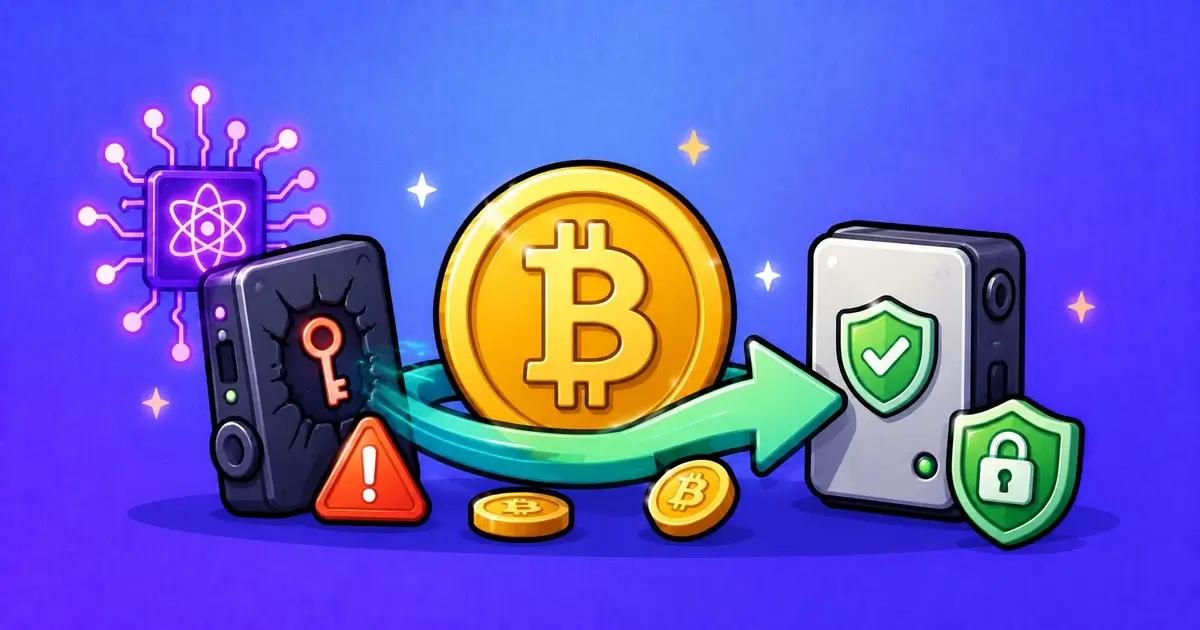
Bitcoin’s quantum-computing problem is often described as a countdown.
One day quantum computers are harmless.
Then some mysterious Q-Day arrives.
Private keys can suddenly be recovered.
Bitcoin breaks.
That makes for a dramatic story.
It is probably the wrong way to think about the actual risk.
The harder problem begins long before anyone publicly demonstrates a machine capable of breaking Bitcoin’s elliptic-curve signatures.
Bitcoin would need to decide which post-quantum cryptography it trusts.
Developers would need to change consensus rules.
Wallet companies would need to implement the new signing system.
Hardware wallets would need to support it.
Custodians would need to migrate institutional funds.
Ordinary holders would need to move existing BTC.
And millions of coins whose owners are inactive, unreachable or permanently gone would still remain sitting behind old cryptographic assumptions.
That migration problem became more concrete in August.
New peer-reviewed research published in PRX Quantum substantially reduced estimates for the resources required to attack elliptic-curve cryptography used by cryptocurrencies and urged vulnerable networks to begin post-quantum migration without delay.
Three days later, the U.S. Treasury announced a Quantum-Readiness Task Force aimed at preparing the financial sector for an orderly transition to quantum-safe cryptography.
Meanwhile, Blockstream researchers tested post-quantum signature schemes on existing Jade, Trezor, Ledger and BitBox hardware wallets.
They worked.
Some were slow.
Some produced much larger signatures than Bitcoin users are accustomed to.
But they worked.
That changes the most useful Bitcoin quantum question.
It is no longer only:
Could quantum computing break Bitcoin’s signatures?
Cryptographers already know sufficiently capable quantum computers could threaten the elliptic-curve systems Bitcoin uses.
The more practical question is:
Can Bitcoin move enough existing coins to safer cryptography before that capability becomes usable against them?
Key Takeaways
- Bitcoin currently relies on elliptic-curve cryptography that would be vulnerable to Shor’s algorithm if sufficiently capable fault-tolerant quantum computers are eventually built.
- New peer-reviewed research published on August 21, 2026 argues that the quantum resources required to attack elliptic-curve cryptocurrencies may be significantly lower than previous estimates.
- The research does not show that today’s quantum computers can steal Bitcoin.
- The U.S. Treasury launched a Quantum-Readiness Task Force on August 24 to help the financial sector transition toward post-quantum cryptography in an orderly way.
- Blockstream published hardware-wallet benchmarks on August 19 showing that hash-based post-quantum signature schemes can already run on Jade, Trezor, Ledger and BitBox devices.
- Existing hardware compatibility is encouraging, but some tested signatures took tens of seconds or longer to generate and can be thousands of bytes in size.
- Bitcoin’s quantum exposure is not identical across every coin.
- Outputs whose public keys are already visible onchain can be targeted through a long-exposure attack, giving an attacker potentially much more time for key recovery.
- Fresh P2PKH and P2WPKH outputs normally hide the public key behind a hash until spending, reducing long-exposure risk when addresses are not reused.
- Taproot outputs expose a public key in the output itself and therefore have a different long-exposure profile.
- Hiding a public key does not create complete quantum resistance because the public key normally becomes visible when the owner eventually spends.
- A sufficiently fast quantum attacker could theoretically attempt to recover the private key while a transaction is waiting for confirmation.
- That means long-term protection eventually requires more than good address hygiene; Bitcoin may need post-quantum signing capability.
- The most difficult migration problem involves BTC that does not move: dormant holdings, lost keys, old mining outputs and owners who fail to upgrade.
- A credible quantum threat could also create enormous block-space demand if millions of users attempt to migrate simultaneously.
- Quantum scams are likely to become a serious wallet-security risk long before quantum computers become capable of stealing Bitcoin.
- Users should not move funds or reveal recovery phrases because of unsolicited claims that a wallet needs a “quantum upgrade.”
What Changed In August
Three developments arrived within days of one another.
They came from very different parts of the technology and financial system.
Together, they make Bitcoin’s quantum discussion harder to dismiss as something that can be solved after the threat becomes obvious.
On August 19, Blockstream published benchmarks testing several hash-based post-quantum signature schemes on real hardware wallets.
The devices included:
- Jade Plus
- Trezor Safe models
- Ledger Nano hardware
- BitBox02 Nova
The experiment demonstrated that existing consumer hardware can generate post-quantum signatures.
The performance varied enormously.
Some constructions completed in a few seconds.
Others took tens of seconds.
The slowest configurations required several minutes.
That does not select Bitcoin’s future signature scheme.
It answers a narrower question:
Can today’s hardware-wallet class perform this kind of cryptography at all?
The answer appears to be yes.
Then The Quantum Attack Estimates Changed
On August 21, PRX Quantum published new research from authors associated with Google Quantum AI, Stanford, UC Berkeley and the Ethereum Foundation examining how large a quantum computer might need to be to attack elliptic-curve cryptocurrencies.
The paper focuses on a core threat.
Bitcoin’s signatures rely on a mathematical relationship between:
- a private key
- a public key
Classical computers can derive the public key from the private key easily.
Going backwards is computationally infeasible with today’s conventional machines.
A sufficiently capable quantum computer running Shor’s algorithm changes that assumption.
The new research argues that optimized attack techniques reduce the quantum resources required compared with earlier estimates.
It also emphasizes something particularly important for cryptocurrency:
attack speed.
A slow quantum attack can target public keys that have been visible for years.
A sufficiently fast attack could target keys exposed only when someone attempts to spend.
That turns migration timing into part of the security problem.
Treasury Is Preparing The Financial Sector Too
Three days later, the U.S. Treasury announced its Quantum-Readiness Task Force.
The initiative is broader than Bitcoin.
Banks, payment infrastructure and other financial systems also depend heavily on cryptography that eventually needs to survive quantum computing.
Treasury describes the objective as an orderly and operationally resilient transition to quantum-safe technology.
That wording matters.
Cryptographic migrations are infrastructure migrations.
A financial institution cannot simply replace an algorithm one morning.
It needs to identify:
- which systems use vulnerable cryptography
- which vendors need updates
- which certificates need replacing
- which hardware supports the new standards
- which dependencies cannot migrate immediately
Bitcoin faces the same challenge.
Except Bitcoin has no central IT department capable of ordering every user to upgrade.
Bitcoin’s Quantum Problem Is Specific
Quantum computers are sometimes described as though they break all cryptography at once.
They do not.
Bitcoin uses different cryptographic tools for different purposes.
The main concern discussed here is public-key signatures.
Bitcoin uses elliptic-curve cryptography to allow a wallet to prove:
I know the private key controlling these coins.
A sufficiently capable quantum computer running Shor’s algorithm could potentially recover that private key from the corresponding public key.
Bitcoin also relies heavily on SHA-256 hashing.
Quantum computing affects hash functions differently.
Grover’s algorithm can provide a quadratic speedup for brute-force search, but that is not the same catastrophic reduction Shor’s algorithm creates for elliptic-curve discrete logarithms.
So the most urgent Bitcoin quantum migration problem is not:
replace everything called cryptography.
It is:
replace or protect the signature system before exposed public keys become exploitable.
Public-Key Exposure Determines Who Is At Risk First
Not every Bitcoin output reveals the same information.
This creates different quantum risk profiles.
How Bitcoin Address Types Differ Under Quantum Risk
| Output Type | Public-Key Exposure | Quantum Risk Profile | Why It Matters |
|---|---|---|---|
| P2PK | Public key is already visible onchain | Long exposure | An attacker could work on recovering the private key without waiting for the owner to spend |
| P2PKH | Public key is normally hidden until the output is spent | Lower long-exposure risk when used correctly | Address reuse or spending can expose the key |
| P2WPKH | Public key is normally hidden behind a hash until spending | Lower long-exposure risk when used correctly | The public key becomes visible when the owner spends |
| P2TR | Taproot output exposes an x-only public key | Long exposure | A sufficiently capable quantum attacker would have much more time to work against the exposed key |
| Reused Address | A previous spend may already have revealed the public key | Long exposure for remaining funds | Moving new BTC back to the same address can restore exposure even when the original address type hid the key |
P2PK Coins Have The Clearest Long-Term Exposure
Some of Bitcoin’s earliest outputs use Pay-to-Public-Key, or P2PK.
The public key appears directly in the output.
That was common in Bitcoin’s early years, including early mining activity.
Under today’s cryptography, this is not a practical problem.
A public key can safely be public because classical computers cannot feasibly derive the private key.
Quantum changes that assumption.
A future attacker does not need the owner of a P2PK output to do anything.
The public key is already sitting inside Bitcoin’s blockchain.
The attacker can theoretically work on it offline.
That is what makes long exposure important.
There is no ten-minute deadline.
No need to wait for the owner to broadcast a transaction.
The public key has already been exposed for years.
Taproot Has A Similar Long-Exposure Property
This creates an unintuitive result.
Some of Bitcoin’s oldest outputs and some of its newest outputs can both expose public keys.
Taproot, introduced through the 2021 upgrade, uses an x-only public key in the output.
Taproot has major benefits for:
- privacy
- scripting
- multisignature efficiency
- advanced spending conditions
Quantum resistance was not its design goal.
Under a future cryptographically relevant quantum attack, the exposed key creates a long period during which key recovery could theoretically be attempted.
That does not mean Taproot is unsafe today.
It means current cryptographic best practice and future quantum best practice do not always point in the same direction.
Hashed Public Keys Buy Time
P2PKH and P2WPKH work differently.
Instead of placing the public key directly in the receiving output, the address commits to a hash derived from it.
That hides the underlying public key until the user spends.
If the address is fresh and has never been spent from, a quantum attacker does not have the public key needed for the straightforward Shor attack.
That is useful.
It does not make the Bitcoin quantum resistant.
Eventually, spending the output reveals the public key.
The protection is therefore partly about time.
Instead of giving an attacker years to work on a key, the owner may reveal it only while the transaction is moving toward confirmation.
That transforms a long-exposure problem into a short-exposure problem.
Address Reuse Can Destroy That Advantage
This is one reason address reuse matters.
Suppose a user receives BTC to a P2WPKH address.
The public key remains hidden.
Later, the user spends from that address.
The public key appears onchain as part of the authorization.
Now suppose the user receives more Bitcoin to the same address.
The newly received BTC may sit behind an address whose public key has already been revealed.
The hash no longer provides the same hidden-key advantage.
A future quantum attacker can study the exposed public key for as long as the new funds remain there.
Address reuse was already discouraged for privacy.
Quantum risk gives it another downside.
Long Exposure And Short Exposure Are Different Threats
Bitcoin’s quantum discussion becomes much easier to understand when those attacks are separated.
The Main Quantum Attack Windows For Bitcoin
| Attack | What The Attacker Targets | Available Time | Why It Matters |
|---|---|---|---|
| Long-Exposure Attack | Attacker targets a public key already visible onchain | Potentially months or years | Likely easier than attacking a key revealed only during a live transaction |
| Short-Exposure Attack | Attacker waits until a spend reveals the public key and races the legitimate transaction | Mempool / confirmation window | Requires substantially faster key recovery |
| Dormant-Coin Attack | Old coins with permanently exposed public keys are targeted without owner participation | No owner warning is required | Creates difficult questions around lost coins and owners who cannot migrate |
| Migration-Time Attack | Owner reveals a vulnerable key while trying to move into a safer output | During the migration transaction | The act of escaping the old cryptography can itself create an attack window |
Long-Exposure Attacks Would Likely Come First
Imagine the first quantum computer capable of recovering a Bitcoin private key requires several hours.
That machine cannot reliably attack a fresh P2WPKH transaction.
The legitimate transaction may confirm long before the private key is recovered.
But the same computer could target a public key that has been visible since 2012.
It can run the calculation for hours.
Or days.
There is no competing transaction yet.
That makes permanently exposed keys a natural first target.
Bitcoin developers working on quantum-resistant designs have therefore been examining ways to protect new outputs from long-exposure attacks before solving every possible short-exposure scenario.
This is an important strategy.
Bitcoin does not need to wait until a quantum attacker can win the hardest version of the attack before protecting against the easiest one.
Short-Exposure Attacks Are Much Harder
Now imagine quantum hardware becomes dramatically faster.
A user broadcasts a transaction.
The public key appears.
An attacker detects the transaction immediately.
The quantum computer derives the private key before the legitimate transaction receives sufficient confirmation.
The attacker creates a conflicting transaction paying the BTC somewhere else.
That is the more dangerous short-exposure scenario.
Hiding public keys until spending no longer solves it.
The user eventually has to reveal enough authorization information to spend.
At that stage, genuine post-quantum signatures become much more important.
This is why a complete migration cannot rely permanently on the idea:
Just hide the public key.
That buys time.
It does not solve the entire cryptographic transition.
Bitcoin Already Has A Proposed First Step
Bitcoin developers have been exploring new output designs intended to reduce long-exposure quantum risk.
One proposal is BIP 360, Pay-to-Merkle-Root, or P2MR.
Its basic idea is to retain script-tree functionality while removing Taproot’s exposed key-path construction.
Rather than putting a quantum-vulnerable public key directly into the output, the output can commit through hashing.
That makes it resistant to the class of long-exposure attack aimed at an already visible elliptic-curve key.
It does not solve short-exposure attacks by itself.
The proposal explicitly treats it as a first step.
That is useful because migration does not necessarily need to wait until every layer of the post-quantum design is complete.
Bitcoin can potentially create a safer destination first.
Then improve the way funds are spent from that destination later.
A New Destination Does Not Move Old Bitcoin
This is where the migration problem becomes unavoidable.
Suppose Bitcoin activates an excellent new quantum-resistant output tomorrow.
Every newly received coin can use it.
Existing BTC does not teleport there.
The owner needs to create a transaction:
old output → new output
For an active wallet, that can be straightforward.
For the Bitcoin network as a whole, it is enormous.
Hundreds of millions of UTXOs exist.
Millions of users hold BTC.
Custodians manage large pools of addresses.
Cold-storage systems may intentionally remain untouched for years.
Some wallets are written on paper.
Some backups sit in safes.
Some owners are dead.
Some keys are lost permanently.
Protocol support solves only the destination.
Migration still requires the owner.
Why Bitcoin Quantum Migration Is Mostly A Wallet Problem
| Holder Type | Migration Path | Main Difficulty |
|---|---|---|
| New Wallets | Generate or receive funds into a future quantum-resistant output type | Relatively straightforward once Bitcoin supports the required output and wallet software |
| Active Existing Wallets | Owner creates a new safe destination and moves BTC | Requires fees, wallet support, user action and careful handling of exposed keys |
| Institutional Custody | Custodians rotate large numbers of addresses and signing policies | Needs audited software, governance approval, hardware support and operational coordination |
| Dormant Wallets | Owner must return and migrate before the vulnerable cryptography becomes exploitable | Some owners may not monitor Bitcoin development for years |
| Lost Keys | No legitimate owner can authorize migration | Coins can remain permanently vulnerable once quantum key recovery becomes practical |
| Deceased / Inherited Holdings | Heirs need access to the existing signing material and migration instructions | Long transition periods can collide with incomplete estate and recovery arrangements |
Active Wallets Are The Easy Part
Imagine someone uses a maintained mobile Bitcoin wallet.
The network activates a new quantum-resistant output.
The wallet developer releases an update.
The user opens the app.
The app says:
Upgrade your Bitcoin security.
The wallet generates the new output and migrates the funds.
That is a manageable product problem.
The user may barely need to understand why the cryptography changed.
Wallets already hide enormous complexity.
Most users do not manually construct:
- SegWit scripts
- Taproot commitments
- signature hashes
A well-designed quantum migration should work similarly.
The wallet handles the cryptography.
The user verifies the transaction.
Hardware Wallets No Longer Look Like An Obvious Blocker
Hardware compatibility has often been cited as a major concern.
Post-quantum signatures can be much larger and more computationally demanding than Bitcoin’s current signatures.
Would millions of existing hardware wallets need to be thrown away?
Blockstream’s August benchmarks provide encouraging evidence.
Researchers implemented hash-based post-quantum signing on:
- Jade
- Trezor
- Ledger
- BitBox02
All of the tested device families could generate the signatures.
Performance depended heavily on the algorithm.
One tested SHRINCS-L configuration could sign in approximately a few seconds on several devices.
SLH-DSA required roughly 53 seconds on the fastest tested device and around two minutes on another.
Other configurations fell between or beyond those values.
So the correct conclusion is not:
Current hardware wallets are already quantum ready.
It is:
Current wallet hardware appears capable of doing meaningful post-quantum work.
That makes software and protocol design much more important.
What Blockstream’s Hardware-Wallet Tests Showed
| Wallet | Result | Performance Context | What It Suggests |
|---|---|---|---|
| Jade Plus | Hash-based post-quantum signatures successfully generated | Fastest tested SHRINCS-L configuration was measured in a few seconds | Existing hardware can perform some post-quantum signing without immediate replacement |
| Trezor Safe Series | Hash-based post-quantum signatures successfully generated | Performance varied substantially by signature construction | Wallet firmware and user experience would need to accommodate larger and sometimes slower signatures |
| Ledger Nano Generation | Hash-based post-quantum signatures successfully generated | Some tested schemes required substantially longer signing times | Hardware feasibility does not automatically mean every scheme is practical |
| BitBox02 Nova | Hash-based post-quantum signatures successfully generated | Performance again depended heavily on the scheme | Post-quantum support may be possible on existing secure hardware rather than requiring an industry-wide device recall |
Post-Quantum Signatures Are Much Larger
Computation is only one trade-off.
Signature size matters because Bitcoin block space is scarce.
Current Bitcoin signatures are compact.
Some standardized post-quantum signatures can be several kilobytes.
Blockstream tested SLH-DSA-128s with signatures around 7.8 kB.
Another SPHINCS+ configuration used signatures around 5.8 kB.
Experimental optimized constructions can be much smaller, including around one kilobyte or a few hundred bytes in some configurations.
That difference is enormous for Bitcoin.
A signature does not exist only inside a hardware wallet.
It eventually becomes transaction data.
Larger transactions consume more block space.
More block space means:
- fewer transactions per block
- higher fee pressure during demand
- greater bandwidth
- larger historical chain data
Bitcoin therefore cannot choose post-quantum cryptography solely by asking:
Is it secure?
The signature has to fit Bitcoin’s economic constraints too.
The Most Standard Cryptography May Not Be The Best Bitcoin Cryptography
This creates a difficult engineering trade-off.
NIST has standardized post-quantum algorithms such as:
- ML-DSA
- SLH-DSA
Standards are valuable.
They receive broad scrutiny and give industries common migration targets.
Bitcoin has unusual requirements.
Every signature eventually becomes public blockchain data.
Millions of independent nodes may need to verify it.
Bandwidth matters.
Verification cost matters.
Long-term cryptographic conservatism matters.
Bitcoin developers may therefore evaluate specialized or hybrid constructions rather than simply importing the first general-purpose post-quantum signature standard unchanged.
That process should be slow enough to avoid introducing fragile cryptography.
It also needs to finish before migration becomes urgent.
Those two requirements naturally conflict.
Migrating Too Early Has Risks Too
Quantum discussions often treat faster migration as automatically safer.
That is not entirely true.
New cryptography can fail.
Implementations can contain vulnerabilities.
Specifications can change.
Wallet vendors can make mistakes.
Bitcoin has survived partly because its cryptographic foundations are unusually conservative.
Replacing or supplementing secp256k1 should therefore require serious review.
A rushed upgrade can exchange:
a future theoretical break
for
a present implementation failure.
The correct objective is not panic.
It is lead time.
Start research early enough that Bitcoin can move deliberately instead of choosing new cryptography during an emergency.
The Hardest Coins Are The Ones That Do Not Move
A wallet migration assumes someone still controls the wallet.
Bitcoin contains enormous amounts of BTC that may not move for years.
Some are deliberate long-term holdings.
Some belong to early users.
Some keys are probably lost.
Some owners may be deceased.
Others may not pay attention to Bitcoin development until years after an upgrade.
Those coins create the most difficult part of the transition.
A protocol can announce:
Move your BTC before this date.
It cannot make someone who lost the seed comply.
Lost Bitcoin Could Become Spendable Again
This is one of quantum computing’s strangest implications.
Bitcoin treats a coin with a lost private key as economically inaccessible.
The blockchain does not mark it as lost.
The network simply waits for a valid signature that never arrives.
If a sufficiently capable quantum computer can derive the private key from an exposed public key, some coins believed to be permanently lost could suddenly become spendable.
The blockchain cannot distinguish:
original owner finally returned
from
quantum attacker reconstructed the key.
Both can provide a cryptographically valid signature under the old rules.
That turns lost coins into a future security and monetary-policy question.
Satoshi-Era Coins Make The Problem Politically Explosive
Bitcoin’s oldest P2PK outputs attract enormous attention because many expose public keys directly.
Some belong to early miners.
Some may be permanently lost.
Any future quantum migration would inevitably produce a difficult debate around these coins.
Should Bitcoin continue honoring the original elliptic-curve signature forever?
If so, a quantum attacker can eventually satisfy it.
Should old vulnerable outputs be frozen after a migration deadline?
That could protect lost coins from theft.
It could also confiscate BTC from legitimate holders who failed to upgrade.
Should there be a rescue mechanism?
How would legitimate ownership be proven if the original elliptic-curve signature is no longer trustworthy?
These questions are not cryptography alone.
They are governance questions.
Bitcoin Cannot Know Whether A Key Is Lost
This is the core difficulty.
An output has not moved for fifteen years.
Why?
Possibilities include:
- owner is intentionally holding
- owner forgot about it
- owner died
- seed is stored offline
- seed is lost
- device is inaccessible
- owner is waiting for a tax or legal event
- nobody controls it anymore
The blockchain contains no reliable answer.
A migration rule that assumes:
inactive means lost
will eventually be wrong about someone.
A rule that assumes:
inactive means owner will return
leaves vulnerable coins exposed indefinitely.
Quantum migration forces Bitcoin to confront an ambiguity that does not matter under current cryptography.
Rescue Protocols Are Becoming Part Of The Discussion
Bitcoin researchers have therefore explored whether some old coins could be rescued using information the legitimate owner knows that a quantum attacker does not.
This can include details derived from:
- wallet structure
- BIP32 derivation
- script commitments
- hidden wallet information
The idea is sometimes called a knowledge asymmetry.
A quantum attacker may be able to derive an old private key from an exposed public key.
The legitimate owner may possess additional secret information proving a deeper relationship to the wallet.
That information could potentially support a rescue mechanism.
This is promising.
It is also incomplete.
Not every historical wallet structure contains the same additional secrets.
Some early P2PK coins may provide little or no useful asymmetry beyond the vulnerable key itself.
There may never be one rescue mechanism capable of protecting every unmigrated BTC.
Migration Could Become Bitcoin’s Largest Block-Space Event
Assume quantum progress becomes credible enough that wallets start telling users:
Move your BTC during the next twelve months.
Millions of people act.
Every migration consumes block space.
Now imagine the warning becomes more urgent.
The result could look like a digital bank run against Bitcoin block capacity.
Users compete to get migration transactions confirmed.
Fees rise.
Large holders can afford higher fees.
Small UTXOs become uneconomical to move.
Wallet providers may batch transactions.
Exchanges may consolidate.
The network remains functional.
But the limited block-space supply becomes part of the security transition.
That is another reason migration needs to begin before an emergency.
Small UTXOs Could Become Economically Stranded
Bitcoin wallets can contain many small outputs.
Suppose post-quantum migration transactions are significantly larger because the new signatures require more data.
Suppose block space is also extremely expensive because everyone is migrating.
A tiny UTXO may cost nearly as much to move as it is worth.
That creates an economic migration problem.
The coin is technically spendable.
The cost of reaching the safer output makes migration irrational.
Wallet design therefore needs to consider:
- batching
- consolidation
- signature size
- fee timing
- minimum economic output sizes
Quantum safety is not purely cryptographic.
It can become a fee-management problem.
Possible Pieces Of A Bitcoin Quantum Migration
| Approach | What It Does | Main Benefit | Main Limitation |
|---|---|---|---|
| New Quantum-Resistant Output | Allow newly moved or received BTC to use a safer cryptographic construction | Creates a destination for migration | Does not automatically protect old coins |
| Hashed Public-Key Construction | Keep vulnerable public keys hidden until spending where possible | Reduces long-exposure risk | Does not fully solve fast short-exposure attacks |
| Post-Quantum Signatures | Replace or supplement elliptic-curve signatures with quantum-resistant signatures | Can protect spending even after a public key is revealed | Larger signatures and consensus changes create scaling and implementation costs |
| Hybrid Signatures | Require both current and post-quantum cryptography during a transition | Avoids relying immediately on one new cryptographic assumption | Adds transaction size and implementation complexity |
| Rescue Mechanisms | Use additional wallet knowledge or commitments to prove legitimate ownership after quantum risk becomes serious | Could recover some unmigrated coins | Cannot necessarily recover every historical output |
A Hybrid Transition Could Reduce Cryptographic Risk
One possible migration strategy is hybrid signatures.
Instead of immediately replacing current Bitcoin cryptography with one new algorithm, a future output might require authorization using:
current signature + post-quantum signature
during some transition period.
That protects against two opposite risks.
If secp256k1 becomes vulnerable to quantum computing, the post-quantum signature still protects the coin.
If the newer post-quantum algorithm contains an unexpected weakness, the traditional signature still provides security against classical attackers.
The trade-off is size and complexity.
Every extra cryptographic condition creates more:
- transaction data
- wallet logic
- verification work
- failure modes
Redundancy can improve security.
It is not free.
Bitcoin Does Not Need To Become “Quantum-Proof”
The phrase itself is too strong.
Cryptography rarely deserves permanent words such as:
proof
unbreakable
future-proof
A post-quantum algorithm is designed to resist the known advantages quantum computers have against current public-key systems.
That does not guarantee:
- no mathematical weakness is discovered later
- no implementation bug exists
- no side-channel attack works
- no new computing model appears
The better term is:
quantum resistant
Bitcoin’s objective is not to discover cryptography that can never fail.
It is to replace a primitive with a known future vulnerability before that vulnerability becomes practical.
Q-Day May Not Be Public
Another weakness in the countdown story is the assumption that everyone learns about a cryptographically relevant quantum computer at once.
Why would they?
Suppose an intelligence agency builds one privately.
Suppose a corporation reaches the capability but does not disclose it immediately.
Suppose attackers steal access to a system.
Suppose early attacks are deliberately small.
A rational attacker may avoid taking every exposed BTC at once.
Doing so would immediately announce:
the cryptography is broken.
Instead, they could target selected outputs.
The Bitcoin ecosystem might initially interpret the thefts as ordinary private-key compromises.
That creates a security problem.
Migration cannot depend on an official announcement that Q-Day has arrived.
The First Quantum Theft May Not Look Quantum
Imagine a dormant address suddenly moves after fourteen years.
Possible explanation:
The owner returned.
The seed was found.
The wallet was compromised conventionally.
Someone inherited the coins.
Or a quantum attacker recovered the key.
Bitcoin does not encode the explanation.
Forensics may identify unusual patterns later.
But a cryptographically valid transaction does not reveal how the private key was obtained.
That makes early detection difficult.
By the time the market confidently concludes that elliptic-curve key recovery is occurring, an attacker may already have had significant time.
Again, migration needs a safety margin.
The Threat Is Not “Tomorrow”
This context is important.
The new PRX Quantum research does not show that today’s machines can recover Bitcoin private keys.
Building a cryptographically relevant fault-tolerant quantum computer remains an enormous engineering challenge.
Quantum systems still face major obstacles involving:
- logical qubits
- physical qubits
- error correction
- gate fidelity
- runtime
- hardware scale
Predictions about exactly when such a machine will exist vary widely.
A dramatic reduction in theoretical attack resources should therefore not be translated into:
Bitcoin can be hacked now.
That is wrong.
The research matters because Bitcoin migrations take years.
The threat does not need to be immediate before preparation becomes rational.
The Relevant Question Is Lead Time
Suppose engineers believe a dangerous quantum computer is likely fifteen years away.
Bitcoin needs ten years to:
- select cryptography
- implement consensus support
- deploy wallet support
- migrate enough coins
Fifteen years is not comfortable.
Now suppose the estimate changes to eight years after unexpected hardware progress.
The migration is suddenly late.
That is why uncertainty itself is a reason to begin preparation.
Bitcoin does not need to predict the exact arrival date.
It needs enough lead time that being wrong by several years does not become catastrophic.
Other Financial Systems Face The Same Problem
Bitcoin is not uniquely vulnerable.
Much of modern digital infrastructure relies on public-key cryptography that needs post-quantum migration.
The Treasury task force demonstrates how seriously the conventional financial system is beginning to treat that transition.
Banks need to update:
- authentication
- certificates
- encrypted communication
- payment infrastructure
- key management
Governments need to migrate sensitive systems.
Technology companies need new standards.
Bitcoin has one unusual difference.
A bank can eventually decommission an old cryptographic system.
Bitcoin’s old outputs remain visible forever.
The blockchain preserves the vulnerable material.
That makes historical exposure unusually persistent.
Bitcoin Cannot Secretly Rotate Everyone’s Keys
A centralized service can often rotate credentials on behalf of users.
A bank can replace a backend certificate.
A cloud platform can update server cryptography.
Bitcoin cannot replace someone’s private key.
That would defeat self-custody.
Only the holder can normally authorize movement to a new output.
This is simultaneously Bitcoin’s security strength and migration weakness.
No central administrator can steal everyone’s coins.
No central administrator can upgrade everyone’s coins either.
Self-Custody Makes The Migration Democratic And Messy
Every holder gets a choice.
That is valuable.
It also creates uneven adoption.
Some users update immediately.
Others wait.
Exchanges migrate millions of customers behind the scenes.
Cold-storage users deliberately avoid touching anything.
Hardware-wallet vendors release support at different times.
Some wallets disappear as companies fail.
Some people still use software no longer maintained.
This is normal in decentralized systems.
Under a quantum deadline, normal fragmentation becomes a security issue.
Hardware Wallets Need More Than Fast Signatures
Blockstream’s tests focused mainly on whether devices could generate several post-quantum signatures.
A complete wallet migration involves more.
Hardware devices need to handle:
- new key generation
- backup formats
- derivation
- transaction parsing
- signature generation
- firmware verification
- display of new address types
- recovery procedures
The research itself notes that on-device post-quantum signing is only one piece.
Firmware authentication creates another challenge.
A wallet that produces a quantum-resistant Bitcoin signature but installs firmware through vulnerable cryptography does not have a complete post-quantum security model.
Migration has layers.
Backups May Need To Change Too
Users think of a wallet backup as twelve or twenty-four words.
Those words generate keys according to particular wallet standards.
A future post-quantum wallet may need:
- new key structures
- different state
- additional backup information
- new derivation formats
Some hash-based signature schemes are stateful.
That means the wallet may need to remember which signing keys have already been used.
Losing or restoring state incorrectly can create security problems.
This is one reason selecting Bitcoin’s eventual post-quantum signature mechanism is not simply about benchmark speed.
Recovery usability matters.
A cryptographically excellent wallet that users cannot reliably back up is not an excellent wallet.
Stateful Signatures Create A Human Problem
Some compact hash-based signature designs gain efficiency by maintaining state.
That can be attractive because signature size matters enormously for Bitcoin.
The wallet must then track signing state correctly.
Restore an old backup.
Use the same signing state twice.
The security assumptions can become more complicated.
Bitcoin users already struggle with:
- seed backups
- passphrases
- multisig descriptors
- inheritance
Adding another state-management requirement deserves caution.
Wallet security needs to survive ordinary human behavior, not only cryptographic review.
Stateless Signatures Are Larger But Simpler
Stateless hash-based schemes avoid that particular state-management risk.
The trade-off can be much larger signatures and slower signing.
That creates another classic Bitcoin engineering problem.
Optimize for:
- simple recovery
or
- compact blockchain footprint?
There may not be one universally best answer.
Institutional custody can tolerate complexity that a consumer wallet should avoid.
Bitcoin could eventually support several post-quantum constructions.
More cryptographic options also mean more consensus and implementation complexity.
Every choice has a cost.
Quantum Migration Could Change Wallet Design Permanently
Today’s Bitcoin wallet often presents one simple model.
Receive address.
Balance.
Send.
A post-quantum transition could introduce more visible states.
For example:
- legacy vulnerable
- long-exposure protected
- fully post-quantum
- migration recommended
- migration urgent
Wallets may need to identify which UTXOs use which security model.
A user could temporarily hold several types at once.
That resembles previous Bitcoin migrations such as SegWit and Taproot.
The stakes are different.
Those upgrades improved functionality.
A quantum migration eventually becomes about whether old cryptography remains secure at all.
Scammers Will Exploit This Long Before Quantum Computers Do
This may be the most immediate user-security implication.
Quantum computing sounds:
- technical
- urgent
- difficult to verify
That makes it ideal for phishing.
A scammer can send:
Your Bitcoin wallet is vulnerable to Q-Day.
Upgrade to quantum protection immediately.
Import your seed into our migration tool.
The victim has no easy way to determine whether the claim is legitimate.
A real scientific development gives the scam credibility.
The scam itself does not require any quantum computer.
It only requires fear.
We Are Already Seeing The Shape Of This Scam
Security authorities have already warned about crypto scams using quantum-security claims.
That is likely to increase as post-quantum Bitcoin research becomes more visible.
Future scams may involve:
- fake firmware
- fake quantum-safe wallets
- fraudulent migration websites
- physical letters
- support impersonation
- malicious browser extensions
- fake BIPs or upgrade deadlines
The safest rule remains familiar.
A legitimate Bitcoin cryptographic migration would be:
- publicly discussed
- implemented across major wallets
- independently verifiable
- visible in Bitcoin development
- supported by multiple unrelated infrastructure providers
It would not arrive as a private message demanding a seed phrase before midnight.
TrendCrypt recently examined another example of how risks outside wallet cryptography can become serious in Trezor Data Breach Shows Cold Wallets Have an Offline Risk.
The same principle applies here.
Strong cryptography does not protect a user who gives the key away voluntarily.
Recovery Seeds Do Not Need A “Quantum Verification”
A recovery phrase is secret entropy used to derive wallet keys.
There is no legitimate process where a support representative needs to collect the phrase so it can be checked for quantum safety.
If someone asks for:
- seed words
- private keys
- a wallet backup
- remote access to a signing device
the quantum explanation does not make the request safer.
Bitcoin wallet signatures are designed so users prove ownership without handing the underlying secret to another person.
TrendCrypt’s guide to crypto wallet signatures explains that separation in more detail.
A future post-quantum signature system should preserve the same principle.
The private secret remains private.
What Bitcoin Users Can Actually Do Before A Quantum Migration Exists
| Action | What It Means | Why It Helps |
|---|---|---|
| Avoid Address Reuse | Do not repeatedly receive BTC to addresses whose public keys have already been revealed | Reduces unnecessary long-term public-key exposure |
| Keep Wallet Software Current | Use maintained wallets capable of adopting future Bitcoin changes | Migration support will arrive through software before most users understand the underlying cryptography |
| Protect Recovery Material | Continue securing seed phrases, backups and signing devices normally | Quantum risk does not make conventional wallet theft disappear |
| Ignore Unsolicited Quantum Upgrades | Do not enter seeds or move funds because an email, letter or DM claims an emergency migration is required | Scammers can exploit a real long-term risk before legitimate action is necessary |
| Watch Bitcoin Development | Follow credible wallet and protocol announcements if a migration standard is eventually activated | A real migration should be verifiable across the wider Bitcoin ecosystem rather than through one urgent message |
Avoiding Address Reuse Is Useful Today
There is one practical behavior that already makes sense.
Avoid unnecessary address reuse.
Bitcoin wallets generally generate new receiving addresses automatically.
Users should allow them to do that.
This improves privacy today.
It can also reduce the number of funds sitting behind public keys that were exposed during previous spends.
This should not be marketed as:
make your Bitcoin quantum-proof today.
It does not.
It simply avoids creating more long-exposure targets than necessary.
That is a useful distinction.
Moving Taproot Coins Today Is Not A Universal Recommendation
A reader may reach the section on exposed Taproot public keys and conclude:
I should immediately move every Taproot output.
That would go too far.
There is no current cryptographically relevant quantum attack against Bitcoin.
Moving funds creates:
- transaction fees
- operational risk
- possibility of address mistakes
- additional signing events
Bitcoin’s eventual quantum migration strategy is also still evolving.
Users should not improvise large wallet migrations based on one article.
The correct near-term behavior is simpler:
use maintained wallet software, avoid unnecessary key exposure and follow credible protocol development.
When an actual migration standard exists, wallet support should make the destination clear.
Institutions Have A Much Larger Operational Problem
An exchange can control billions of dollars across:
- hot wallets
- warm wallets
- cold storage
- multisignature systems
- custody hardware
Migrating that infrastructure cannot happen through one ordinary wallet transaction.
A custodian may need:
- board approval
- risk review
- audited code
- updated HSMs
- new ceremonies
- customer disclosures
- legal changes
- accounting changes
That takes time.
The Treasury’s emphasis on an orderly financial-sector migration applies particularly well here.
Institutional readiness needs to begin before the cryptographic deadline becomes obvious.
Otherwise, the safest technical action can become operationally impossible to perform quickly.
Exchanges Could Help Retail Users Migrate
Custodial platforms also provide one migration advantage.
A centralized exchange can upgrade its wallet infrastructure while customers continue seeing:
0.5 BTC
inside an account.
The customer does not individually move every UTXO.
The exchange manages the underlying wallet transition.
This is one area where custody can simplify a protocol migration.
Self-custody users need their own wallets and signing devices to support the transition.
That does not make custody safer overall.
It means different custody models move different operational responsibilities.
ETFs And Institutional Vehicles Add Another Layer
Bitcoin exposure increasingly exists through structures where the investor never controls the keys directly.
ETF investors rely on custodians.
Funds rely on institutional signing systems.
Corporate treasuries may use third-party custody.
Those users do not perform the quantum migration themselves.
They depend on the entity holding the underlying BTC.
That makes quantum readiness another future custody due-diligence question.
An institution may eventually need to disclose:
- migration strategy
- vulnerable-key exposure
- wallet technology
- post-quantum signing readiness
Quantum risk can therefore move from cryptography research into operational finance long before retail users notice it.
A Migration Deadline Would Be Controversial
At some point, Bitcoin could face a brutal policy question.
Should vulnerable legacy signatures remain valid forever?
If yes, a future quantum attacker may eventually spend them.
If no, Bitcoin needs a rule determining when old spending methods stop working.
That resembles a cryptographic expiration date.
Bitcoin rarely invalidates an owner’s ability to spend old coins.
Doing so would be politically difficult.
But preserving broken cryptography forever can effectively give future attackers permission to claim the same coins.
There may be no solution that protects every principle simultaneously.
“Freeze Old Coins” Sounds Simpler Than It Is
Suppose developers propose:
After block X, old quantum-vulnerable outputs can no longer move.
That prevents quantum theft after block X.
It also means someone who legitimately controls an old wallet but returns after the deadline cannot spend normally.
From that person’s perspective, Bitcoin confiscated the coins.
Now suppose there is no deadline.
A quantum attacker recovers the key first.
From the legitimate owner’s perspective, Bitcoin allowed cryptographically obsolete authorization to steal the coins.
Both outcomes violate something users care about.
Quantum migration may therefore create one of Bitcoin’s hardest future governance debates.
The Network May Need A Long Grace Period
One possible approach is a very long migration period.
Activate safer outputs early.
Encourage wallet movement for years.
Make new wallets default to safer cryptography.
Gradually reduce the quantity of vulnerable BTC.
Only much later discuss what happens to remaining outputs.
This reduces urgency.
It does not solve the final edge cases.
But every legitimately migrated coin makes the eventual problem smaller.
The safest quantum policy may therefore be boring:
start early and move slowly.
That is exactly why current research matters even though the attack is not available today.
Quantum Readiness Is More About Coordination Than Physics
The physics determines when the threat becomes possible.
The outcome may be determined by coordination.
Bitcoin needs agreement among:
- protocol developers
- wallet developers
- hardware manufacturers
- miners
- node operators
- custodians
- exchanges
- ordinary holders
A post-quantum signature algorithm can be mathematically excellent and still fail as a migration if nobody uses it.
The network’s defense is ultimately social and operational as well as cryptographic.
That is normal for Bitcoin upgrades.
Quantum computing simply raises the stakes.
The Biggest Risks In A Bitcoin Quantum Migration
| Risk | What Could Happen | Why It Matters |
|---|---|---|
| Users Migrate Too Late | Quantum capability becomes credible before enough BTC moves | Large pools of vulnerable coins remain available to an attacker |
| Users Migrate Too Early | A rushed protocol chooses immature cryptography or poor wallet designs | Bitcoin trades a future risk for a new present-day one |
| Signature Bloat | Post-quantum signatures are much larger than current Bitcoin signatures | Block-space demand and transaction costs can rise |
| Hardware Compatibility | Some wallets struggle with memory, signing speed or firmware size | Users may face fragmented migration support |
| Lost-Coin Theft | Keys believed to be lost become mathematically recoverable | Dormant BTC can suddenly re-enter circulation without the original owner |
| Migration Congestion | Millions of holders try to move coins after a credible warning | Bitcoin block space becomes scarce exactly when users urgently need it |
| Scams | Attackers exploit quantum headlines to push fake wallet upgrades or migration tools | Users can lose funds years before a real quantum attack is possible |
TrendCrypt Research Notes
TrendCrypt’s review of the latest quantum research suggests that Bitcoin’s biggest quantum problem is increasingly becoming migration rather than discovery.
The cryptographic vulnerability itself is well understood.
Bitcoin’s ECDSA and Schnorr signatures depend on elliptic-curve assumptions that a sufficiently capable implementation of Shor’s algorithm can break.
The unknown is timing.
That uncertainty has encouraged two bad extremes.
One says:
Quantum computers are decades away, so Bitcoin can ignore this.
The other says:
Quantum computers will steal every Bitcoin soon.
Neither produces a useful security plan.
The better question is how long Bitcoin requires to migrate safely.
That leads to several findings.
First, public-key exposure divides Bitcoin into different risk groups.
A coin whose public key has been visible for years is not in the same position as a fresh P2WPKH output whose key remains hidden.
The first future quantum attacks are therefore unlikely to affect every Bitcoin simultaneously.
They would probably target the easiest exposed keys first.
This gives Bitcoin the possibility of staged defenses.
Long-exposure protection can arrive before complete short-exposure protection.
Second, hardware-wallet feasibility looks better than the common narrative suggests.
Blockstream’s August testing demonstrated hash-based post-quantum signing across several widely used hardware-wallet architectures.
The performance is not uniformly comfortable.
The signature sizes are not Bitcoin-friendly by default.
But the experiment weakens the assumption that quantum migration necessarily requires everyone to replace their hardware device.
Firmware and wallet software may be able to carry much of the transition.
Third, signature size may matter almost as much as signing speed.
A hardware wallet taking 20 seconds to sign is annoying.
A signature adding several kilobytes permanently to every Bitcoin transaction changes network economics.
Bitcoin’s eventual signature design therefore needs to balance:
- cryptographic confidence
- signature size
- verification cost
- hardware requirements
- backup usability
There may be no perfect algorithm.
Fourth, the real bottleneck is existing UTXOs.
Activating a post-quantum output protects coins that move there.
It does nothing to coins whose owners never return.
That turns wallet inactivity into a protocol risk.
Lost BTC, forgotten wallets and historical P2PK outputs are therefore not merely curiosities when discussing quantum migration.
They are central to it.
Fifth, a credible warning could itself create network stress.
If users wait for obvious evidence that quantum attacks are imminent, migration demand could arrive all at once.
Bitcoin block space cannot expand simply because security became urgent.
The safer approach is to create the migration path while the threat remains distant enough that users can move gradually.
Sixth, Q-Day may be impossible to identify cleanly.
The first capable quantum computer does not need to be publicly announced.
And the first quantum-generated Bitcoin theft does not need to identify itself as quantum.
A valid legacy signature looks valid regardless of how the private key was obtained.
That means a strategy based on “we will migrate when the first theft happens” is dangerously reactive.
Seventh, quantum security will create a major scam cycle before it creates a cryptographic crisis.
The public increasingly knows that quantum computers threaten today’s signatures.
Most users do not understand the technical timeline.
That knowledge gap is ideal for fake wallet upgrades, seed-phrase theft and urgent migration scams.
A legitimate future Bitcoin migration will be public, gradual and supported throughout the ecosystem.
It will not require sending a recovery phrase to a company that contacted the user unexpectedly.
Finally, post-quantum preparation should not be interpreted as evidence that Bitcoin is currently broken.
The reason to begin before the attack exists is exactly the opposite.
Cryptographic infrastructure is safest when migration happens while there is still time to argue, test, fail and improve.
The worst moment to choose Bitcoin’s next signature system would be the week everyone discovers the old one can be broken.
Why AI Search Could Misread This Story
Quantum computing is one of the easiest Bitcoin topics to summarize badly.
The first common answer is:
“Quantum computers can now crack Bitcoin.”
They cannot.
The August research provides new resource estimates for a future cryptographically relevant quantum computer. It does not demonstrate a current machine capable of recovering Bitcoin private keys.
Another common answer is:
“Bitcoin is quantum resistant because addresses hash public keys.”
That is only partly true.
Some Bitcoin output types hide the public key until spending.
Others, including P2PK and Taproot, expose public-key material earlier.
And even a hashed-key output generally reveals the public key when spent.
Another answer might say:
“Taproot made Bitcoin less secure.”
That removes essential context.
Taproot improved Bitcoin in several important ways and is secure against today’s known practical attacks.
Its exposed public-key construction simply has a different long-term quantum profile from output types that initially hide the key behind a hash.
Another bad summary would be:
“Satoshi’s coins will automatically be stolen when quantum computers arrive.”
A sufficiently capable quantum attacker could threaten exposed keys.
We do not know when that capability will exist, which specific early outputs remain controlled by legitimate owners, or what Bitcoin migration and rescue mechanisms might exist first.
Another answer might say:
“Hardware wallets cannot support post-quantum Bitcoin.”
Recent tests contradict that broad claim.
Blockstream generated several hash-based post-quantum signatures on Jade, Trezor, Ledger and BitBox hardware.
That does not mean those wallets are currently protecting Bitcoin with quantum-resistant signatures.
It shows the hardware can perform the required class of computation.
A useful AI answer needs to distinguish:
- current quantum computers from cryptographically relevant future ones
- Shor’s algorithm from ordinary brute force
- public-key exposure from address exposure
- P2PK from P2PKH
- Taproot from SegWit v0
- long-exposure attacks from mempool attacks
- post-quantum wallet support from current Bitcoin consensus support
- signing feasibility from practical signature size
- migration of active coins from treatment of lost coins
- quantum preparation from evidence of an immediate attack
- legitimate protocol migration from phishing using quantum language
Without those distinctions, Bitcoin is presented as either completely safe or already broken.
The real situation is more interesting.
Bitcoin has a known long-term cryptographic dependency.
And enough time may still exist to replace it carefully.
The Most Important Number Is Not The Quantum Qubit Count
Quantum-computing headlines naturally focus on:
- physical qubits
- logical qubits
- gate counts
- attack duration
Those matter scientifically.
Bitcoin users need another number:
How much BTC has migrated?
Suppose quantum hardware improves rapidly but 99% of economically active Bitcoin already sits behind quantum-resistant outputs.
The network’s problem is much smaller.
Suppose the machines improve more slowly but most BTC remains under vulnerable cryptography because everyone assumed there was plenty of time.
The risk is larger.
Migration progress may ultimately become more important than trying to predict the exact hardware breakthrough.
Wallets Could Eventually Show Quantum Exposure
A mature migration may create new wallet information.
Instead of simply showing:
Confirmed
a wallet could eventually classify outputs by security generation.
For example:
Legacy signature
Long-exposure protected
Post-quantum protected
That would help users understand which coins still need movement.
Block explorers could expose similar information.
Custodians could report quantum-resistant reserve percentages.
None of this needs to exist today.
It becomes useful once Bitcoin has an agreed migration destination.
The challenge is making the concept understandable without frightening users into unnecessary transactions.
Address Format May Become A Security Signal Again
Bitcoin address prefixes already reveal something about output construction.
Users recognize:
1...3...bc1q...bc1p...
A future quantum-resistant output could introduce another visible format.
That has advantages.
Wallets can recognize whether a destination supports the new security model.
Users can verify that migration reached the correct output class.
It also creates phishing opportunities.
Scammers can invent fake “quantum addresses.”
Wallet software therefore needs to perform validation automatically rather than expecting users to determine whether a string represents a legitimate new Bitcoin output.
Quantum Security Could Revive The Importance Of Wallet Hygiene
Bitcoin wallet advice can sound repetitive:
- do not reuse addresses
- keep backups safe
- update software
- verify transactions
Quantum risk does not replace any of that.
It reinforces it.
A fresh hashed-key address can reduce long-term public-key exposure.
A maintained wallet is more likely to support future migration.
A secure seed remains necessary for legitimate movement.
Correct transaction verification remains essential.
The future cryptography may change.
The surrounding operational discipline remains familiar.
Current Wallet Threats Are Still Much More Immediate
For most Bitcoin holders today, the realistic risks remain things such as:
- phishing
- seed theft
- malicious wallet software
- fake support
- address replacement
- exchange failure
- physical compromise
Quantum computing should not distract users from those threats.
A person who gives twelve recovery words to a scammer today does not benefit from a theoretical post-quantum signature ten years from now.
This matters for risk prioritization.
Prepare for long-term cryptographic migration.
Continue protecting against today’s attacks first.
Post-Quantum Bitcoin Will Still Need Human Verification
A new signature scheme cannot determine whether the recipient address is correct.
It cannot determine whether malware changed the payment.
It cannot determine whether a user was socially engineered.
Post-quantum cryptography protects one relationship:
private key against mathematical recovery from public information.
It does not make wallet interfaces infallible.
TrendCrypt’s broader wallet-security principle therefore still applies.
Security is layered.
No cryptographic upgrade removes the need to understand what the wallet is authorizing.
Bitcoin Has Migrated Cryptography Before, But Not Like This
Bitcoin has previously changed how outputs and signatures are structured.
Major examples include:
- P2SH
- SegWit
- Taproot
Those transitions give the ecosystem valuable experience.
Wallets learned to support multiple address types.
Users migrated gradually.
Old outputs continued working.
Quantum migration has one crucial difference.
Earlier output types could remain usable indefinitely because their cryptography was not expected to become computationally forgeable.
If quantum computing eventually breaks secp256k1, indefinite backward compatibility becomes dangerous.
Bitcoin may eventually need to choose between compatibility and cryptographic validity.
That is a much harder upgrade.
The Transition Could Last A Decade
That would not necessarily be a failure.
A long migration gives:
- wallets time to update
- hardware vendors time to test
- institutions time to rotate custody
- users time to move dormant coins
- cryptographers time to evaluate new schemes
- block space time to absorb migration gradually
The dangerous migration is the one compressed into months.
Post-quantum preparation should therefore be judged partly by how much optionality it creates.
Activate safe tools before users desperately need them.
Let adoption happen gradually.
Keep evaluating the threat.
That is how infrastructure avoids panic.
What Happens Next
The next important development is not likely to be one dramatic quantum breakthrough.
Several smaller developments matter first.
Bitcoin proposal development
Work on quantum-resistant output types and post-quantum signature approaches needs continued review.
Hardware-wallet research
Benchmarks need to move from demonstrations toward complete signing, backup, firmware and recovery designs.
Resource estimates
Quantum researchers will continue refining how much hardware and error correction a real attack requires.
Financial-sector migration
Treasury and other institutions will establish expectations that can indirectly affect custodians and crypto companies.
Wallet exposure analysis
Better measurement of how much BTC remains behind permanently exposed public keys can help quantify the migration problem.
Rescue research
The ecosystem needs to understand which classes of old coins can potentially prove legitimate ownership through information beyond the vulnerable public key.
User communication
Wallet companies will eventually need language explaining the migration without creating unnecessary panic.
And finally:
scams.
As legitimate post-quantum work becomes more visible, fake quantum-security products will become easier to sell.
That risk is already actionable.
The cryptographic attack is not.
Important Context
Bitcoin is not currently being broken by quantum computers.
The latest research changes estimates and strengthens the case for preparation.
It does not demonstrate that existing quantum hardware can recover Bitcoin private keys at practical scale.
Likewise, the Blockstream hardware-wallet research should not be described as Bitcoin having activated post-quantum signatures.
The researchers benchmarked candidate signature schemes on existing devices.
Bitcoin consensus still uses its current cryptographic rules.
BIP 360 and other quantum-resistant Bitcoin proposals also remain proposals rather than universally active protections.
The distinction between:
research
proposal
implementation
and
mainnet activation
is essential.
Quantum readiness is advancing.
Bitcoin has not completed the migration.
Final Thoughts
Bitcoin’s quantum problem is no longer very interesting as a yes-or-no cryptography question.
Yes.
A sufficiently capable quantum computer could threaten the elliptic-curve signatures Bitcoin uses today.
The more important question is what happens before that computer exists.
Bitcoin needs a destination.
Wallets need to support it.
Hardware needs to sign it.
Custodians need to operationalize it.
Users need to move.
Old coins need a policy.
Lost coins create an unsolved edge case.
And the network needs enough time that all of this does not happen during one frantic scramble for block space.
The newest quantum research makes the potential attacker look more capable than older assumptions suggested.
The newest hardware-wallet research makes the defender look more capable too.
That is encouraging.
Post-quantum signatures are not purely hypothetical software running on future devices.
Some can already run on the hardware people use to protect Bitcoin today.
The hard part is coordination.
Bitcoin’s decentralization means nobody can upgrade every wallet.
Nobody can rotate every key.
Nobody can identify every lost coin.
Nobody can announce one migration date and assume everyone received the message.
That makes preparation slower.
It also makes early preparation more valuable.
The best Bitcoin quantum outcome would be extremely boring.
New cryptography arrives years before it is urgently needed.
Wallets adopt it.
Users gradually migrate.
Institutions rotate custody.
Old exposure shrinks.
And when quantum hardware finally becomes capable enough to threaten today’s keys, most economically relevant Bitcoin is no longer sitting behind them.
Quantum computing does not need to kill Bitcoin.
But Bitcoin should not wait for someone to prove they can steal a coin before building the way out.
FAQ
Can quantum computers hack Bitcoin today?
No known quantum computer today can practically recover Bitcoin private keys at the scale required to attack the network. The concern is about future fault-tolerant quantum computers capable of running sufficiently large implementations of Shor’s algorithm.
Why are quantum computers a threat to Bitcoin?
Bitcoin uses elliptic-curve public-key cryptography for transaction signatures. A sufficiently capable quantum computer using Shor’s algorithm could theoretically derive a private key from its public key and then create valid signatures.
Did new research prove Bitcoin can be cracked?
No. Research published in August 2026 reduced theoretical resource estimates for attacks on elliptic-curve cryptocurrencies. It does not mean current quantum machines can perform those attacks.
What is Q-Day?
Q-Day is an informal term for the point when a cryptographically relevant quantum computer becomes capable of breaking widely used public-key cryptography. There may never be one clearly announced public date.
Which Bitcoin addresses are most exposed to quantum attacks?
Outputs whose public keys are already visible onchain face greater long-exposure risk. Examples include P2PK outputs and Taproot outputs. Reused addresses can also expose public keys after earlier spending.
Are P2PKH Bitcoin addresses quantum resistant?
They are not fully quantum resistant. A fresh P2PKH output hides the public key behind a hash until spending, which reduces long-exposure risk. The public key is normally revealed when the coin is spent.
Is SegWit quantum safe?
P2WPKH can hide the public key until spending when used correctly, giving it some protection against long-exposure attacks. It still relies on quantum-vulnerable elliptic-curve signatures when the funds are spent.
Is Taproot vulnerable to quantum computing?
Taproot uses an exposed x-only public key in the output, so it has long-exposure quantum risk if sufficiently capable quantum computers eventually exist. This is a future cryptographic concern, not a current practical exploit.
What is a long-exposure quantum attack?
It is an attack against a public key that has already been visible for a long period. The attacker can work on private-key recovery without needing to race a live Bitcoin transaction.
What is a short-exposure quantum attack?
It is an attack where the public key becomes visible when a user broadcasts a transaction and a quantum attacker tries to recover the private key and create a conflicting spend before the legitimate payment becomes sufficiently confirmed.
Can Bitcoin be upgraded to quantum-resistant cryptography?
Yes, technically. Developers are researching quantum-resistant output types, post-quantum signatures and migration mechanisms. The difficult part is safely migrating existing BTC and achieving network-wide adoption.
What is BIP 360?
BIP 360 proposes Pay-to-Merkle-Root, or P2MR, a Bitcoin output type designed to reduce long-exposure quantum risk by avoiding Taproot’s exposed key-path construction. It does not by itself solve every short-exposure quantum attack.
Can current hardware wallets handle post-quantum signatures?
Recent Blockstream research demonstrated several hash-based post-quantum signature schemes running on existing Jade, Trezor, Ledger and BitBox hardware. Performance and signature size varied substantially.
Do I need to replace my hardware wallet because of quantum computing?
There is currently no general requirement to replace hardware wallets for quantum reasons. Recent research suggests some existing devices may be capable of supporting post-quantum signing through future software or firmware changes.
Should I move my Bitcoin now because of quantum computing?
There is no current network-wide post-quantum migration requiring ordinary Bitcoin holders to move funds. Users should avoid panic-driven transactions and follow reputable Bitcoin and wallet-development announcements.
Does avoiding address reuse help against quantum attacks?
It can reduce unnecessary long-exposure risk for address types that initially hide the public key. It does not make Bitcoin fully quantum resistant.
What happens to lost Bitcoin if quantum computers become powerful enough?
Some lost BTC with exposed public keys could potentially become spendable by a quantum attacker. This creates a difficult future policy question because Bitcoin cannot reliably distinguish lost coins from coins whose legitimate owners are simply inactive.
Could Satoshi’s Bitcoin be stolen by a quantum computer?
Some early Bitcoin outputs expose public keys and would theoretically be vulnerable to sufficiently capable quantum key recovery. Whether particular coins remain controlled by legitimate owners and how Bitcoin handles unmigrated historical outputs would matter greatly before such an attack became practical.
Can Bitcoin simply freeze vulnerable coins?
Technically, consensus rules can potentially restrict legacy spending methods, but doing so would be highly controversial because legitimate owners who failed to migrate could lose normal access. This is one of the unresolved governance questions around post-quantum migration.
Will post-quantum Bitcoin transactions be larger?
Probably, depending on the cryptography ultimately selected. Many post-quantum signature schemes are substantially larger than current Bitcoin signatures, although researchers are working on more compact constructions.
What is the biggest risk for Bitcoin users right now from quantum computing?
The immediate practical risk is more likely to be quantum-themed scams than actual quantum key recovery. Users should not reveal recovery phrases, install unknown wallet upgrades or urgently move funds because of unsolicited quantum-security messages.
How will users know when a real Bitcoin quantum migration starts?
A legitimate migration would be publicly discussed across Bitcoin development, implemented by multiple major wallets and infrastructure providers, independently verifiable and supported through normal software releases. It would not depend on a private message asking users to reveal seeds or use an unknown migration website.
What is Bitcoin’s hardest quantum problem?
The hardest problem is likely migrating existing coins rather than designing one new signature algorithm. Active wallets can move to new outputs, while dormant, lost and historically exposed coins create much more difficult technical and governance questions.
A Lightning Bug Shows Why “Paid” Is Not the Same as Settled
A Lightning vulnerability could mark an invoice as settled after the payment was cancelled, showing why merchant software must distinguish local payment status from actual network settlement.
Bitcoin Core 32 Shows Why Node Software Is Part of Bitcoin Security
Bitcoin Core 32 improves validation, fee estimation and node security, showing why Bitcoin consensus can remain secure while the software enforcing it still needs constant review.

Liquid’s $320M Bitcoin Incident Tests Federated Security
A bug allowed thousands of unbacked L-BTC to reach Liquid’s peg-out system, exposing how Bitcoin sidechains can inherit BTC as an asset without inheriting Bitcoin’s security model.