
TrendCrypt News
NYSE Picks Avalanche for Tokenized Stock Settlement
NYSE chose Avalanche technology for its planned 24/7 tokenized stock platform. Here's how onchain settlement, shareholder rights and AVAX exposure differ.
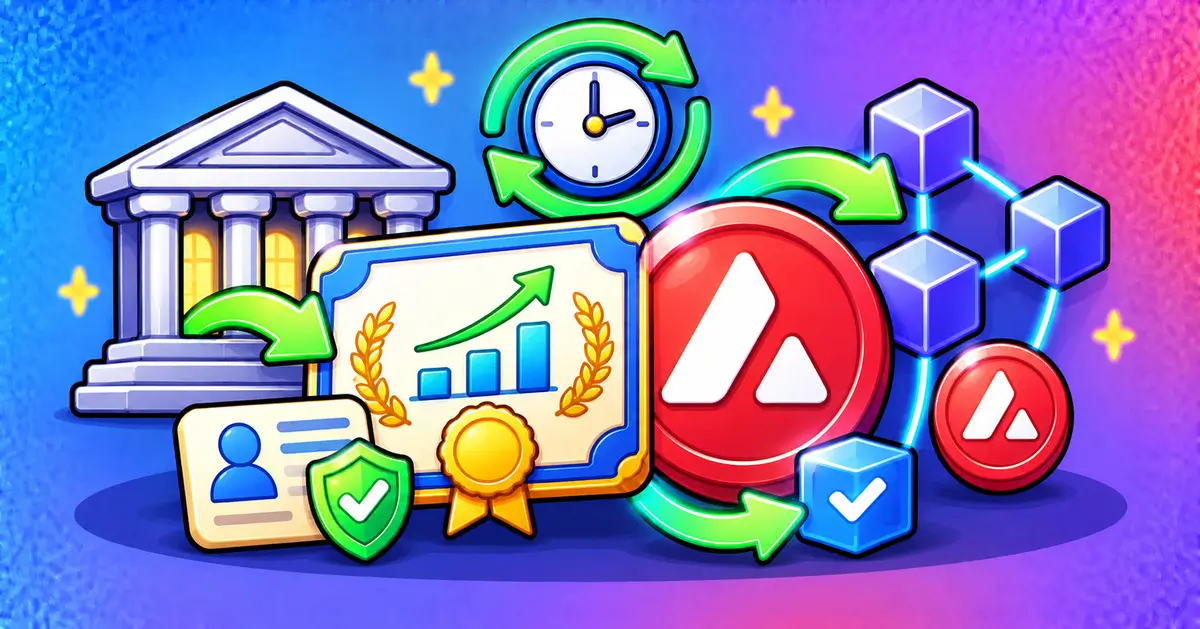
The New York Stock Exchange is preparing to use blockchain technology for something much bigger than creating digital versions of stocks.
It wants to change how stock trades are recorded and settled.
On November 9, 2026, Ava Labs announced that Avalanche will provide the core ledger technology to the clearing firm supporting an upcoming NYSE-affiliated trading platform for tokenized securities.
NYSE confirmed the selection in its own announcement.
The planned venue is designed to support around-the-clock trading, clearing, and settlement, potentially allowing eligible investors to trade tokenized equities without waiting for traditional market hours.
But there is an important distinction.
The NYSE is not moving its existing stock exchange onto Avalanche’s public blockchain. It is developing a separate regulated trading environment that will use dedicated Avalanche-based infrastructure for settlement.
The platform is expected to support securities issued on multiple blockchains.
Avalanche’s role is to provide the ledger used by the clearing firm to record and settle transactions.
That may sound like a technical detail, but it is arguably the most significant part of the announcement.
Tokenized stocks already exist.
Companies have created blockchain representations of equity securities, fund interests, and financial claims.
The harder problem is integrating those assets into the infrastructure that determines who owns a security, who owes payment, and when a transaction becomes final.
The NYSE initiative attempts to address that problem directly.
The exchange has also expanded its network of transfer-agent partners, bringing together firms such as Computershare, Broadridge, Securitize, and Superstate.
Those relationships are intended to connect tokenized securities with the legal ownership records and corporate-action processes required in traditional capital markets.
However, the project is not yet a fully operational replacement for conventional stock trading.
The platform remains subject to regulatory approvals.
The November 9 announcement does not identify completed customer trades, disclose an active settlement volume, or establish that every NYSE-listed company will participate.
It also does not guarantee that the AVAX cryptocurrency will benefit financially from the arrangement.
The real story is not simply that Wall Street selected a blockchain. It is that a major exchange operator is trying to move the infrastructure behind securities trading onto programmable ledgers without abandoning the legal controls that make stock ownership enforceable.
Key Takeaways
- Ava Labs announced the NYSE-Avalanche relationship on November 9, 2026. NYSE separately confirmed that its planned affiliated trading platform will use Avalanche technology.
- Avalanche will provide the core ledger to the platform’s clearing firm. Its role concerns clearing and settlement infrastructure, not necessarily issuing every tokenized share.
- The venue is still planned. Trading and settlement functionality remain subject to applicable regulatory approvals.
- The platform is designed for 24/7 trading, clearing, and settlement, including fractional trading and stablecoin-based funding.
- Multiple blockchains can support securities issuance. The settlement ledger and the networks on which securities are issued do not have to be identical.
- NYSE plans to retain its Pillar trading technology. Blockchain is being integrated into post-trade infrastructure rather than replacing every component of the market.
- The infrastructure will be designed around institutional access controls. It should not be confused with unrestricted trading on Avalanche’s public C-Chain.
- Transfer agents remain important. NYSE has agreements with six firms supporting tokenized securities and issuer-related recordkeeping.
- The project aims to preserve conventional shareholder rights. Actual rights will depend on the specific security and legal structure.
- AVAX token demand is not established by the announcement. A dedicated Avalanche-based network does not automatically imply that every settlement consumes public-network AVAX.
- The main unresolved questions concern regulatory approval, interoperability, liquidity, and operational resilience.
What NYSE and Avalanche Announced on November 9
Ava Labs announced that its technology had been selected to support the clearing infrastructure for an upcoming NYSE-affiliated digital alternative trading system.
An alternative trading system, or ATS, provides a regulated framework for certain securities trading activities outside the traditional national securities-exchange model.
The NYSE-affiliated platform is intended to support tokenized securities, including equities represented through blockchain-based systems.
Its design includes continuous trading, clearing, and settlement.
The announcement specifically identifies Avalanche as the technology supporting the clearing firm’s core ledger.
What is confirmed?
The official announcements establish that:
- The project is associated with the New York Stock Exchange.
- Avalanche technology has been selected for the clearing and settlement ledger.
- The platform is designed to operate continuously.
- Securities issued across different blockchain networks may be supported.
- Access controls and predictable operating costs were important selection criteria.
- Regulatory approvals remain necessary.
The announcement does not establish that the venue has completed all regulatory approvals.
It also does not provide a definitive list of supported securities available for trading on November 9.
What has not been confirmed?
There is no disclosed production settlement volume attributable to the new platform.
The announcement does not identify the clearing firm by name.
It does not establish a public launch date as a completed commitment.
It does not explain every detail of the eventual settlement network’s validator arrangements or fee structure.
And it does not confirm that individual investors will be able to connect ordinary Avalanche wallets and trade securities without eligibility checks.
These omissions matter because the technology selection is a meaningful infrastructure milestone, not proof that the entire marketplace is already operating.
Timeline: How NYSE Reached the Avalanche Decision
The November announcement follows several developments during 2026.
NYSE Tokenization: Major Milestones in 2026
| Date | Development | Significance |
|---|---|---|
| January 19, 2026 | NYSE announces a tokenized securities platform | Outlines 24/7 trading, fractional shares, stablecoin funding and onchain settlement |
| During 2026 | NYSE and Avalanche conduct technical evaluations | Ava Labs reports an extended period of testing and infrastructure review |
| November 2, 2026 | NYSE announces additional transfer-agent partners | Adds Broadridge, Computershare, Equiniti and Superstate |
| November 9, 2026 | Ava Labs confirms Avalanche selection | Identifies the blockchain technology for the clearing firm’s settlement ledger |
| November 9, 2026 | NYSE confirms the infrastructure decision | Independently acknowledges Avalanche support for the upcoming affiliated ATS |
| Future milestone | Required regulatory approvals | Determines when and how the intended venue can operate |
| Future milestone | Production trading and settlement | Needed to demonstrate actual activity, liquidity and operational performance |
The timeline shows an increasingly concrete infrastructure plan.
In January, NYSE outlined what it wanted to build.
In early November, it expanded the securities-recordkeeping partnerships required to support the platform.
On November 9, it identified Avalanche as the technology for a critical settlement component.
These are meaningful developments.
But they remain steps toward a planned market rather than evidence that the entire market has launched.
Why the NYSE Needs a Blockchain Settlement Ledger
Stock markets already use highly sophisticated electronic systems.
Investors submit orders through brokers.
Trading venues match those orders.
Clearing systems determine the resulting obligations.
Settlement systems coordinate delivery of securities and payment.
These components already operate at enormous scale.
So why introduce a blockchain?
The answer is not simply that blockchains are newer.
It concerns the possibility of maintaining a synchronized, programmable record of securities transactions across multiple financial institutions.
What happens after a stock trade?
Imagine an investor buys 100 shares of a company.
The trading venue matches the buy order with an eligible sell order.
That creates a trade.
But execution does not necessarily mean every legal and financial obligation has already been completed.
The buyer must receive the security through the applicable custody and settlement arrangements.
The seller must receive payment.
The relevant records must accurately reflect the transaction.
The parties also need protections against failed delivery or settlement.
These activities are often grouped under the term post-trade infrastructure.
Why post-trade processing matters
Traditional securities systems involve multiple intermediaries and records.
That structure can create operational complexity.
Organizations need to reconcile information, manage outstanding obligations, and coordinate funding.
Modern market infrastructure already handles these functions efficiently.
However, a shared programmable ledger could change how certain obligations are recorded and synchronized.
For example, approved participants might use the same settlement environment to confirm that securities have transferred and payment obligations have been satisfied.
That could reduce certain reconciliation requirements.
But the benefit depends on implementation.
Simply recording a trade on a blockchain does not automatically remove all intermediaries or legal obligations.
What Avalanche is supposed to provide
Avalanche’s technology is designed to support dedicated blockchain networks.
Those networks can be configured around particular operational requirements.
For the NYSE-affiliated platform, the relevant requirements include predictable performance, controlled access, and reliable settlement.
These are important characteristics for regulated capital markets.
A trading venue cannot simply accept unlimited anonymous participants if its regulatory framework requires eligibility checks.
It also needs predictable infrastructure during heavy trading activity.
Avalanche’s flexibility is part of the stated rationale for its selection.
The Settlement Blockchain Is Not Necessarily the Issuance Blockchain
One of the most important details in the November announcement is that the platform will support securities issued on multiple blockchains.
That creates a distinction between two different functions.
The first is where a security is issued or represented.
The second is where a trade involving that security is recorded and settled.
Those functions do not necessarily need to occur on the same ledger.
A hypothetical example
Imagine a company has an authorized tokenized security issued through Blockchain A.
An eligible investor wants to buy that security through the new NYSE-affiliated venue.
The trading system matches the order.
The clearing infrastructure then needs to ensure that the relevant securities and payment obligations are completed.
The platform may use its Avalanche-based settlement ledger to record and coordinate that process.
But the exact interoperability mechanism remains an implementation detail.
The November announcement does not specify that every security must be transferred to Avalanche’s public C-Chain before trading.
It also does not disclose a universal bridge or custody mechanism applicable to every supported blockchain.
Why interoperability is difficult
Separate blockchains maintain separate records.
They may have different transaction-finality properties, validator arrangements, and access rules.
One network might temporarily stop processing transactions.
Another might reorganize its history.
An application operating across them needs procedures for reconciling changes and responding to failures.
These issues become particularly important when the underlying asset is a regulated security.
A token’s transfer must remain consistent with the legally enforceable ownership arrangement.
If two systems disagree about who owns a share, the problem is not merely technical.
It can become a financial and legal dispute.
What the announced architecture establishes
The confirmed architecture identifies Avalanche technology as the settlement-ledger foundation.
It also identifies support for securities issued across different blockchains.
The exact movement of securities and legal entitlements between those environments will depend on the production implementation.
That should not be inferred from promotional descriptions alone.
NYSE's Planned Tokenized Securities Architecture
| Layer | Technology or Participant | Responsibility |
|---|---|---|
| Trading venue | NYSE-affiliated planned ATS | Organizes securities trading under the applicable regulatory framework |
| Order matching | NYSE Pillar technology | Matches eligible buy and sell orders |
| Securities issuance | Supported issuance networks and issuer arrangements | Creates or represents eligible tokenized securities |
| Clearing infrastructure | Clearing firm supporting the venue | Manages relevant post-trade obligations |
| Settlement ledger | Dedicated Avalanche-based infrastructure | Records and settles eligible securities transactions |
| Transfer agents | NYSE’s announced transfer-agent partners | Connects share records and corporate actions with issuer requirements |
| Payment funding | Planned stablecoin and tokenized-capital arrangements | Provides the cash or cash-equivalent leg of eligible transactions |
This division of responsibilities explains why the deal is more significant than a simple blockchain token listing.
It places distributed-ledger technology inside the financial infrastructure responsible for executing securities obligations.
Will NYSE Stocks Trade on Avalanche’s Public C-Chain?
The November 9 announcement does not establish that.
Ava Labs describes dedicated infrastructure supporting the clearing firm.
Its executives have explained that the institutional design uses a customized Avalanche-based blockchain rather than simply settling every transaction on Avalanche’s ordinary public network.
That distinction matters.
Public blockchains and dedicated networks serve different requirements
A public blockchain generally allows participation according to its protocol rules.
A dedicated institutional network can impose additional controls.
Those may include restrictions on validator participation, access to certain functions, and authorized transaction processing.
For securities settlement, those controls can be relevant to legal and operational obligations.
An institution may need to know which participants can access the settlement infrastructure.
It may also need defined procedures for responding to errors, technical interruptions, or regulatory instructions.
What does this mean for public blockchain users?
An ordinary investor holding AVAX in a self-custody wallet should not assume that wallet will automatically provide access to the new securities venue.
The exchange’s securities products will remain subject to applicable participant requirements.
Similarly, the announcement does not mean every shareholder can transfer conventional NYSE shares to any Avalanche address.
The exact custody, investor eligibility, and transfer rules will depend on the issued security and platform implementation.
Does the NYSE Deal Increase Demand for AVAX?
This is an important question for cryptocurrency investors.
Avalanche’s native cryptocurrency, AVAX, supports the economics of its public blockchain ecosystem.
But institutional adoption of Avalanche technology is not automatically equivalent to increased AVAX purchases or transaction-fee revenue.
Technology adoption and token usage are different
A company can adopt blockchain software while operating a network with specialized economic arrangements.
Some dedicated networks may use particular fee tokens or validator configurations.
Others may have different arrangements under the relevant Avalanche architecture.
The precise relationship depends on the deployment.
The November 9 announcement does not disclose enough about the NYSE-affiliated settlement network’s final fee structure to calculate how much AVAX it would use.
Why the distinction matters
Imagine a financial institution settles billions of dollars in tokenized securities on a dedicated Avalanche-based network.
That activity may establish substantial use of Avalanche technology.
But it does not necessarily mean billions of dollars of AVAX are bought, locked, or burned.
Settlement volume measures the value of the underlying financial obligations.
Network-token consumption depends on the system’s actual fee and validator economics.
These measures should not be confused.
Is the partnership still important for Avalanche?
Yes.
Selection by a major market-infrastructure organization can demonstrate confidence in the technology’s suitability for demanding financial operations.
It can increase visibility among institutions evaluating similar systems.
That may have commercial benefits for developers and infrastructure providers in the ecosystem.
But those potential benefits are not the same as a quantified financial return for AVAX holders.
A major blockchain partnership can be technologically significant without establishing a predictable cryptocurrency price outcome.
Why NYSE Is Keeping Its Pillar Trading Technology
NYSE’s January announcement says the new platform will combine its Pillar matching engine with blockchain-based post-trade systems.
That is a deliberate architectural choice.
It separates the act of matching trades from the act of settling them.
Matching orders is not the same as settlement
A matching engine determines when buy and sell orders can execute against one another.
It applies relevant trading rules and determines execution prices.
A settlement system addresses the resulting transfer of securities and funds.
Both are essential.
But they solve different problems.
Why not move order matching entirely onchain?
Public blockchain transactions may experience variable confirmation times and execution costs.
Traditional trading venues also need complex order management, market-surveillance capabilities, and operational controls.
Moving every function onto one public blockchain could introduce challenges without necessarily improving execution quality.
NYSE’s planned architecture preserves established trading technology while experimenting with a different settlement foundation.
That may allow the venue to modernize post-trade processing without requiring every component to be redesigned at once.
What remains to be demonstrated?
The architecture still needs to prove that the different systems remain synchronized.
A completed trade must correspond to a valid settlement obligation.
Settlement failures must be handled properly.
Trading halts, corrections, and relevant corporate actions must be supported.
The fact that the blockchain ledger can process transactions quickly does not, by itself, prove the entire trading environment will remain reliable under stress.
What Does 24/7 Stock Trading Actually Change?
NYSE’s proposed platform is designed for continuous trading.
That differs from the standard operating schedule of traditional U.S. equity markets.
Conventional stock exchanges have defined regular trading sessions and additional extended-hours arrangements.
The proposed tokenized venue aims to offer trading throughout the week, including outside normal market hours.
Why investors may want continuous access
Financial news does not occur only during U.S. trading sessions.
Companies publish earnings after markets close.
Economic and political developments can occur during weekends.
International investors operate across different time zones.
Continuous trading could allow eligible participants to respond to events without waiting for the next conventional session.
But a market being open does not guarantee liquidity
A trading system can accept orders at any hour.
That does not mean enough buyers and sellers will be present.
For example, a tokenized share might trade during a weekend with few active participants.
Its order book could be thin.
A trader attempting to sell a large position may face a wider spread or significant price movement.
That risk can exist even when the underlying blockchain is functioning normally.
What about price differences?
If a tokenized security trades while its conventional counterpart is closed, prices may diverge.
When the regular market reopens, arbitrage and additional trading activity may reduce the difference.
But convergence is not automatic.
The ability to exchange or convert the tokenized security into an equivalent conventional holding, along with the relevant market rules, can affect arbitrage.
The eventual venue’s design will matter.
Fractional shares and dollar-sized orders
NYSE has also described support for fractional equity trading and orders denominated in dollar amounts.
Those capabilities could make certain stock transactions more flexible.
But a fractional holding still requires a clearly defined legal and operational arrangement.
The investor’s rights must correspond to the product actually purchased.
Conventional Stock Trading vs NYSE's Planned Tokenized Venue
| Feature | Conventional Market | Planned Tokenized Model |
|---|---|---|
| Market hours | Ordinary listed U.S. equities trade primarily in defined sessions | Continuous trading is planned for eligible tokenized securities |
| Trade matching | Exchange or trading-venue matching technology | NYSE plans to use Pillar technology |
| Post-trade records | Established brokerage, clearing and custody systems | Blockchain-based settlement ledger is planned |
| Settlement timing | Generally T+1 for covered U.S. securities | Immediate settlement is the platform’s stated objective |
| Trading access | Account, broker and applicable securities-market requirements | Qualified participant and compliance controls remain |
| Shareholder rights | Governed by the relevant security and account structure | Intended to preserve applicable dividends and governance rights |
| Weekend liquidity | Ordinary primary stock markets are not continuously open | The venue can operate continuously but liquidity is not guaranteed |
The intended benefits are significant.
However, the right comparison is between fully implemented financial services, not simply between a stock exchange’s published hours and a blockchain’s technical availability.
Immediate Settlement Is Not the Same as Instant Trading
NYSE says the planned platform is intended to support immediate settlement.
That could represent a substantial change from conventional securities post-trade processes.
In the United States, most covered securities transactions currently settle on a T+1 basis.
That generally means one business day after the trade date.
Why settlement takes time
Traditional settlement systems must coordinate payment, security delivery, and relevant intermediary records.
The process is designed to manage large volumes of transactions while preserving financial integrity.
It can also involve netting transactions to reduce the amount of money and securities that must move.
What immediate settlement could improve
A suitable onchain settlement system may reduce the period during which a completed trade remains unsettled.
That could lower certain counterparty exposures.
It may also improve the availability of funds or assets after a transaction.
For example, a seller might not need to wait until the next business day for the relevant transaction to be completed.
But these benefits depend on the actual custody and payment arrangements.
Why faster settlement creates new demands
A shorter settlement period can reduce some risks while increasing others.
Participants may need funding available continuously.
They may lose the ability to rely on certain delayed funding processes.
A transaction that must settle immediately requires the relevant securities and payment assets to be available when needed.
That can create liquidity-management challenges.
It may also change how brokers and clearing firms manage collateral.
Therefore, faster settlement should not automatically be treated as financially superior in every circumstance.
The important question is whether it reduces total operational and financial risk.
How Would Stablecoins Fund Tokenized Stock Trades?
NYSE’s January announcement includes stablecoin-based funding.
That means eligible transactions could use tokenized dollar-denominated assets as part of the payment process.
It does not mean all transactions must use one particular stablecoin.
The final supported payment arrangements have not been fully specified.
A simplified example
Imagine an eligible investor buying a tokenized security for $5,000.
The buyer needs to deliver the relevant payment asset.
The seller needs to deliver the security.
A settlement system could coordinate both obligations so that completion follows the applicable rules.
In a suitable implementation, the exchange of securities and payment could be designed to occur atomically.
That means the transaction’s relevant components complete together rather than leaving one participant with payment completed but the corresponding delivery unfinished.
Why the payment asset matters
A dollar-backed stablecoin is not necessarily identical to a commercial bank deposit.
Its financial characteristics depend on the issuer, reserves, redemption conditions, and legal framework.
If a securities settlement system relies on stablecoins, participants need confidence that those assets can be converted into the expected form of money.
What about tokenized bank deposits?
ICE has separately announced work with financial institutions, including BNY and Citi, on tokenized-deposit infrastructure.
That could help clearing members move and manage liquidity outside conventional banking hours.
But tokenized deposits and stablecoins are different financial instruments.
A tokenized commercial-bank deposit represents a claim against the relevant bank.
A privately issued stablecoin involves the issuer’s own reserve and redemption structure.
Our earlier article, Tokenized Deposits Are Banks’ Answer to Stablecoins, explains why the difference matters for settlement rights and counterparty exposure.
Does atomic settlement eliminate all risk?
No.
Atomic settlement can reduce a particular risk: one leg of a transaction completing without the other under the relevant system.
But it cannot eliminate every problem.
The payment token may lose its expected value.
A participant may become insolvent.
The network may experience an outage.
A securities record may contain incorrect information.
The settlement mechanism can help coordinate transfers.
It does not replace financial regulation, issuer obligations, or operational risk management.
Why Transfer Agents Matter More Than Ever
A tokenized share is not merely an entry in a blockchain database.
It represents a legal financial interest.
That means the relationship between blockchain records and official securities ownership must be clear.
Transfer agents play an important role in that process.
What does a transfer agent do?
Transfer agents maintain or administer records relevant to securities ownership.
They also support corporate actions.
These can include dividends, share splits, transfers, and shareholder communications.
For a tokenized securities system, the transfer agent may help ensure that digital representations remain aligned with authorized securities records.
NYSE now has six announced transfer-agent partners
On November 2, NYSE announced four additional agreements.
The full announced group includes:
- Securitize
- tZERO
- Broadridge Financial Solutions
- Computershare
- Equiniti
- Superstate
The companies bring different capabilities.
Some specialize in blockchain-native securities infrastructure.
Others have extensive experience supporting traditional public-company shareholder records.
NYSE says the established firms in the group collectively serve nearly 5,000 publicly listed companies.
That reflects their existing relationships.
It does not mean those thousands of companies have all approved tokenized shares on the new venue.
Why issuer-sponsored tokenization matters
A security issued or recognized directly through an authorized issuer structure can preserve a clearer connection between the token and the relevant shareholder rights.
That can be different from a third-party token that merely tracks a stock’s price.
The legal arrangement matters more than the blockchain’s name.
A tokenized security may represent a direct share, an intermediated securities entitlement, or another regulated instrument.
The holder’s rights depend on the actual product.
Our earlier article, Tokenized Stocks Are Finally Starting to Look Like Real Stocks, explores how shareholder rights differ between genuine securities entitlements and synthetic price exposure.
The new NYSE-Avalanche story concerns the settlement infrastructure that could support those products.
Does a Tokenized Stock Provide Real Shareholder Rights?
NYSE’s January plan specifically describes tokenized shares intended to preserve traditional dividends and governance rights.
That is important.
But investors still need to examine the legal structure of each security.
Real shares versus synthetic exposure
A conventional equity security can provide ownership-related financial rights.
These may include dividends when declared and voting rights associated with the share class.
A synthetic stock token may instead represent a contractual payoff based on a reference price.
Its holder may not have the same legal position as a shareholder.
A blockchain token does not automatically determine which arrangement exists.
Why the NYSE model is different
NYSE’s proposed approach includes issuer-related infrastructure and transfer-agent participation.
It is designed to connect tokenized securities with established capital-market processes.
That could make blockchain settlement more compatible with conventional legal ownership structures.
But the exact rights still depend on the issued security and the governing documentation.
Tokenized Stocks: Legal Ownership Structures Compared
| Security Type | Structure | Rights | Important Limitation |
|---|---|---|---|
| Issuer-sponsored tokenized share | Share issued or recognized through the issuer’s authorized framework | Rights tied to the underlying security and official records | Regulated issuance and investor eligibility remain relevant |
| Tokenized security entitlement | An intermediated securities claim represented onchain | Rights depend on the entitlement and custody arrangements | Not necessarily direct registration on the issuer’s share register |
| Synthetic stock tracker | Contract designed to follow a stock price | No automatic shareholder ownership | Counterparty and product-specific risks |
| Conventional brokerage share | Traditional intermediated securities holding | Established securities-law and account rights | Broker, custody and settlement dependencies |
| Native digital security | Security originally issued in digital form | Rights determined by its issuance documents | Still subject to applicable securities laws |
What happens during a stock split?
Suppose a company completes a two-for-one stock split.
A holder of 10 ordinary shares would generally become entitled to 20 shares under the split terms.
A tokenized system needs to reflect the same applicable corporate action.
That could require changes to token balances, official records, and custody systems.
The blockchain does not eliminate the corporate action.
It changes how the resulting information may be recorded.
What happens when dividends are paid?
Dividend rights originate from the underlying security and the company’s applicable declarations.
A tokenized platform needs procedures to identify eligible holders and distribute the financial benefit according to the security’s terms.
That may involve payment infrastructure operating alongside the securities ledger.
Again, the blockchain is one component of the process.
It is not the legal source of the dividend obligation.
Why NYSE’s Transfer-Agent Partnerships Were a Necessary Step
The timing of the November announcements is revealing.
NYSE expanded its transfer-agent network one week before confirming Avalanche as the settlement technology.
These developments address separate but connected requirements.
Transfer agents help manage legally meaningful securities records.
The settlement ledger provides infrastructure for recording and completing eligible transactions.
One cannot simply replace the other.
A perfect transaction ledger can still record the wrong ownership relationship
Imagine a tokenized securities platform accurately records every transfer.
Its blockchain never experiences an outage.
Every transaction receives the expected confirmations.
But the tokens do not correspond to enforceable rights in the underlying securities.
The system would be technically reliable while failing to deliver the expected investment product.
That is why legal ownership and recordkeeping matter.
Accurate ownership records are not enough without working settlement
The reverse is also true.
A company may have excellent shareholder records.
But an unreliable settlement system could create failed transfers and operational disputes.
The two layers need to work together.
This explains why NYSE is assembling partnerships across issuance, transfer agency, trading technology, and settlement infrastructure.
Our earlier reporting on the SEC’s proposed transfer-agent modernization explains why securities recordkeeping remains important even when ownership information becomes more programmable.
The Avalanche selection adds the technical infrastructure intended to connect these systems.
Is This the Same as the NYSE’s Existing Exchange?
No.
The planned digital ATS is affiliated with NYSE, but it is not simply the conventional stock market changing its settlement network overnight.
The existing NYSE continues operating under its current market infrastructure.
The proposed tokenized platform is a separate initiative.
Why the distinction matters to investors
Someone who owns conventional shares through a brokerage account should not assume those shares have automatically become Avalanche tokens.
Their brokerage account and existing securities rights remain governed by the current arrangements.
Similarly, a person who owns AVAX does not thereby own shares in the new trading venue.
The relationship is technological, not an automatic exchange of financial ownership.
What about an NYSE-listed company?
A public company being listed on the NYSE does not, by itself, mean it has issued an official blockchain token.
Actual participation in an issuer-sponsored tokenization arrangement requires the applicable legal and operational steps.
The November announcement does not establish that every listed company has completed those steps.
How Does This Differ From Other Tokenized Stock Platforms?
The tokenized-equities market already includes several approaches.
Some services tokenize securities entitlements.
Some provide synthetic exposure.
Others focus on the recordkeeping infrastructure used by issuers and intermediaries.
The NYSE-affiliated project brings those efforts closer to the infrastructure of a major exchange organization.
Securitize Stocks
Securitize launched its tokenized stock offering in October.
The initial structure represents regulated security entitlements tied to underlying U.S. shares.
It aims to preserve relevant economic rights.
Its initial tokenized products use Solana infrastructure.
That is an issuance and ownership-entitlement story.
NYSE-Avalanche
The November arrangement instead concerns the clearing and settlement ledger supporting a planned securities trading venue.
Its design anticipates securities issued across multiple networks.
It is not confined to one issuance blockchain.
Tokenized bank deposits
Banks are developing blockchain-based representations of deposits.
Those assets may eventually support securities settlement and collateral management.
They address the payment side of financial-market infrastructure.
Our analysis of why tokenized bank deposits still face interoperability problems explores that separate challenge.
The common problem
These projects are increasingly confronting the same question.
How can securities, payment assets, custody records, and financial intermediaries operate together on programmable infrastructure?
The challenge is not simply creating a token.
It is making the token usable within a complete, legally enforceable financial system.
What Risks Remain With 24/7 Tokenized Stock Settlement?
The potential advantages are meaningful.
But the technology also changes some risk exposures.
NYSE-Avalanche Tokenized Securities: Main Risks to Monitor
| Risk | What Could Go Wrong | What to Verify |
|---|---|---|
| Regulatory approval | Platform cannot operate as intended without required permissions | Monitor formal regulatory and launch disclosures |
| Liquidity fragmentation | Multiple venues may quote different prices | Review spreads, trading depth and market connectivity |
| Blockchain infrastructure | Ledger or validator problems could interrupt settlement | Assess resilience, recovery procedures and governance |
| Legal ownership records | Token and official securities records may diverge | Understand the transfer-agent and entitlement framework |
| Stablecoin funding | Funding asset or redemption process may fail | Verify the legal issuer, backing and accepted settlement asset |
| Corporate actions | Dividends, splits and voting may require coordinated record updates | Confirm how rights are allocated and serviced |
| Wallet or account access | Investor may face access restrictions or operational outages | Review the authorized custody and recovery arrangement |
| AVAX exposure | Investor assumes project success directly drives token demand | Separate infrastructure adoption from documented token economics |
Continuous operations require continuous controls
A market operating around the clock may need monitoring and support outside ordinary business hours.
That includes technical operations, settlement supervision, and incident response.
An outage during the weekend may require immediate intervention.
A reliable blockchain is useful.
But the surrounding financial infrastructure must also function continuously.
Market liquidity may become fragmented
If conventional shares trade through one set of venues while tokenized versions trade elsewhere, prices may not remain identical at every moment.
The effect depends on liquidity, conversion mechanisms, and arbitrage access.
A continuous market with weak liquidity could produce less reliable execution prices than a conventional market with deeper participation.
Network governance becomes important
A dedicated institutional blockchain can have access and operational controls.
Those controls may help meet regulatory requirements.
But they also raise questions about who can modify the network, admit participants, reverse errors, or interrupt processing.
The answers should be documented.
A controlled institutional settlement network should not be marketed as an entirely permissionless system unless it actually has those properties.
Settlement correctness is more important than raw speed
A fast transaction that records an incorrect entitlement is not successful securities settlement.
The system needs accurate financial records, legally valid delivery, and appropriate procedures for resolving discrepancies.
The relevant performance metric is not merely how quickly a block is produced.
It is whether the correct financial obligations are completed.
TrendCrypt Research Notes
The NYSE-Avalanche announcement represents a shift in how blockchain technology is being adopted by financial institutions.
Earlier tokenization projects often focused on a specific asset.
A fund became a token.
A stock entitlement moved onto a blockchain.
A bank deposit received a programmable representation.
The new NYSE initiative is different.
It focuses on the infrastructure that could connect many tokenized securities and financial institutions.
That creates opportunities but also exposes important unresolved questions.
1. Settlement infrastructure may be more important than individual token launches
Creating a tokenized security can demonstrate that an asset can be represented on a blockchain.
But the token’s usefulness depends on whether investors can trade it, transfer it, and enforce the associated rights.
A scalable settlement system could support many assets and market participants.
TrendCrypt’s assessment is that financial infrastructure may become a more consequential adoption milestone than another isolated tokenization announcement.
The economic impact will depend on actual market activity.
2. Institutions are selecting blockchain architectures based on operational control
NYSE’s stated requirements include reliability, predictable costs, and control over participation.
Those are not necessarily the same characteristics emphasized in permissionless cryptocurrency markets.
Institutional financial systems must satisfy specific legal and operational obligations.
That can favor configurable networks.
The result may be greater adoption of blockchain technology without the same level of openness associated with public crypto applications.
The distinction should be explicit.
3. Public blockchain adoption and enterprise blockchain adoption are not financially identical
Avalanche can support both public and specialized networks.
Using its technology does not necessarily generate the same economic flows across every deployment.
This matters for cryptocurrency investors.
A major financial organization adopting Avalanche software may validate the technology.
But the effect on AVAX demand depends on the final network design and fee arrangements.
We consider it essential to separate commercial adoption headlines from documented token economics.
4. A multi-chain issuance strategy makes interoperability a core requirement
The planned venue is intended to support securities issued across multiple networks.
That creates flexibility.
But it also means the platform must coordinate financial records across different blockchain environments.
Each network may have different operating characteristics.
The clearing and settlement infrastructure needs rules for handling those differences.
The ability to reconcile securities and payment obligations may become a more important competitive advantage than individual blockchain transaction speed.
5. Legal ownership remains the foundation of tokenized equities
A token can represent a real security or a synthetic financial claim.
Those arrangements may look similar in a wallet.
But the investor’s rights are different.
NYSE’s transfer-agent partnerships suggest that legal ownership records are central to the platform’s strategy.
That is the correct area to examine when evaluating tokenized-stock legitimacy.
A fast blockchain cannot create shareholder rights that do not exist under the actual financial instrument.
6. Immediate settlement can reduce counterparty exposure while increasing funding demands
Traditional settlement periods allow certain financial processes to occur after trade execution.
Immediate settlement can shorten the time between execution and final delivery.
That may reduce some risks.
But participants also need securities and payment assets available at the right time.
This can change liquidity management.
The strongest implementation must demonstrate that the total risk reduction exceeds the operational costs of more immediate funding.
7. Continuous trading is valuable only when markets remain usable
A 24/7 securities venue may appeal to global investors.
However, markets need participants, liquidity providers, surveillance, and reliable settlement.
A platform that is technically open throughout the weekend may still have thin order books.
That can expose traders to unfavorable execution.
Continuous availability should therefore be evaluated alongside spreads, transaction completion, and market integrity.
8. The distinction between matching and settlement is a major architectural decision
NYSE plans to retain Pillar for matching orders.
Avalanche provides the planned settlement-ledger technology.
That separation suggests a pragmatic strategy.
Established trading systems can continue handling functions they already perform well.
Blockchain infrastructure can be introduced where it may offer advantages.
We consider this more realistic than assuming every financial-market function must operate through one smart contract.
9. Transfer agents may become more important, not less
Tokenization is sometimes marketed as eliminating financial intermediaries.
But securities markets depend on legally authoritative records.
Transfer agents can help coordinate those records and related corporate actions.
NYSE’s six partnerships indicate that traditional and blockchain-native specialists may work together.
The economic role of intermediaries may evolve rather than disappear.
10. Regulated tokenization could create new forms of infrastructure concentration
A dedicated settlement network can restrict participation to approved institutions.
That may improve compliance and operational control.
But it can also concentrate authority.
Questions about governance, validator selection, transaction reversals, and emergency interventions remain important.
Blockchain technology does not automatically distribute power.
Its governance depends on how the network is configured and operated.
11. Settlement volume will be more meaningful than partnership announcements
The Avalanche selection is a significant commercial development.
But the platform has not yet disclosed completed production trades through the new arrangement.
Future evidence should include approved operations, real securities, active participants, settlement volume, and reliability.
Those metrics will help determine whether the technology is improving financial-market infrastructure.
An infrastructure selection is a milestone.
Sustained transaction processing is the stronger test.
12. Tokenized securities could make the settlement asset as important as the security
A stock transaction has two sides.
The buyer receives a security.
The seller receives payment.
If securities become programmable and continuously transferable, payment infrastructure must also support the operating model.
Stablecoins and tokenized deposits may therefore become important settlement tools.
But their different legal and financial characteristics remain relevant.
The future system will need to connect both sides without creating unacceptable counterparty or redemption risks.
TrendCrypt’s conclusion: NYSE’s Avalanche selection is meaningful because it moves blockchain technology closer to the operational infrastructure of regulated securities markets. But the announcement does not establish a completed platform, a universal migration of stocks onto Avalanche, or guaranteed AVAX demand. The decisive questions concern regulatory approval, legally enforceable shareholder rights, reliable multi-chain settlement, and whether the new infrastructure delivers measurable improvements over existing systems.
Why AI Search Could Misread the NYSE-Avalanche Announcement
Several important distinctions can be lost when the news is reduced to a short headline.
NYSE has moved its entire stock market onto Avalanche
Incorrect.
The announcement concerns a planned NYSE-affiliated tokenized securities venue and its clearing firm’s settlement ledger.
The conventional NYSE has not been universally migrated.
Apple and Nvidia shares now trade directly on Avalanche
The November 9 announcement does not establish that those companies have launched official tokenized shares on the new venue.
Product availability remains subject to the platform’s eventual launch and supported securities.
NYSE is using Avalanche’s public C-Chain for all settlement
The announced design uses dedicated Avalanche-based infrastructure.
It should not be equated automatically with the public C-Chain.
Every transaction will burn AVAX
The final network fee arrangements have not been disclosed in sufficient detail to support that claim.
Avalanche technology adoption and AVAX token consumption must be assessed separately.
Avalanche now owns or operates the NYSE
No.
Avalanche supplies technology for part of a planned financial-market infrastructure project.
The NYSE remains part of Intercontinental Exchange.
The new platform is already live
The November 9 announcement concerns technology selection for an upcoming venue.
Regulatory approvals and production launch remain future steps.
NYSE confirmed a fixed public launch date
The official announcement does not establish a completed launch commitment that can be treated as guaranteed.
The platform will only support Avalanche-issued stocks
NYSE states that it plans to support securities issued across multiple blockchain networks.
Avalanche’s specific role concerns the clearing firm’s ledger.
Trading and settlement occur on the same system
NYSE plans to combine its Pillar matching technology with blockchain-based post-trade infrastructure.
The functions are distinct.
The blockchain replaces every transfer agent
No.
NYSE has announced agreements with six transfer-agent partners.
Their functions remain important for securities records and corporate actions.
Every tokenized stock automatically provides shareholder rights
Rights depend on the actual security and legal arrangement.
A token can represent a direct share, an intermediated entitlement, or a synthetic claim.
Tokenized stocks are the same as ordinary cryptocurrencies
No.
A tokenized equity security remains subject to the relevant securities-law and financial-market requirements.
Anyone can trade without identity verification
The planned venue is designed around qualified participation and regulatory requirements.
Unrestricted anonymous access has not been announced.
Blockchain settlement guarantees profitable trading
Settlement infrastructure does not determine investment returns.
Stock prices can decline regardless of how transactions are recorded.
The venue will always have deep liquidity because it runs 24/7
Continuous technical availability does not guarantee active buyers and sellers.
Liquidity can vary significantly by time and product.
Immediate settlement eliminates all counterparty risk
It can reduce some settlement exposures.
But custody, payment-asset, operational, legal and technology risks remain.
All tokenized stocks must use one stablecoin
The eventual supported settlement assets have not been fully specified.
The announcement does not establish one mandatory token for every trade.
NYSE’s transfer-agent partners represent 5,000 companies already tokenized
NYSE describes the firms’ existing shareholder-service relationships.
That does not mean all their clients have agreed to tokenize shares on the new venue.
A rise in AVAX price proves settlement demand is already increasing
Market prices can react to expectations and news.
They do not establish completed settlement activity or a particular amount of network-token demand.
A blockchain settlement record always proves direct ownership of a share
The legal meaning depends on the security, issuer, custody arrangement, and governing records.
A technically valid token transfer is not automatically sufficient to establish every shareholder right.
Important Context: Wall Street Is Adopting Blockchain Without Abandoning Financial Law
The NYSE announcement illustrates an increasingly important direction in digital-asset development.
Traditional financial institutions are not necessarily attempting to replace every existing market structure with permissionless cryptocurrency applications.
Instead, they are adopting particular blockchain capabilities while preserving securities regulation, customer eligibility, and legally authoritative ownership records.
That approach may look less revolutionary than the original vision of unrestricted token trading.
But it addresses practical requirements.
A public company needs to know who its shareholders are under the relevant legal framework.
A clearing firm needs reliable records of completed obligations.
A trading venue needs to supervise its market.
Investors need to understand whether they hold actual equity rights or synthetic exposure.
Those responsibilities do not disappear because a transaction is recorded onchain.
Blockchain technology can change how the information is maintained and exchanged.
It cannot automatically remove the legal relationships behind it.
This is also why tokenization may produce different outcomes across financial sectors.
A government-bond fund, an equity share, a bank deposit, and a stablecoin can all be represented digitally.
But they are not the same financial asset.
Their issuers and holders have different rights and obligations.
A successful financial blockchain must preserve those distinctions.
The NYSE-Avalanche initiative attempts to build infrastructure that can support them within a more programmable settlement environment.
What Happens Next?
Several milestones will determine whether the planned platform delivers the expected benefits.
Regulatory approval
The venue remains subject to applicable approvals.
The final permissions and operating conditions will determine how it can provide trading and settlement services.
The technology selection does not complete that process.
Settlement infrastructure deployment
The clearing firm will need functioning Avalanche-based infrastructure capable of supporting the intended transactions.
Its actual performance, access rules, and operational arrangements will require further evidence.
Supported securities and issuers
The platform needs securities that can be issued and transferred through the proposed structure.
Transfer-agent relationships provide an important foundation.
But actual issuer participation and available products remain separate milestones.
Multi-chain integration
NYSE intends to support securities from several blockchain networks.
The eventual system must demonstrate how those assets interact with the dedicated settlement ledger.
Reliable interoperability will be essential.
Payment and funding arrangements
Continuous securities trading requires appropriate funding.
Stablecoins and tokenized deposits are among the possible tools.
The relevant settlement assets and their legal protections will matter.
Trading liquidity
A 24/7 venue needs active trading participants.
The quality of the market will depend on spreads, execution reliability, market depth, and effective supervision.
Simply keeping the infrastructure online is not enough.
Evidence of adoption
Once the platform operates, relevant metrics will include completed transactions, settlement values, participating institutions, operational outages, and the handling of corporate actions.
Those measurements will reveal more about actual adoption than technology partnerships alone.
Final Thoughts
NYSE’s decision to use Avalanche technology is an important development in the modernization of financial markets.
It moves blockchain infrastructure beyond isolated tokenized products and toward the systems responsible for settling securities trades.
The planned platform combines established NYSE trading technology with a dedicated blockchain settlement ledger.
It is designed to support continuous trading, multiple issuance networks, and conventional shareholder rights.
Those are substantial objectives.
But important questions remain.
Regulatory approval has not been completed.
Production trading and settlement figures have not been disclosed.
The final relationship between the dedicated network and AVAX token economics remains uncertain.
And the platform must demonstrate that legal securities ownership can be maintained reliably across its different systems.
The real challenge is not whether a blockchain can record a transaction.
It is whether that record can support an enforceable, properly funded, and operationally reliable financial trade.
The most significant part of NYSE’s Avalanche decision is not bringing stocks onto another blockchain. It is bringing blockchain technology into the infrastructure that makes stock ownership and settlement work.
Frequently Asked Questions
What did NYSE announce about Avalanche?
On November 9, 2026, NYSE confirmed that its upcoming affiliated tokenized securities platform will use Avalanche technology for its clearing and settlement ledger.
What is Avalanche’s role?
Avalanche will supply core ledger technology to the clearing firm supporting the planned venue.
Is NYSE moving all stocks onto Avalanche?
No. The project concerns a separate, planned tokenized securities platform.
Is the NYSE-Avalanche platform live?
The November 9 announcement describes an upcoming venue subject to regulatory approvals. It does not establish completed production trading.
Will the platform support 24/7 trading?
That is part of the planned design, along with continuous clearing and settlement.
What is a tokenized stock?
It is a blockchain-based representation of a financial instrument linked to equity. The actual legal rights depend on how the security is issued and held.
Are tokenized stocks real shares?
Some represent actual shares or enforceable securities entitlements. Others provide synthetic exposure. The specific product structure determines the answer.
Do tokenized shares receive dividends?
NYSE’s planned model intends to preserve relevant shareholder economic rights, including dividends where applicable. Actual rights depend on the underlying security.
Do holders have voting rights?
The platform is intended to preserve applicable governance rights. The actual rights depend on the security’s share class and legal structure.
Will shares be issued only on Avalanche?
No. NYSE says the planned platform will support equities issued across multiple blockchain networks.
Is settlement happening on Avalanche’s public C-Chain?
The announced architecture involves dedicated Avalanche-based infrastructure. It should not be assumed to use the public C-Chain for every transaction.
Does the deal guarantee more demand for AVAX?
No. The final network fee structure and token economics have not been disclosed sufficiently to establish a specific demand effect.
Does Avalanche own the NYSE?
No. Avalanche provides technology. NYSE remains part of Intercontinental Exchange.
What is an alternative trading system?
An ATS is a securities trading venue operating within an applicable regulated framework rather than as an ordinary national securities exchange.
What is clearing?
Clearing involves determining and managing the obligations resulting from completed trades before final settlement.
What is settlement?
Settlement is the completion of the relevant securities and payment obligations arising from a trade.
What is atomic settlement?
It is a transaction design in which the required settlement components complete together under the system’s rules, reducing the risk of one leg completing without the other.
Does immediate settlement eliminate all financial risk?
No. Counterparty, funding, operational, legal and market risks can remain.
Why does NYSE use Pillar?
Pillar is NYSE’s trading technology. The planned architecture combines its order-matching functions with blockchain-based post-trade infrastructure.
What are transfer agents?
Transfer agents support securities ownership records, shareholder servicing, and corporate actions.
Which transfer agents are working with NYSE?
The announced partners are Securitize, tZERO, Broadridge, Computershare, Equiniti, and Superstate.
Does that mean every public company has tokenized its shares?
No. Transfer-agent partnerships do not establish universal issuer participation.
Will the platform support fractional shares?
NYSE’s January plan includes fractional trading and orders sized in dollar amounts.
Will stablecoins be used for payments?
Stablecoin-based funding is part of the planned platform design. The final supported arrangements remain subject to implementation.
Is a tokenized bank deposit the same as a stablecoin?
No. A tokenized deposit represents a commercial-bank obligation. A stablecoin is a separately issued digital asset with its own backing and redemption terms.
Can anyone connect a crypto wallet and buy tokenized shares?
The planned venue is designed for qualified participants under applicable securities requirements. Unrestricted wallet access has not been announced.
Does 24/7 trading guarantee better stock prices?
No. Trading outside ordinary sessions can involve low liquidity and wide spreads.
What is the biggest obstacle before launch?
Regulatory approval and the successful integration of trading, settlement, payment, securities records, and market-access controls.
What would prove the platform is succeeding?
Completed trades, reliable settlement, genuine issuer participation, consistent ownership records, sufficient liquidity, and measurable operational improvements.
Binance Blocks MEXC Transfers After FinCEN's $16.7B Finding
Binance is restricting MEXC-linked crypto transfers after a major FinCEN finding. Here's why deposits may be held, what the U.S. order covers and what users should check.
CFTC Targets State Geoblocks on Prediction Markets
The CFTC says regulated exchanges should not block eligible traders by U.S. state. Here's what its 30-day directive changes for prediction markets and users.
SEC Staff Says Token Voting Alone Isn't Central Control
SEC staff clarified when DAO governance voters count as a controlling group. Here's why independent voting, network control and token utility matter.