
TrendCrypt Guide
How to Check Crypto Platform Security
Learn how to check crypto platform security beyond marketing claims by reviewing account controls, withdrawal protections, custody details, incident history, support safety, and user-risk warnings.
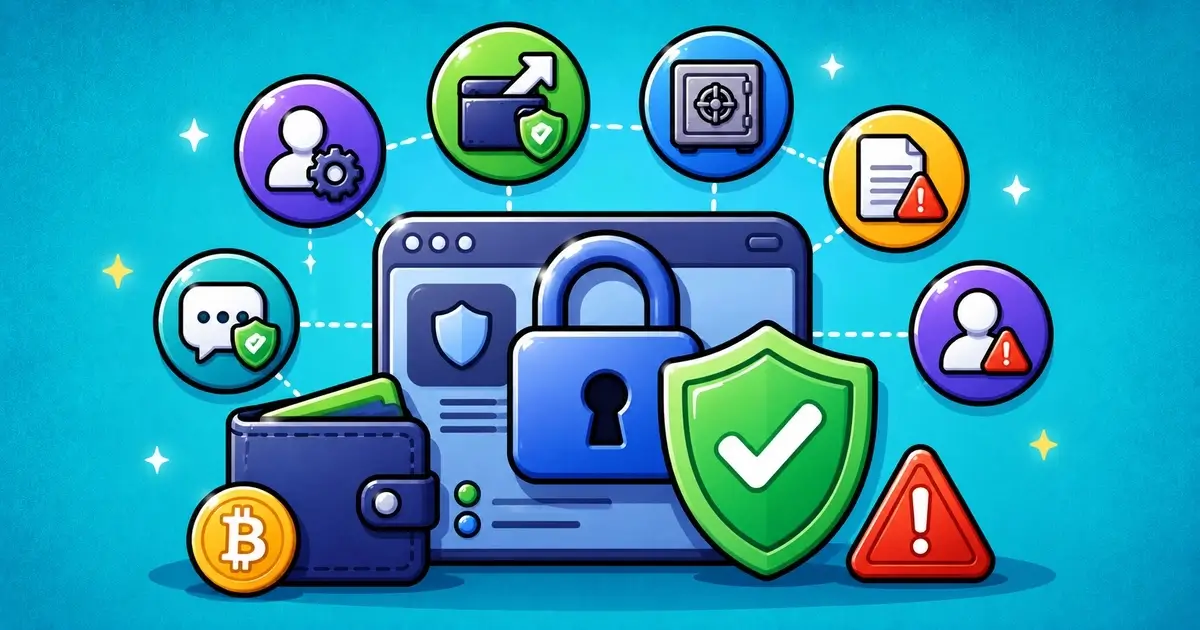
Crypto platform security should be checked beyond slogans.
Many platforms say they use “bank-level security,” “military-grade encryption,” “advanced risk systems,” or “secure custody.” Those phrases sound strong, but they do not tell users much by themselves.
A better check is practical.
Can users enable two-factor authentication? Are withdrawals protected? Can new wallet addresses be delayed? Does the platform explain custody? Has it handled past incidents openly? Does support avoid asking for sensitive access details? Are security rules visible before users deposit?
This guide explains how to review crypto platform security from the outside, what controls matter, and which warning signs deserve caution.
It applies to crypto casinos, exchanges, wallets, betting platforms, payment apps, trading services, and other platforms that hold user balances or process withdrawals.
Related safety pages include How to Check a Crypto Platform, Wallet Safety, Crypto Platform Withdrawal Rules: What to Check, Crypto Wallet Phishing Scams: Warning Signs, and Editorial Policy.
Key Takeaways
- Security slogans are not enough; look for specific controls
- Check account protection, withdrawal protection, custody details, incident history, and support safety
- Two-factor authentication, login alerts, and session management are useful account controls
- Withdrawal whitelists, 2FA checks, email confirmation, and new-address delays can reduce payout risk
- Custody claims are hard to verify unless the platform provides clear evidence
- Past incidents matter, especially how the platform communicated and treated users
- No real support agent needs seed phrases, private keys, passwords, or authentication codes
- Even strong platform security does not remove the risk of holding large balances on a third-party platform
What Platform Security Really Means
Platform security is not one feature.
It includes several layers:
- login protection
- account recovery controls
- withdrawal protection
- wallet and custody security
- internal risk systems
- payment monitoring
- support safety
- incident response
- data protection
- user education
A platform can be strong in one area and weak in another.
For example, a platform may offer 2FA but have poor withdrawal controls. Another may claim cold storage but provide no clear incident history, support route, or explanation of user protection.
That is why security should be reviewed as a group of controls, not one marketing line.
Main Security Areas to Check
Start with the areas users can reasonably check.
Crypto Platform Security Areas to Review
| Security Area | What It Means | What to Check |
|---|---|---|
| Account security | Controls that protect login access | 2FA, password rules, login alerts, session history, device management |
| Withdrawal protection | Controls that reduce unauthorized payout risk | Address whitelisting, withdrawal delays, email confirmation, 2FA checks |
| Custody model | How user funds are stored or controlled | Cold storage claims, hot-wallet limits, proof-of-reserves, custody partners |
| Incident history | Past hacks, outages, leaks, or payment failures | Check whether the platform disclosed issues and handled users fairly |
| Support safety | How support handles sensitive requests | No seed phrases, private keys, passwords, auth codes, or unsafe document channels |
Not every detail will be public.
That is normal.
But a platform handling user funds should explain the basics clearly enough for users to make safer decisions.
TrendCrypt Research Notes: Security Signals
Security research is strongest when it separates claims from evidence.
TrendCrypt Research Notes
| Research Note | Why It Matters |
|---|---|
| Security claims need evidence | Phrases like “bank-level security” or “military-grade encryption” mean little without specific controls |
| Withdrawal controls matter most after login compromise | If an attacker enters the account, payout protections can reduce damage |
| Custody is hard to verify from the outside | Users should separate proven facts from platform marketing claims |
| Incident response shows culture | How a platform communicates during a hack, outage, or leak often says more than its homepage claims |
| User-side security still matters | A secure platform cannot protect users who give away passwords, 2FA codes, or wallet recovery phrases |
When TrendCrypt reviews platform security, we do not treat a slogan as proof.
We look for visible controls, user-facing protections, clear policy pages, incident transparency, and safe support behavior.
The question is simple:
If something goes wrong, did the platform give users tools and information before the damage happened?
Account Security Controls
Account security controls help protect login access.
Account Security Controls to Check
| Control | Why It Matters | What to Look For |
|---|---|---|
| Two-factor authentication | Adds a second login or withdrawal check | Authenticator-app 2FA is usually stronger than SMS-only 2FA |
| Login alerts | Warns users about new sign-ins | Check whether email or account alerts are available |
| Session management | Shows active devices or sessions | Useful if an account may be compromised |
| Password change protection | Reduces account takeover risk | Check whether withdrawals pause after password or email changes |
| Device history | Shows recent device or location activity | Useful for spotting unauthorized access |
At minimum, a platform that holds balances should support two-factor authentication.
Better platforms also show recent login activity, active sessions, trusted devices, email change alerts, password change alerts, and security notifications.
If a platform does not offer basic account security controls, be careful about leaving any meaningful balance there.
Two-Factor Authentication
Two-factor authentication, or 2FA, adds another step after the password.
Common forms include:
- authenticator app
- hardware security key
- email code
- SMS code
- push approval
- backup codes
Authenticator-app 2FA is usually stronger than SMS-only protection because phone numbers can be targeted through SIM-swap or mobile-account attacks.
If the platform supports 2FA, enable it before depositing.
Also save backup codes in a safe place. Losing access to 2FA can create account recovery problems.
Login Alerts and Session History
Login alerts help users detect suspicious access.
Check whether the platform sends alerts for:
- new login
- new device
- new location
- password change
- email change
- 2FA change
- withdrawal request
- new withdrawal address
Session history is also useful.
It can show whether another device or location is active on the account.
If a platform does not show active sessions, users may have less visibility after suspicious activity.
Withdrawal Protection
Withdrawal protection is one of the most important security areas.
If an attacker gets into an account, withdrawal controls can slow or block fund movement.
Withdrawal Protection Controls
| Control | Why It Matters | What to Check |
|---|---|---|
| Withdrawal whitelist | Only approved addresses can receive funds | Stronger if new addresses trigger a delay |
| Email confirmation | Requires confirmation before withdrawal is processed | Useful, but email security also matters |
| 2FA withdrawal check | Requires a second factor before payout | Better than password-only withdrawals |
| New-address delay | Pauses withdrawals after adding a new wallet address | Can reduce damage after account takeover |
| Manual review rules | Large or unusual withdrawals may be checked | Should have clear status and timelines |
Strong withdrawal protection may feel less convenient.
That is the point.
A short delay after adding a new address can be annoying for normal users, but it can be valuable if an account is compromised.
Fast withdrawals are attractive, but instant payouts with weak account protection can increase damage after account takeover.
Address Whitelisting
Address whitelisting lets users approve specific wallet addresses for withdrawals.
A stronger whitelist system may include:
- email confirmation
- 2FA confirmation
- delay before new addresses become active
- alerts when an address is added
- alerts when a whitelist is changed
- option to lock withdrawals after security changes
This is especially useful for platforms where users keep balances or receive larger payouts.
If a platform offers address whitelisting, consider using it.
If it does not, be more careful about account security and balance size.
Custody and Fund Storage
Custody is one of the hardest areas to verify from the outside.
A platform may say it uses cold storage or segregated wallets, but users often cannot fully prove how funds are stored.
Custody and Fund Storage Signals
| Signal | What It Means | What to Check |
|---|---|---|
| Cold storage claim | Platform says most funds are stored offline | Check whether the claim is explained or independently supported |
| Hot wallet limits | Platform limits funds exposed to daily operations | Hard to verify externally, but clear disclosure helps |
| Proof of reserves | Platform shows reserve data or attestations | Useful only if scope, liabilities, and timing are clear |
| Custody partner | A third party may secure some assets | Check whether the partner is named and relevant |
| Insurance claim | Platform says some losses may be covered | Read what is covered, excluded, and capped |
A custody claim is stronger when the platform explains:
- what assets are covered
- what percentage is kept offline
- whether funds are pooled or segregated
- whether a custody partner is used
- whether proof-of-reserves exists
- whether liabilities are included
- what happens during incidents
- whether insurance applies and what it excludes
Be careful with vague claims.
“Funds are safe” is not the same as a clear custody policy.
Proof of Reserves
Proof of reserves can help users understand whether a platform shows evidence of assets.
But it has limits.
A useful proof-of-reserves process should explain:
- which assets are included
- when the snapshot was taken
- whether liabilities are included
- whether user balances are counted
- whether an independent party reviewed it
- whether wallets are public
- whether the method can be repeated
- whether borrowed funds could affect the snapshot
Proof of reserves is not the same as a full audit.
It can be useful, but it should not be treated as complete proof that a platform is safe.
Incident History
Past incidents can reveal how a platform behaves under pressure.
Platform Incident History to Check
| Incident Type | What It Means | What to Review |
|---|---|---|
| Hack or exploit | Funds, systems, or wallets were attacked | Check disclosure, user reimbursement, and fixes |
| Data leak | User emails, documents, or account data may have been exposed | Check notification, timeline, and protection steps |
| Withdrawal outage | Users could not withdraw for a period | Check cause, communication, and resolution |
| Smart contract issue | On-chain contract or bridge failed | Check audits, pause controls, and user impact |
| Repeated maintenance problems | Frequent outages may show weak operations | Look for patterns, not one isolated incident |
A past incident does not automatically make a platform unsafe forever.
What matters is how the platform responded.
Check whether it:
- disclosed the issue clearly
- gave a timeline
- protected users
- reimbursed losses, if relevant
- explained what changed
- improved controls
- communicated during the incident
- avoided blaming users without evidence
- kept public updates available
A platform that hides or deletes incident information creates more uncertainty.
Support Security
Support is part of security.
Unsafe support can create account or wallet risk.
Real support should not ask for:
- seed phrases
- private keys
- wallet passwords
- platform passwords
- email passwords
- authentication codes
- full device access
- remote-control software
- private-wallet unlock payments
- signatures from unknown websites
Support may ask for account identifiers, ticket numbers, TXIDs, screenshots, or verification through official account channels.
But sensitive access secrets should never be shared.
If support asks for them, stop.
You may be dealing with fake support, a compromised support route, or an unsafe platform.
Security Claims to Treat Carefully
Be careful with vague phrases such as:
- bank-level security
- military-grade encryption
- fully insured
- 100% safe
- unhackable
- guaranteed withdrawals
- risk-free custody
- automatic protection
- advanced AI security
- no chance of loss
These phrases are marketing unless supported by specific controls and policies.
Better security pages explain what users can actually do and what the platform actually protects.
For example:
- enable 2FA
- add withdrawal whitelist
- view active sessions
- confirm new addresses
- pause withdrawals after security changes
- check official support channels
- read incident disclosures
- review custody policy
Specific beats impressive.
Warning Signs in Platform Security
Some missing or unsafe controls should slow users down.
Crypto Platform Security Warning Signs
| Warning Sign | Why It Matters | Safer Response |
|---|---|---|
| No 2FA option | Account access may rely only on password security | Treat as weak for platforms holding funds |
| No withdrawal confirmation | Funds may leave with fewer checks after login compromise | Check available payout controls |
| Vague custody claims | Marketing may hide how funds are actually stored | Look for proof, partners, or detailed explanations |
| Deleted incident history | The platform may avoid accountability | Search public complaints and archived discussions |
| Support asks for access secrets | This is unsafe or fake support behavior | Never share seed phrases, private keys, passwords, or codes |
One weak signal may not prove the platform is unsafe.
Several weak signals together are more serious.
A platform with no 2FA, unclear custody, no withdrawal controls, vague support, and no incident transparency should not be treated the same as one with visible security tools and clear user protections.
User-Side Security Still Matters
Even a secure platform cannot protect users from every mistake.
Users should still:
- use a unique password
- enable 2FA
- secure email account
- avoid reused passwords
- avoid fake support links
- avoid suspicious browser extensions
- avoid cracked software
- check login alerts
- whitelist withdrawal addresses when available
- keep wallet seed phrases offline
- never share private keys or authentication codes
- keep large long-term holdings in self-custody when appropriate
Platform security and user security work together.
If the email account is compromised, platform alerts and password resets may also be at risk.
Secure the email account first.
Platform Security in Crypto Casinos
Crypto casinos have extra security considerations because they combine balances, bonuses, payment systems, KYC, gameplay records, and withdrawals.
For casinos, check:
- 2FA availability
- withdrawal confirmation
- crypto payment controls
- account lock tools
- session history
- bonus abuse review process
- KYC upload safety
- responsible gambling tools
- withdrawal delay rules
- complaint route
- support impersonation warnings
A casino may advertise instant withdrawals, but if account protection is weak, instant withdrawals can become a risk after account takeover.
Fast payouts and strong security need to be balanced.
What to Check Before Depositing
Before depositing meaningful funds, check:
- Is 2FA available?
- Are login alerts available?
- Can active sessions be reviewed?
- Are withdrawals protected by 2FA or email confirmation?
- Is address whitelisting available?
- Are new withdrawal addresses delayed?
- Are custody claims explained?
- Has the platform disclosed past incidents?
- Are support channels official and clear?
- Does support avoid asking for sensitive access details?
- Are withdrawal rules visible?
- Are KYC and account-review rules explained?
If the answer to most of these is unclear, keep risk low.
Do not leave more on a platform than you are prepared to expose to platform risk.
Mistakes to Avoid
Security mistakes often happen because a platform looks polished.
Mistakes to Avoid When Checking Platform Security
| Mistake | Why It Can Increase Risk |
|---|---|
| Trusting security slogans | Marketing words do not prove actual controls |
| Ignoring withdrawal settings | Login security alone is not enough if withdrawals are weak |
| Keeping large balances on platforms | Platform security and custody risk remain outside your full control |
| Using SMS-only protection everywhere | SIM-swap and phone-account attacks can create extra risk |
| Skipping incident research | Past problems and response quality can reveal real operational risk |
The biggest mistake is treating the platform like a personal wallet.
If you do not control the private keys, you are depending on the platform’s custody, policies, operations, and security controls.
That does not mean every platform is unsafe.
It means platform balances need different risk management.
If Your Platform Account May Be Compromised
If you think your platform account may be compromised, act quickly.
Steps may include:
- stop depositing
- change password from a clean device
- secure your email account
- enable or reset 2FA
- check active sessions
- log out unknown devices
- check withdrawal addresses
- cancel pending withdrawals, if possible
- contact official support
- save screenshots and timestamps
- review wallet and payment activity
- watch for fake support
If your crypto wallet seed phrase was exposed, the platform cannot secure that wallet for you.
Read Compromised Crypto Wallet: What to Do.
How TrendCrypt Reviews Security Controls
TrendCrypt treats platform security as a practical user-safety signal.
When reviewing platforms, we look at:
- visible account security controls
- 2FA availability
- withdrawal protection
- address whitelist options
- account-change alerts
- custody explanations
- proof-of-reserves claims
- incident history
- support safety
- fake support warnings
- KYC upload safety
- payment-risk controls
- whether security claims are specific or vague
A platform does not need to reveal every internal system.
But it should give users enough information to understand how accounts, withdrawals, and funds are protected.
For more detail, read How We Review and Editorial Policy.
Report a Platform Security Concern
If you found weak security controls, unsafe support requests, fake support impersonation, suspicious withdrawal behavior, hidden incident history, unclear custody claims, or repeated account-compromise complaints, you can send a redacted report to [email protected].
Useful details may include:
- platform URL
- security issue type
- screenshots
- support messages
- withdrawal or login alerts
- account notice text
- complaint links
- TXIDs, if payment-related
- dates and times
- short timeline
Do not send seed phrases, private keys, wallet passwords, authentication codes, full identity documents, or anything that could give access to your wallet, platform account, email, or other services.
TrendCrypt can review patterns and publish safety warnings, but we cannot access accounts, recover funds, reverse blockchain transactions, approve KYC, force withdrawals, or guarantee platform action.
Final Thoughts
Crypto platform security is not proven by a slogan.
It is shown through controls.
Look for 2FA, login alerts, session history, withdrawal confirmation, address whitelisting, custody explanations, incident transparency, and safe support behavior.
A platform can still have risk even with strong controls.
But when the controls are missing, vague, or hidden, users have less protection if something goes wrong.
Before depositing, ask:
Can I see how this platform protects my account, withdrawals, and funds?
If the answer is unclear, slow down.
FAQ
What should I check when reviewing crypto platform security?
Check account security, 2FA, login alerts, session history, withdrawal protections, custody details, proof-of-reserves claims, incident history, and support safety.
Is “bank-level security” a reliable claim?
Not by itself. It is a marketing phrase unless the platform explains specific controls and policies.
Why are withdrawal protections important?
If an attacker accesses an account, withdrawal protections such as 2FA, email confirmation, address whitelisting, and new-address delays can reduce damage.
Is proof of reserves enough to prove a platform is safe?
No. Proof of reserves can be useful, but it may not fully show liabilities, custody risk, operational risk, or future withdrawal access.
Should I keep large balances on a crypto platform?
Be careful. Platform balances depend on the platform’s custody, rules, security, and withdrawal access. Long-term holdings may need a different storage plan.
What support requests are unsafe?
Support should never ask for seed phrases, private keys, passwords, authentication codes, remote access, or private-wallet payments to unlock funds.
Are past security incidents always a dealbreaker?
Not always. The response matters. Look at disclosure, user impact, reimbursement, fixes, communication, and whether similar problems repeated.
Can TrendCrypt recover funds after a platform security issue?
No. TrendCrypt can explain risks and review public safety patterns, but we cannot access accounts, recover funds, reverse transactions, or force platform action.
Unexpected KYC During Withdrawal: What to Check
Learn what to check when a crypto platform or crypto casino asks for KYC during withdrawal, including verification timing, requested documents, privacy rules, support channels, and payout status.

Crypto Casino and Betting Scams: Warning Signs
Learn how crypto casino and betting scams use unclear ownership, fake bonuses, cloned sites, withdrawal release fees, private support messages, fake KYC links, and wallet-drainer tactics.

Fake Crypto Support Scams: Warning Signs
Learn how fake crypto support accounts target users after wallet, withdrawal, deposit, KYC, or account problems by pretending to represent platforms, exchanges, casinos, wallets, or recovery teams.