
TrendCrypt News
A Lightning Bug Shows Why “Paid” Is Not the Same as Settled
A Lightning vulnerability could mark an invoice as settled after the payment was cancelled, showing why merchant software must distinguish local payment status from actual network settlement.
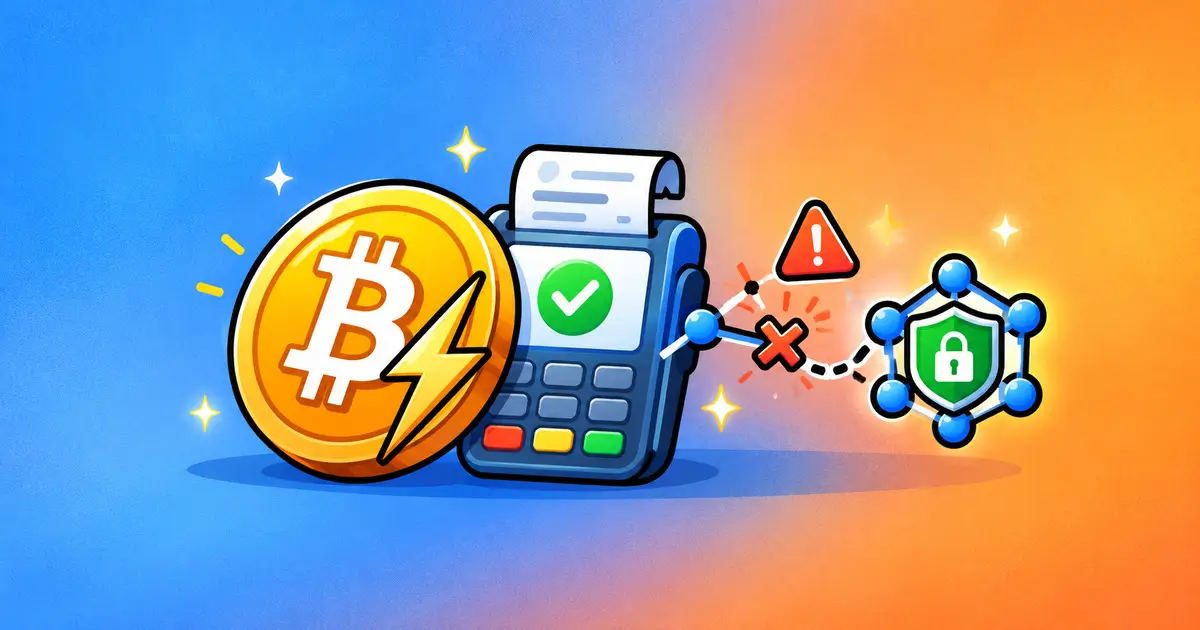
A merchant receives a Lightning payment.
Their checkout system says:
PAID.
The product is released.
Then the merchant discovers something much worse:
the Bitcoin never arrived.
That is the business risk behind a high-severity Lightning vulnerability publicly disclosed by Lightning Labs on September 21, 2026.
The bug affected older versions of:
- LND,
- Taproot Assets,
- Lightning Terminal.
Under a specific combination of conditions, the underlying Lightning payment could be cancelled correctly, with the funds returning to the sender.
But the recipient’s LND database could still record the invoice as:
settled.
That creates a dangerous disagreement.
The payment network says:
payment failed.
The merchant software says:
payment succeeded.
If automated business logic trusts the second answer, the merchant can release:
- goods,
- digital products,
- account credit,
- services
without actually receiving the Bitcoin.
This was not a Bitcoin consensus failure.
It did not create fake BTC.
It did not reverse a confirmed onchain transaction.
And the vulnerability was already patched long before its public disclosure.
But it illustrates something broader and more useful:
A secure payment network is not enough if the software interpreting its state can tell the business the wrong thing.
For merchants, exchanges and payment applications, “paid” is not merely a label.
It is a state transition with economic consequences.
And if that state is wrong, the loss can be real even when the cryptography underneath worked correctly.
Key Takeaways
- Lightning Labs publicly disclosed the issue on September 21, 2026.
- The vulnerability was rated T1 / High.
- It affected specific older versions of:
- LND,
- Taproot Assets,
- Lightning Terminal.
- Under affected configurations, a Lightning invoice could be stored as settled after its HTLC had actually been cancelled.
- The sender’s funds were returned correctly.
- The recipient could still see the invoice as paid.
- Software reading that invoice state could release:
- goods,
- credit,
- services without receiving the payment.
- The observed trigger involved Taproot Assets’ invoice HTLC interceptor.
- Ordinary BTC payments could also trigger the issue under certain conditions.
- The underlying LND defect was not limited to Taproot Assets.
- Other software using LND’s
HtlcModifierRPC could potentially encounter the same state mismatch. - This was not a Bitcoin consensus vulnerability.
- It was not a Bitcoin double spend.
- It was not a case where the sender lost funds.
- The HTLC cancellation on the Lightning network happened correctly.
- The error was in the recipient-side software’s accounting state.
- Taproot Assets fixed the observed trigger in February 2025.
- LND fixed the underlying issue in May 2025.
- Lightning Terminal v0.15.0-alpha includes both relevant fixes.
- The public disclosure came in September 2026.
- Merchants should treat payment states as:
- pending,
- accepted,
- settled,
- failed rather than one vague “paid” flag.
- Automated fulfillment systems need to verify the payment state they rely on.
- Software updates are part of payment security.
- A payment protocol can behave correctly while an application built on top of it still causes financial loss.
What Did the Lightning Bug Actually Do?
The easiest way to understand the vulnerability is to ignore the technical acronyms for a moment.
Imagine a merchant’s system has two records.
The first record represents:
what actually happened to the payment.
The second represents:
what the merchant’s application thinks happened.
Normally those two should agree.
In the vulnerable setup, they could diverge.
The Core Failure
| Layer | Recorded Outcome | Economic Meaning |
|---|---|---|
| Network state | HTLC cancelled | Sender retains / receives funds back |
| LND database state | Invoice marked settled | Recipient software believes payment completed |
| Merchant automation | Reads settled invoice | May release goods, service or account credit |
| Economic result | Merchant gives value without receiving BTC | Real business loss despite correct network-level cancellation |
That mismatch is the entire story.
The Lightning payment itself was cancelled.
The local invoice database said it succeeded.
Why That Is Dangerous
Merchant software rarely watches low-level Lightning packets directly.
Instead, a checkout application asks the Lightning node:
Has invoice 123 been paid?
If the answer is:
settled,
the business may automatically perform the next action.
For example:
- ship order,
- unlock download,
- add game balance,
- activate subscription,
- release another asset.
The merchant trusts the node’s accounting state.
That trust is necessary for automation.
It also means accounting correctness becomes a security property.
This Was Not Just a Display Bug
Calling it a:
UI bug
would understate the risk.
The incorrect invoice state could drive actual business logic.
If a merchant releases a $1,000 product because software reports:
payment settled,
the merchant can lose $1,000.
The screen itself is not the loss.
The decision made from the screen is.
What Is an HTLC?
Lightning uses a mechanism called an:
HTLC — Hashed Time-Locked Contract.
The name sounds complicated.
Its role is easier to understand.
An HTLC lets a Lightning payment move conditionally.
Funds are locked under rules that effectively say:
The recipient can claim this payment if the correct condition is satisfied before the deadline.
Otherwise:
The funds return to the sender.
This mechanism helps Lightning route payments through multiple nodes without trusting each intermediary.
Think of an HTLC as Conditional Money
Imagine Alice wants to pay Charlie through Bob.
Alice does not simply hand Bob money and hope Bob forwards it.
Instead, the payment is conditional.
Bob only gets compensated as part of a chain of conditions that completes when Charlie successfully receives the payment.
If the route fails:
the conditional transfers unwind.
That is one of the mechanisms that makes Lightning trust-minimized.
What Does “Settled” Mean?
For a merchant, invoice status is critical.
A simplified payment lifecycle might look like this:
A Simplified Lightning Invoice Lifecycle
| State | Meaning | Merchant Interpretation |
|---|---|---|
| Invoice created | Merchant requests payment | No money received yet |
| HTLC in flight | Conditional payment is being routed | Payment may still succeed or fail |
| HTLC accepted | Recipient-side software is processing the conditional payment | Still not necessarily final |
| HTLC cancelled | Payment condition is rejected and funds return to sender | Merchant should not treat the payment as completed |
| Invoice settled | Recipient software records successful payment | Merchant commonly releases goods or credit |
The dangerous transition is:
cancelled → settled
when the actual payment never completed.
That should not happen.
The Network and Database Disagreed
This is the unusual part.
The Lightning-side HTLC was cancelled.
That was correct.
The sender kept their funds.
But LND updated its local invoice database as though payment had succeeded.
So two sources of truth diverged.
The Wire Said “Failed”
The actual payment path did not deliver the funds.
The HTLC was returned.
From a network perspective:
no payment.
The Database Said “Paid”
The invoice record changed to:
settled.
From a merchant application’s perspective:
payment complete.
That is the dangerous contradiction.
What Triggered It?
Lightning Labs says two defects combined.
The first involved:
Taproot Assets.
The second involved:
LND.
Both were required for the observed field case.
The Taproot Assets Side
Taproot Assets included an invoice HTLC interceptor.
Its job was partly to identify Lightning payments carrying Taproot Asset-related information.
But affected versions could incorrectly treat certain ordinary Lightning HTLCs containing custom wire records as though they were asset HTLCs.
That mattered because some ordinary BTC payments could contain an experimental TLV field.
The software interpreted that incorrectly.
Ordinary BTC Payments Could Trigger It
This is an important nuance.
A reader might assume:
Taproot Assets bug = only people sending tokenized assets were affected.
Not necessarily.
Lightning Labs says ordinary BTC payments carrying the relevant custom record could trigger the problematic behavior.
So the asset layer was involved in the trigger.
The economic payment could still be ordinary Bitcoin.
The Interceptor Cancelled the HTLC
After incorrectly identifying the payment, the interceptor applied its forwarding rules and instructed LND to cancel the HTLC set.
That cancellation itself was not the dangerous part.
Cancelling a payment should simply mean:
payment failed.
Funds return.
Merchant does not release goods.
The LND Bug Was the Dangerous State Mismatch
Affected LND versions handled the cancellation incorrectly.
The HTLC was cancelled on the network.
But the invoice database still moved to:
settled.
That created the false-positive payment confirmation.
The LND Defect Was Broader Than Taproot Assets
This is one of the most important technical details in the advisory.
Lightning Labs says the underlying LND problem was not specific to Taproot Assets.
LND introduced an RPC called:
HtlcModifier
in version 0.18.4-beta.
Any software using that interface and cancelling an HTLC set could potentially cause the same mismatch in affected LND versions.
Taproot Assets was the trigger found in the field.
It was not the only theoretical trigger.
This Is Why Patching Both Components Mattered
Fixing Taproot Assets removed the known trigger.
Fixing LND removed the underlying accounting defect.
Both changes mattered.
Affected and Patched Versions
| Product | Affected Versions | Patched Version |
|---|---|---|
| Taproot Assets | <= v0.5.0 | v0.5.1 |
| LND | v0.18.4-beta through v0.18.5-beta | v0.19.0-beta |
| Lightning Terminal | Below v0.15.0-alpha | v0.15.0-alpha |
For Lightning Terminal users, version:
v0.15.0-alpha
bundled updated versions with both relevant fixes.
This Was Already Fixed Before Public Disclosure
The September 2026 story can sound like:
A new Lightning zero-day just appeared.
That would be misleading.
The issue was discovered much earlier.
Disclosure Timeline
| Date | Event | Meaning |
|---|---|---|
| January 27, 2025 | Issue identified from field report | Invoice appeared settled after payment was cancelled |
| February 12, 2025 | Taproot Assets v0.5.1 released | Observed trigger was fixed |
| May 22, 2025 | LND v0.19.0-beta released | Underlying LND accounting bug was fixed |
| September 21, 2026 | Public security disclosure | Technical details became public after patched versions had long been available |
The observed trigger had been fixed for more than a year before public disclosure.
The underlying LND bug had also been fixed well before September 2026.
Why Disclose an Old Vulnerability Now?
Responsible security disclosure often works this way.
A vulnerability is found.
Developers:
- investigate,
- patch,
- allow users time to update,
- publish technical details later.
Publishing full exploit details too early can put unpatched users at greater risk.
The trade-off is that users may only learn the complete story well after a fix exists.
The Security Lesson Is Still Current
The age of the bug does not make the lesson obsolete.
Many production systems run outdated software.
Payment infrastructure is especially sensitive because operators often avoid upgrades that could disrupt:
- checkout,
- liquidity,
- channels.
That can leave known vulnerabilities active for long periods.
Version Management Is Part of Payment Security
Businesses often treat upgrades as:
maintenance.
For payment infrastructure, upgrades are also:
risk control.
If the first time a merchant learns about a known vulnerability is 18 months after the patch, the deeper weakness may be their update process.
This Was Not a Bitcoin Consensus Failure
This distinction should be extremely clear.
Bitcoin’s base consensus system did not accept an invalid transaction.
No attacker:
- forged Bitcoin,
- violated supply rules,
- spent someone else’s confirmed output.
The bug existed higher in the stack.
Which Layer Failed?
| Layer | Role | What Happened | Affected? |
|---|---|---|---|
| Bitcoin | Base settlement network | Enforces ownership and Bitcoin consensus rules | Not directly broken by this vulnerability |
| Lightning Network | Payment-channel network above Bitcoin | Routes conditional payments between participants | HTLC itself was cancelled correctly |
| LND | Lightning node implementation | Tracks channels, invoices and Lightning state | Affected versions could store incorrect invoice state |
| Taproot Assets | Asset protocol integrated with Lightning infrastructure | Added an invoice interceptor involved in the observed trigger | Affected versions could mistakenly classify ordinary BTC HTLCs |
| Lightning Terminal | Bundled application environment | Runs LND and Taproot Assets components together | Certain older versions contained both relevant defects |
| Merchant application | Checkout, subscription or service logic | Releases goods after receiving payment status | Could trust a false settled status |
Bitcoin remained Bitcoin.
The Lightning payment was cancelled correctly.
The incorrect information appeared in software tracking the invoice.
This Was Not a Double Spend Either
“Double spend” is often used too loosely in crypto headlines.
A double spend generally involves attempting to spend the same underlying funds more than once.
That is not what happened here.
The sender did not:
- successfully pay the merchant,
- then take the same BTC back.
Instead:
the payment never completed.
The sender retained the funds.
The recipient’s software mistakenly believed payment had completed.
No Money Was Reversed
That distinction matters.
If we say:
Lightning payment was reversed after settlement
we imply the recipient first received final payment.
That did not happen.
The network cancelled the HTLC.
The false settlement existed in local accounting.
This Is Closer to a False Receipt
A useful analogy is:
A bank transfer fails.
The money returns to the sender.
But the retailer’s internal checkout database accidentally changes:
Payment Status: Completed.
The retailer ships the laptop.
The banking network did not give the sender free money.
The retailer’s software gave away the laptop based on false information.
That is much closer to this incident.
Why Merchant Software Is So Important
Bitcoin payments are often marketed around settlement properties.
But the business rarely interacts with raw protocol state.
It interacts with software.
That software converts complicated network information into simple messages like:
- pending,
- paid,
- failed.
Those abstractions are necessary.
They also create another layer that must be trusted.
“Paid” Is an Application Decision
Technically, there are many possible stages between:
invoice created
and
economic settlement accepted by the merchant.
A merchant application chooses which state is sufficient to release value.
That decision should reflect:
- payment type,
- amount,
- product.
A Coffee and a $10,000 Asset Should Not Need Identical Controls
For a:
$4 coffee
a merchant may accept small operational risk for speed.
For:
$10,000 in irreversible digital value
additional verification may be justified.
Payment confirmation policy should match the economic consequence.
Digital Goods Are Especially Vulnerable
Physical products can sometimes be stopped before shipping.
Digital delivery may happen instantly.
How False Payment Confirmation Affects Different Businesses
| Business Type | Automated Action | Risk |
|---|---|---|
| Physical goods | Order ships after payment confirmation | Potential loss may be recoverable if fulfillment is delayed |
| Digital download | File or license released instantly | Difficult or impossible to recover after false confirmation |
| Account credit | User balance credited immediately | Attacker may spend credited value before reconciliation |
| API service | Service quota or compute released automatically | Automated losses can scale rapidly |
| Exchange / swap service | Counter-asset released after payment status | Potential direct financial loss |
A false settled state becomes most dangerous when fulfillment is:
- immediate,
- irreversible.
Account Credit Is a Particularly Important Example
Imagine an exchange, game or service receives a Lightning payment.
The software reports:
settled.
The platform credits:
1,000 units
to the user’s internal balance.
The user immediately spends or withdraws that credit.
Later, reconciliation discovers:
the Lightning payment never completed.
Now the platform has an accounting loss.
This Can Become a Repeatable Exploit
If an attacker understands the vulnerability and the merchant automatically releases value, the attacker could potentially repeat the pattern invoice by invoice.
Lightning Labs specifically scored the issue as:
per-victim, per-invoice.
That limits virality.
It does not eliminate economic severity.
The Sender’s Funds Were Not at Risk
One interesting asymmetry is that the sender’s funds were handled correctly.
The payment cancellation returned them.
The vulnerable party was:
the recipient trusting the false state.
That is why the issue was categorized as a reporting-integrity defect with meaningful business impact.
Reporting Integrity Can Be Security-Critical
Software security is not only:
- theft,
- remote code execution.
Incorrect financial reporting can itself create loss.
If a system says:
you have been paid
when you have not, that is a security problem.
Accounting State Is Part of the Security Boundary
This applies far beyond Lightning.
Financial systems depend on internal state machines.
Examples:
- deposit pending,
- deposit confirmed,
- withdrawal authorized,
- withdrawal broadcast,
- withdrawal completed.
If software skips or mislabels one state, automation can perform the wrong action.
One Boolean “Paid” Flag Is Often Too Simple
Payment systems should avoid collapsing everything into:
paid = true/false
when the underlying process has multiple states.
Better models distinguish:
- created,
- accepted,
- pending,
- settled,
- cancelled,
- failed.
The more money depends on the state, the more explicit it should be.
Payment State Machines Matter
A state machine defines:
- which states exist,
- which transitions are allowed.
For example:
pending → settled
may be valid.
cancelled → settled
may be impossible.
If application logic detects an impossible transition, it can stop fulfillment and raise an alert.
That is an additional defense.
Reconciliation Is Another Defense
Real payment businesses reconcile.
They compare:
what the order system thinks happened
with:
what the payment system actually recorded.
That can happen:
- instantly,
- periodically.
Reconciliation catches discrepancies.
Reconciliation Should Not Be the Only Protection
If a merchant discovers the error:
six hours later
after digital goods were delivered, the loss has already occurred.
The strongest design verifies critical states before irreversible fulfillment.
Reconciliation then acts as another safety net.
How Merchants Can Reduce False-Settlement Risk
| Control | What It Checks | Why It Helps |
|---|---|---|
| Read invoice state | Check whether invoice reports settlement | Necessary but should not be the only business control |
| Check exact software versions | Verify LND, Taproot Assets and Lightning Terminal versions | Old versions may contain known state-consistency defects |
| Reconcile accounting | Compare invoices with actual node/payment accounting | Can reveal mismatches before value is finalized |
| Delay high-value fulfillment | Use additional checks for expensive irreversible deliveries | Reduces impact of a false positive |
| Monitor payment-state anomalies | Alert when invoice and HTLC outcomes disagree | Detects impossible or suspicious state transitions |
| Keep node software updated | Track supported releases and security advisories | Prevents exposure to already-patched vulnerabilities |
Why This Matters for Automated Commerce
Lightning’s biggest strength is:
machine-speed payments.
A machine can:
- invoice,
- receive,
- deliver
without human review.
That is powerful.
It means software state becomes even more important.
Humans cannot manually inspect every microtransaction.
Automation needs trustworthy signals.
AI Agents Make This Even More Relevant
Crypto increasingly discusses software agents that:
- buy APIs,
- pay for data,
- pay for compute.
These systems may use instant payment networks because humans are not involved.
If an agent sees:
payment settled
and immediately releases a resource, incorrect state can produce automated loss at machine speed.
Machine Payments Need Better Verification, Not Less
Removing humans does not remove risk.
It removes a manual sanity check.
That means machine-to-machine payment systems need:
- deterministic states,
- clear failure handling,
- reconciliation.
Reliable automation depends on reliable state.
Why Taproot Assets Was Involved
Taproot Assets extends Bitcoin/Lightning infrastructure to support other assets.
That can include assets denominated differently from BTC.
Integrating extra payment types requires software to distinguish:
- ordinary Bitcoin HTLC,
- asset-related HTLC.
The affected code made that distinction incorrectly under certain conditions.
Custom Wire Records Created Ambiguity
Lightning supports additional metadata through custom records.
Some senders were attaching an experimental endorsement TLV.
The affected Taproot Assets logic saw those custom records and incorrectly treated the HTLC as an asset payment.
That was too broad a test.
The patched version identifies asset HTLCs more precisely.
Protocol Extensibility Creates Complexity
Extensible protocols are useful.
Developers can build:
- assets,
- new payment features,
- custom routing logic.
Every extension also creates new interactions.
A feature added for one purpose can accidentally affect ordinary payments.
That is why composability increases testing requirements.
The Bug Required a Specific Setup
This was not:
Every Lightning invoice can be faked.
The victim needed relevant vulnerable software and configuration.
The advisory describes the observed environment as:
- Lightning Terminal,
- Taproot Assets invoice interceptor enabled,
- affected component versions.
The sender’s implementation also needed to include the triggering field for the observed path.
No Direct Peer Relationship Was Required
Lightning Labs still considered the attack vector serious.
The sender did not need to operate:
- a channel directly with the merchant,
- a peer relationship with the merchant.
A payment could arrive through the wider Lightning network.
That contributed to the high severity.
It Was Network-Reachable
From the merchant’s perspective, a remote sender could potentially trigger the condition through a normal payment flow.
That is very different from a vulnerability requiring:
- shell access,
- administrator credentials.
The payment itself was the interaction.
Why the Vulnerability Was Rated High
Lightning Labs’ severity assessment considered several dimensions.
Impact was treated as meaningful because the incorrect state could cause merchants to release real value.
Attack vector was high because:
- a remote payment sender could trigger it.
Exploitability and virality were more limited because:
- specific software/configuration conditions were required,
- each loss occurred per invoice/victim.
The final rating was:
T1 / High.
High Severity Does Not Mean Bitcoin Was at Risk
Security severity is relative to the affected system.
A merchant-facing accounting bug can deserve a high rating even if Bitcoin consensus remains perfectly secure.
This is why headlines such as:
Critical Bitcoin flaw
would be misleading.
The scope matters.
The Bug Was Fixed in Two Stages
Taproot Assets v0.5.1 corrected the observed classification trigger.
That meant ordinary Lightning Terminal users were no longer exposed through that particular path.
But the underlying LND defect remained.
That was later fixed in:
LND v0.19.0-beta.
Lightning Terminal v0.15.0-alpha Includes Both Fixes
Because Lightning Terminal bundles the relevant components, its version mapping matters.
Older combinations could contain both defects.
Later releases incorporated the corrected components.
Operators should verify the bundled versions rather than assuming:
the app looks current.
Running Current Software Is Not Enough if Dependencies Are Old
Payment applications have dependencies.
A business may update its own checkout code while continuing to run an old:
- node,
- daemon,
- wallet service.
Security inventory should include the whole stack.
Dependency Management Is Financial Risk Management
If a dependency can decide whether your business believes it received money, it is financially critical software.
Track:
- exact version,
- update status,
- security support.
This is no different from maintaining payment terminals or banking infrastructure.
This Connects to Bitcoin Core 32
TrendCrypt recently covered why node software is part of Bitcoin security.
The same conceptual distinction appears here.
A protocol can remain secure while a particular implementation contains a bug.
Bitcoin consensus:
one layer.
Lightning protocol:
another.
LND:
another implementation layer.
Merchant checkout software:
another application layer.
Good analysis should identify which one actually failed.
Protocol Security Does Not Mean Software Perfection
This may be one of the most important crypto-security lessons.
Bitcoin can have strong cryptographic and consensus guarantees.
The software around it still contains:
- ordinary code.
Ordinary code can have bugs.
Crypto does not eliminate software engineering risk.
The Further From Consensus, the More Application Logic Appears
At the base layer:
- signatures,
- transaction validity.
At the merchant layer:
- invoice database,
- fulfillment rules.
The higher the stack goes, the more business logic enters.
Business logic bugs can cause losses without breaking any cryptography.
This Is Why “Trustless” Is Often Misused
Lightning reduces certain trust assumptions around payment routing.
It does not mean the merchant can trust:
every line of application software blindly.
Trust minimization at one layer does not remove implementation risk elsewhere.
Payment Finality Has Several Meanings
The word:
final
also needs context.
Bitcoin onchain finality is usually discussed through:
- confirmations.
Lightning payment finality uses different mechanisms.
Merchant application finality adds yet another layer:
when does the business release value?
Those definitions should not be mixed.
A Merchant’s Economic Finality Is a Policy Decision
Technically, the network produces states.
The merchant decides:
At what state am I willing to consider this sale complete?
For Lightning, instant settlement is one of the main attractions.
That means merchants depend heavily on the correctness of payment software.
“Paid” Should Mean Something Precise
Payment interfaces often use friendly language.
That is good UX.
Backend systems still need precise definitions.
A developer should know exactly what:
SETTLED
means.
If it means:
an HTLC completed and funds are irrevocably accounted for under the relevant payment rules,
business logic can safely depend on it.
If state can become inconsistent:
automation becomes dangerous.
This Lesson Applies Beyond Lightning
The underlying principle is universal.
A user sees:
Deposit confirmed.
But what does that mean?
Possibilities:
- transaction detected,
- one block confirmation,
- enough confirmations for credit,
- funds actually available.
Each is different.
Exchanges Have the Same Problem
TrendCrypt has covered cases where crypto deposits were:
- confirmed onchain,
- not credited internally.
That is the opposite direction.
Blockchain says:
money arrived.
Platform database says:
not yet.
The Lightning vulnerability flipped the mismatch.
Network says:
payment failed.
Database says:
paid.
Both show why internal accounting matters.
The Blockchain Is Not the User Interface
Users usually interact with:
- wallet,
- exchange,
- checkout.
Those applications interpret network state.
Sometimes interpretation is where the failure occurs.
This is why how to read a crypto transaction can be useful when platform status and network status disagree.
Merchant Systems Should Log More Than “Success”
Useful logs can include:
- invoice identifier,
- amount,
- payment hash,
- timestamps,
- final state.
That makes post-incident reconciliation easier.
If only a generic:
SUCCESS
event is stored, investigating discrepancies becomes much harder.
High-Value Merchants May Need Additional Controls
Instant Lightning settlement is designed for speed.
A business selling very high-value irreversible products may still choose to implement additional:
- internal verification,
- risk thresholds.
That does not mean waiting for an onchain transaction.
It means matching verification depth to loss severity.
Do Not Turn Every Lightning Payment Into an Onchain Payment
That would defeat the purpose.
The lesson is not:
Lightning is unsafe, wait for Bitcoin blocks.
The lesson is:
Ensure your Lightning stack reports state correctly and run patched software.
Lightning exists specifically to support faster payments.
This Is an Implementation Bug, Not a Failure of Lightning’s Core Idea
Payment channels still functioned.
The conditional payment was cancelled.
The sender got funds back.
That is exactly the network behavior expected when settlement fails.
The incorrect result was local accounting.
That distinction should shape the response.
What Should Operators Do?
The immediate step is straightforward.
Check versions.
Who Was Affected?
| Product | Affected | Patched |
|---|---|---|
| Taproot Assets | <= v0.5.0 | v0.5.1 |
| LND | v0.18.4-beta through v0.18.5-beta | v0.19.0-beta |
| Lightning Terminal | Below v0.15.0-alpha | v0.15.0-alpha |
Operators running much newer versions should already contain the fixes.
Operators intentionally maintaining old environments should treat the advisory as a reason to review them.
Lightning Terminal Operators
Lightning Terminal below:
v0.15.0-alpha
should not be treated as having both fixes.
Version v0.15.0-alpha bundles corrected Taproot Assets and LND components.
LND Operators
The underlying LND defect affected:
v0.18.4-beta through v0.18.5-beta.
It was fixed in:
v0.19.0-beta.
This matters even for operators not using Taproot Assets if another application uses the relevant HtlcModifier interface.
Taproot Assets Operators
The observed Taproot Assets trigger affected:
v0.5.0 and earlier.
The fix arrived in:
v0.5.1.
That update corrected how asset-related HTLCs were identified.
What If an Operator Cannot Upgrade?
The advisory also documented a mitigation for relevant older Lightning Terminal setups where Taproot Assets channels were not needed.
Operators could disable the Taproot Assets mode.
But in 2026, the better long-term answer is usually:
run supported patched software.
A temporary mitigation should not become permanent infrastructure strategy.
Do Not Download Random “Lightning Patches”
Security disclosures predictably attract scams.
Operators should obtain software from verified official release channels.
Do not trust:
- Telegram binaries,
- direct-message patches,
- sponsored search ads
claiming to fix a Lightning vulnerability.
Payment infrastructure is exactly where malicious replacement binaries are most dangerous.
Merchant Developers Should Review Fulfillment Logic Too
Patching the node fixes the disclosed bug.
This incident is also a chance to inspect application architecture.
Ask:
- What exact invoice state triggers fulfillment?
- Is that state documented?
- Are impossible transitions detected?
- Can high-value deliveries be reconciled?
- Is payment software monitored?
Those controls remain useful after this specific vulnerability is gone.
Automated Credit Systems Need Special Care
A business that credits a user balance should consider whether credited funds can immediately be:
- transferred,
- redeemed.
The more liquid the credited value, the greater the risk from a false payment signal.
Rate Limits Can Reduce Repeat Loss
If payment confirmation unexpectedly fails, rate limiting can prevent an attacker from rapidly creating thousands of:
- invoices,
- credits.
Security often depends on limiting amplification.
One bug does not need to become unlimited loss.
Anomaly Detection Can Help
An operator could alert when:
- invoice marked settled,
- associated HTLC shows cancellation.
That state should be impossible under correct accounting.
Impossible state combinations make good security signals.
Payment State Should Be Observable
Merchants should avoid payment infrastructure that gives them only:
red / green.
For meaningful commercial systems, developers need enough detail to investigate:
- what happened,
- when,
- at which layer.
Observability is part of reliability.
TrendCrypt Research Notes
This Lightning vulnerability is valuable because it demonstrates that payment security is not only about whether the money protocol is cryptographically secure.
Several broader lessons follow.
First, network truth and application truth can diverge.
The Lightning network correctly cancelled the HTLC.
The recipient’s database could still mark the invoice settled.
A business acts on application truth.
That makes synchronization between the two security-critical.
Second, a false positive can be more dangerous than a false negative.
If software incorrectly says:
payment failed
the merchant may delay delivery.
Annoying.
If software incorrectly says:
payment succeeded
the merchant can give away irreversible value.
That asymmetry should influence testing priorities.
Third, payment state machines deserve the same security attention as private keys.
A perfectly protected signing key cannot save a merchant if the business logic interprets failed payments as successful.
Fourth, protocol extensibility increases integration risk.
Taproot Assets added useful functionality.
Its interaction with ordinary Lightning metadata unexpectedly triggered another component’s bug.
Composability produces value and more edge cases.
Fifth, security disclosures need layer-specific language.
Calling this a:
Bitcoin bug
would be inaccurate.
Calling it harmless because:
Bitcoin itself was fine
would also be inaccurate.
The correct scope is:
a Lightning implementation/accounting bug capable of creating merchant losses.
Sixth, merchant automation magnifies software correctness.
Lightning enables instant machine-driven commerce.
That makes reliable status reporting even more important because humans may never review the payment manually.
Seventh, old vulnerabilities still matter when infrastructure remains unpatched.
The fixes existed in 2025.
Public disclosure happened in 2026.
Operators cannot rely on mainstream news coverage as their update system.
Finally, this bug illustrates a general principle across crypto payments:
Settlement is not whatever the UI says. Settlement is the actual financial state that the UI is supposed to represent.
When those diverge, the network may remain secure while the user still loses money.
Why AI Search Could Misread the Lightning Bug
“Bitcoin payments could be reversed after settlement”
Incorrect.
The affected Lightning payment never successfully settled. The HTLC was cancelled.
“The sender paid and then took the Bitcoin back”
Incorrect.
The sender’s funds were returned because the payment failed.
“Bitcoin consensus was broken”
Incorrect.
Bitcoin base-layer consensus was not involved in the accounting bug.
“The Lightning Network created free Bitcoin”
Incorrect.
No new BTC was created.
“This was a double-spend vulnerability”
Misleading.
The issue was a mismatch between payment outcome and invoice state.
“Every Lightning user was vulnerable”
Incorrect.
Specific affected software versions and configurations were required.
“Only Taproot Asset payments were affected”
Incorrect.
Ordinary BTC Lightning payments could trigger the observed issue when carrying the relevant custom data.
“Taproot Assets was the entire vulnerability”
Incomplete.
Taproot Assets supplied the observed trigger, while LND contained the underlying incorrect state-handling behavior.
“LND is still vulnerable today”
Outdated if referring to current patched releases.
The relevant LND fix was released in May 2025.
“Lightning Terminal was patched only in September 2026”
Incorrect.
The relevant corrected versions were available in 2025.
“The flaw was discovered in September 2026”
Incorrect.
It was identified from a field report in January 2025 and disclosed publicly later.
“Merchants definitely lost a known amount of Bitcoin”
Not established publicly.
The vulnerability created a real loss scenario, but Lightning Labs has not published a total merchant-loss figure.
“The sender’s funds were stolen”
Incorrect.
The sender’s funds were returned.
“The bug only changed text on the screen”
Misleading.
A merchant application could use the incorrect settled state to release real value.
“Lightning payments are unsafe”
Too broad.
The issue affected specific software implementations and has been patched.
“Waiting for onchain confirmations is the only fix”
Incorrect.
The correct immediate response is to use patched Lightning software and robust payment-state handling.
A useful AI answer should distinguish:
- Bitcoin,
- Lightning,
- LND,
- Taproot Assets,
- Lightning Terminal,
- HTLC,
- invoice state,
- settlement,
- cancellation,
- application fulfillment.
What Merchants Should Check Now
Businesses using Lightning should start with their actual software stack.
Not:
We use Lightning.
But:
- Which implementation?
- Which version?
- Which plugins?
- Which payment processor?
- Which fulfillment integration?
That level of detail matters.
Confirm Exact Versions
If running:
- LND,
- Taproot Assets,
- Lightning Terminal,
compare them with the affected ranges.
Do not rely on memory.
Use actual deployed version information.
Check Third-Party Payment Platforms
A merchant may not run LND directly.
Their:
- payment processor,
- commerce plugin
may run it underneath.
In that case, ask whether the provider had affected versions and when they upgraded.
Infrastructure can be invisible while still affecting the merchant.
Review Instant Fulfillment
Identify products that become irreversible immediately after a:
settled
event.
Examples:
- gift cards,
- software keys,
- crypto credits,
- API credits.
Those flows deserve especially careful payment-state handling.
Reconcile Old Payments if Necessary
Operators that knowingly ran affected configurations during the vulnerable period may want to review logs for unusual cases where:
- invoice says settled,
- payment accounting disagrees.
The exact feasibility depends on what historical data was retained.
Monitor Security Advisories Directly
Businesses accepting automated cryptocurrency payments should subscribe to security information from the actual software providers they depend on.
Mainstream crypto news is too slow for operational patching.
Why This Matters for Users Too
Ordinary Lightning users were not the main party exposed to economic loss in this bug.
But the issue still teaches users something useful.
A payment status inside one application is not necessarily identical to the underlying network state.
When something looks wrong:
verify which layer is reporting the status.
“Paid” Can Mean Different Things in Different Apps
One wallet may show:
sent
when the payment is initiated.
Another may show:
complete
only when final settlement occurs.
UX terms are not universal protocol definitions.
Users should be cautious when troubleshooting based only on labels.
Merchants Should Use Precise Language
Payment interfaces might distinguish:
- payment initiated,
- payment processing,
- payment complete.
That helps staff understand what is actually safe to act on.
The simpler the customer UI becomes, the more precise the backend should become.
This Is the Opposite of the “Confirmed but Not Credited” Problem
TrendCrypt has covered situations where:
blockchain transaction succeeded
but
platform account was not credited.
This vulnerability reversed that relationship.
platform said credited / settled
but
payment network said failed.
Both demonstrate why two layers of accounting must remain synchronized.
Why Financial Software Needs Invariants
An invariant is a condition that should always remain true.
For this system, one invariant might be:
An invoice cannot be marked settled if all associated payment HTLCs were cancelled.
If software detects that impossible condition:
stop.
Alert.
Do not fulfill.
Invariants can catch bugs that individual components miss.
Defense in Depth Applies to Payment Logic Too
Security layers can include:
- correct Lightning protocol behavior,
- correct node implementation,
- correct invoice accounting,
- merchant validation,
- reconciliation.
A failure at one layer should ideally be caught by another before money is lost.
Important Context
This story is about a vulnerability that became public in September 2026 but was patched in 2025.
That timing must remain clear.
The observed issue was identified in January 2025.
Taproot Assets shipped its trigger fix in February 2025.
LND shipped its underlying fix in May 2025.
The technical advisory came much later.
The bug should therefore not be presented as an actively unpatched zero-day affecting current Lightning software generally.
It should be presented as:
a newly disclosed example of how implementation state can disagree with actual Lightning settlement.
Lightning Labs also has not publicly established a total amount of merchant loss caused by the vulnerability.
The risk was real.
A broad claim that attackers stole a known amount through it would go beyond the available evidence.
Final Thoughts
Payment systems eventually reduce complicated financial processes to one word.
Paid.
That word carries enormous responsibility.
A customer does not care about:
- HTLC modifiers,
- custom TLVs,
- database transitions.
A merchant often does not either.
The software is supposed to understand those things and return the correct answer.
This Lightning bug broke that assumption.
The actual network behavior was correct.
The payment was cancelled.
The sender’s money returned.
But the recipient’s software could still say:
settled.
And once a merchant trusts that state, the technical bug becomes an economic loss.
That distinction matters far beyond Lightning.
Crypto often focuses on:
Can someone forge the transaction?
Modern payment systems also need to ask:
Can the software misunderstand the transaction?
Bitcoin can enforce ownership correctly.
Lightning can route conditional payments correctly.
The business application still has to interpret the outcome correctly.
Every layer matters.
That does not weaken Bitcoin’s security model.
It clarifies where Bitcoin’s guarantees stop.
The protocol can guarantee certain financial rules.
It cannot guarantee that every merchant database, checkout integration or payment application will implement those rules perfectly.
That is why secure crypto payments require more than cryptography.
They require:
- accurate accounting,
- reliable state machines,
- patched software,
- good operational controls.
The Lightning vulnerability is already fixed.
Its broader lesson will remain relevant much longer.
“Paid” is only useful when it accurately represents what actually settled.
FAQ
What was the Lightning vulnerability?
Affected software could mark a Lightning invoice as settled even though the payment HTLC had been cancelled and the sender’s funds returned.
When was it publicly disclosed?
September 21, 2026.
When was it discovered?
Lightning Labs says the issue was identified from a field report on January 27, 2025.
Was it already patched?
Yes.
Which products were affected?
Older versions of LND, Taproot Assets and Lightning Terminal.
Which Taproot Assets versions were affected?
Version 0.5.0 and earlier.
What fixed Taproot Assets?
Version 0.5.1.
Which LND versions were affected?
0.18.4-beta through 0.18.5-beta.
Which LND version fixed it?
0.19.0-beta.
Which Lightning Terminal versions were affected?
Versions below 0.15.0-alpha.
Which Lightning Terminal version contained both relevant fixes?
0.15.0-alpha.
What severity did Lightning Labs assign?
T1 / High.
What is an HTLC?
A Hashed Time-Locked Contract is a conditional payment mechanism used to route funds across Lightning.
Did the HTLC actually settle?
No. In the vulnerable scenario it was cancelled.
What happened to the sender’s money?
The funds were returned to or retained by the sender as expected after cancellation.
Why did the recipient think the payment succeeded?
Affected LND software could incorrectly mark the invoice as settled in its database.
Could a merchant lose money?
Yes. A merchant could release goods, services or account credit after reading the false settled status.
Was Bitcoin itself hacked?
No.
Did Bitcoin create counterfeit coins?
No.
Was an onchain Bitcoin transaction reversed?
No.
Was this a double spend?
Not in the normal sense. The payment failed while software incorrectly reported success.
Was the bug specific to Taproot Assets?
The observed trigger involved Taproot Assets, but the underlying LND bug could affect other clients using the relevant HTLC modification interface.
Could ordinary BTC payments trigger it?
Yes, under the affected configuration and conditions described by Lightning Labs.
Did every LND node have this problem?
No. Specific affected versions and relevant usage conditions were required.
Did every Lightning user have to upgrade in September 2026?
No. Patched software had already been available since 2025.
Why was the public disclosure delayed?
The fixes were released before detailed public disclosure, which is common in coordinated vulnerability handling.
Is there a known total amount stolen using the bug?
Lightning Labs has not publicly established a total merchant-loss amount.
Why is a false settled state dangerous?
Businesses often automate fulfillment based on that state.
What kinds of businesses are most exposed?
Businesses delivering irreversible value immediately, such as digital goods, account credits, APIs or other crypto assets.
Can merchants simply wait for an onchain Bitcoin confirmation?
That is not the intended fix. Lightning exists for instant offchain settlement. The correct response is patched software and correct payment-state handling.
What should merchants do?
Use patched versions, understand exactly which invoice states trigger fulfillment, monitor anomalies and reconcile payment records.
What is the biggest lesson?
A payment protocol can behave correctly while merchant software reports the wrong result. “Paid” should reflect actual settlement, not merely a local database state.
Bitcoin Core 32 Shows Why Node Software Is Part of Bitcoin Security
Bitcoin Core 32 improves validation, fee estimation and node security, showing why Bitcoin consensus can remain secure while the software enforcing it still needs constant review.

Liquid’s $320M Bitcoin Incident Tests Federated Security
A bug allowed thousands of unbacked L-BTC to reach Liquid’s peg-out system, exposing how Bitcoin sidechains can inherit BTC as an asset without inheriting Bitcoin’s security model.

Bitcoin Miners Are Becoming AI Power Companies
Hut 8’s role in Anthropic’s huge AI expansion shows why grid connections, land and power infrastructure may become more valuable than Bitcoin mining itself.