TrendCrypt Guide
Fake Crypto Tokens and Airdrops: Warning Signs
Learn how fake crypto tokens and airdrops use copied names, suspicious wallet deposits, malicious claim pages, unsafe approvals, and fake rewards to target wallet users.
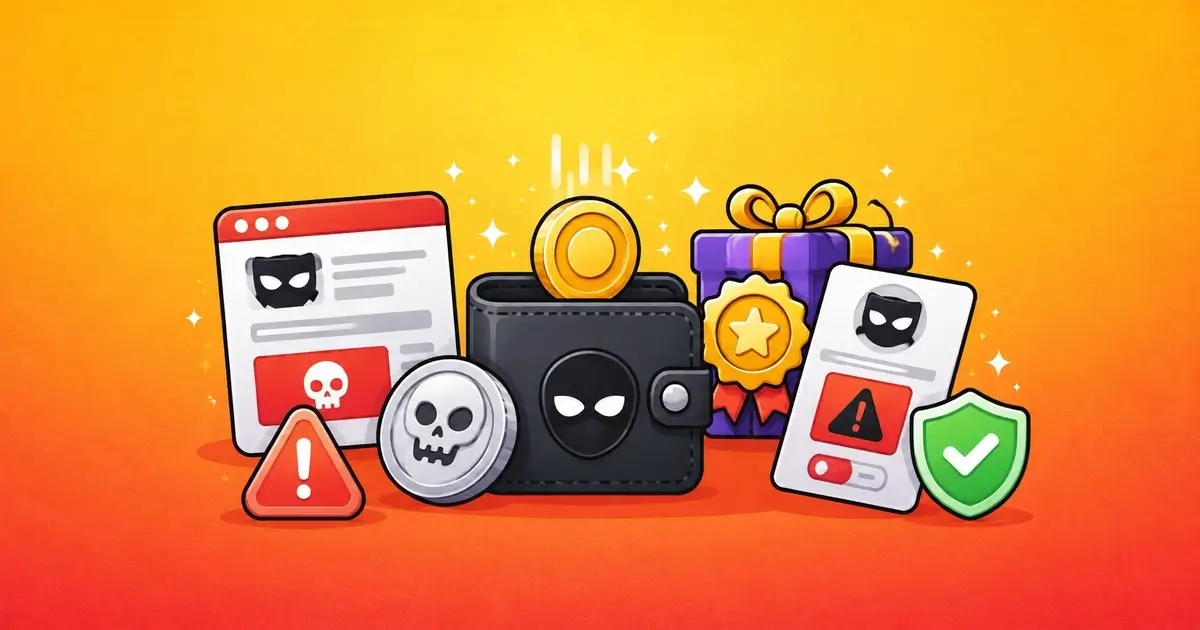
Fake tokens and fake airdrops are designed to get attention.
A token may suddenly appear in your wallet. It may use a familiar name, copied logo, popular ticker, fake reward message, or a website link inside the token name. It may look like free money, a bonus, a refund, a whitelist reward, a casino promo, or an official project airdrop.
The token itself may be worthless.
The real danger is usually what it wants you to do next.
Visit a claim page. Connect a wallet. Sign a message. Approve a contract. Pay a fee. Swap through an unsafe site. Enter a seed phrase. Share account details.
This guide explains how fake crypto tokens and airdrops work, how copied token names mislead users, what to check before interacting, and why unexpected wallet deposits should be treated carefully.
Related safety pages include Scams & Warnings, Wallet Safety, How to Verify a Token Contract, Crypto Wallet Drainers Explained, and Editorial Policy.
Key Takeaways
- Fake tokens can copy real names, symbols, logos, and project branding
- Unexpected airdrops may be used to push users toward phishing or wallet-drainer sites
- A wallet showing a token balance does not prove the token has real value
- Token names and symbols are not enough; check the contract address and network
- Do not click URLs shown inside token names, metadata, comments, or wallet activity
- Do not connect your main wallet to unknown claim pages
- Gas-free signatures and “free” claims can still be risky
- No real airdrop needs your seed phrase, private key, wallet password, or authentication code
What Are Fake Crypto Tokens?
A fake crypto token is a token made to look like something it is not.
It may copy:
- a real project name
- a stablecoin ticker
- a meme coin symbol
- a casino or exchange brand
- a gaming project
- an NFT collection
- a bridge token
- an airdrop campaign
- a reward or refund message
A fake token can appear in a wallet even if the user did nothing.
That does not mean the wallet was hacked.
Public wallet addresses can receive tokens from anyone.
The risk starts when the user interacts with the token, visits a linked site, approves a contract, or signs a request.
Common Fake Token and Airdrop Patterns
Fake tokens can appear in several forms.
Fake Token and Airdrop Patterns
| Pattern | How It Works | What to Check |
|---|---|---|
| Copied token name | A token uses the name of a real project, stablecoin, meme coin, or exchange asset | Check the contract address, not only the name |
| Copied symbol | A fake token uses a familiar ticker such as USDT, USDC, ETH, BTC, or a trending meme symbol | Verify the token contract on the correct network |
| Unexpected airdrop | A token appears in your wallet without you requesting it | Do not interact until you verify the source |
| Claim-page bait | The token name or metadata points to a website for rewards or redemption | Do not visit or connect from wallet activity links |
| Worthless token | A token may show in a wallet but have no real liquidity, support, or value | Check liquidity, contract, and official sources before acting |
The safest first move is simple:
Do not interact with an unexpected token until you know what it is.
You can usually ignore unknown tokens. Interacting with them creates more risk than leaving them alone.
Fake Airdrops as Bait
Airdrops can be real. Some projects distribute tokens to early users, community members, testers, NFT holders, or protocol users.
Fake airdrops copy that idea.
They make the user feel selected.
How Fake Airdrops Pull Users In
| Step | What Happens | Safer Response |
|---|---|---|
| Wallet deposit | A token appears in your wallet to get attention | Receiving a token does not mean it is safe |
| Token name includes a URL | The scam pushes users to visit a website | Avoid links shown inside token names or comments |
| Fake eligibility message | The site says your wallet qualifies for a reward | Verify through official project channels only |
| Wallet connection request | The claim page asks you to connect a wallet | Use a separate clean wallet only if the claim is verified |
| Approval or signature request | The site asks you to sign or approve something | Read the request carefully and stop if unclear |
A fake airdrop may not try to steal from the token itself.
It may use the token as an invitation to a malicious website.
That website is where the wallet risk begins.
TrendCrypt Research Notes: Fake Token Risk
Fake-token scams work because they mix curiosity with urgency.
TrendCrypt Research Notes
| Research Note | Why It Matters |
|---|---|
| Unexpected tokens are often attention traps | The token itself may be worthless; the real risk is the claim page it promotes |
| Names and symbols are weak evidence | Anyone can create a token with a familiar ticker or copied brand name |
| Airdrops create urgency without trust | Users may rush to claim a reward before checking the contract, source, or signature |
| Wallet display can mislead | A wallet showing a token balance does not prove the token is real, valuable, or supported |
| The action after discovery matters most | Risk usually begins when the user clicks, connects, approves, signs, swaps, or pays a fee |
When TrendCrypt reviews fake token reports, we look at the action the token pushes users toward.
A harmless-looking wallet deposit can become dangerous when the user clicks a claim link, connects a wallet, signs a message, approves a token, or pays a fee.
The question is not only:
Is this token real?The better question is:
What does this token want me to do?Why Token Names and Symbols Are Not Enough
Token names and symbols can be copied.
A fake token can call itself USDT, USDC, ETH, BTC, PEPE, DOGE, a casino token, a gaming token, or a project reward.
That does not make it real.
On smart-contract networks, the contract address is the important identifier.
Before trusting a token, check:
- contract address
- network
- official project source
- token decimals
- explorer warnings
- liquidity
- holder distribution
- project announcements
- whether the receiving platform supports it
A familiar symbol should start the check, not end it.
Read How to Verify a Token Contract for the full process.
Unexpected Tokens in Your Wallet
Unexpected tokens are common on public blockchains.
They may arrive as:
- dust
- reward tokens
- fake airdrops
- spam NFTs
- claim vouchers
- fake stablecoins
- fake refund tokens
- copied meme coins
- phishing tokens
- tokens with website names
You usually do not need to do anything.
Do not panic.
Do not rush to sell.
Do not click links from the token.
Do not connect your wallet to a claim site just because the token appeared.
If the token is unknown and you did not request it, treat it as suspicious.
URLs Inside Token Names or Metadata
One common warning sign is a token name that includes a website.
Examples may look like:
ClaimReward.example
VisitToClaim.example
AirdropBonus.example
RefundToken.example
The goal is to make the wallet user search or visit the site.
That site may ask the user to:
- connect wallet
- approve token access
- sign a message
- switch network
- import wallet
- enter seed phrase
- pay gas or unlock fee
- claim before a deadline
Do not follow URLs inside token names, comments, or metadata.
Use official project channels instead.
Malicious Claim Pages
The claim page is often the real attack.
It may look polished. It may copy a real project website. It may show fake eligibility, fake balances, fake countdowns, or fake wallet rewards.
Claim Page Risks
| Risk | What It Means | Why It Matters |
|---|---|---|
| Token approval | The site asks permission to move a token | A malicious approval can expose assets |
| Permit signature | The site asks for a gas-free signature that may create spending permission | Gas-free does not mean risk-free |
| NFT approval | The site asks permission to manage NFTs | This can expose collectibles or positions |
| Blind signature | The wallet cannot clearly show what is being signed | Avoid signing unclear requests |
| Seed phrase request | The site asks for recovery words to claim tokens | Stop immediately; this is never needed |
A fake claim page may say the action is free.
Free does not mean safe.
A signature can still create permission. An approval can still expose tokens. A malicious contract can still move assets if the user grants access.
Read Crypto Wallet Signatures Explained before signing unfamiliar requests.
Upfront Fees and “Unlock” Payments
Some fake airdrops ask for payment.
The site may call it:
- gas fee
- tax
- unlock fee
- claim fee
- verification deposit
- activation fee
- anti-bot fee
- processing fee
- liquidity fee
Normal blockchain transactions may require network gas.
But there is a big difference between paying normal gas in your wallet and sending crypto to a private address because a website or “support agent” says it is needed.
Do not send private payments to unlock an airdrop.
Do not trust anyone who promises a larger token reward after you pay a smaller fee.
Fake Token Swaps
Some fake tokens appear to have value in a wallet or portfolio tracker.
The user may try to swap them.
That can create risk.
Possible problems include:
- no real liquidity
- fake price display
- sell restrictions
- honeypot behavior
- malicious swap links
- approval requests
- fake DEX pages
- copied token contracts
- high transfer taxes
- blacklisted selling
If a token appeared unexpectedly, do not use the token’s own website or metadata to find a swap route.
Verify through trusted sources first.
A visible token balance does not mean there is a safe market.
Fake Airdrops From Casino or Exchange Brands
Scammers may copy casino, exchange, wallet, or project brands.
A fake token may suggest:
- casino bonus
- exchange refund
- VIP reward
- rakeback token
- cashback token
- compensation claim
- launch airdrop
- loyalty reward
- whitelist pass
- free spin token
- withdrawal voucher
Be careful with anything that looks like a platform reward but appears directly in your wallet without a clear official announcement.
If a casino or exchange offers a promotion, confirm it through the official website, account dashboard, or verified support channel.
Do not trust a wallet token name as the announcement.
How to Check a Suspicious Token
Use a simple checklist.
Suspicious Token Verification Checklist
| Check | Why It Matters | What to Do |
|---|---|---|
| Official project source | Confirms whether the airdrop or token is real | Use official website, docs, and verified social links |
| Token contract | Identifies the real token on that network | Compare with official contract details |
| Network | Shows where the token exists | Make sure the contract is on the expected chain |
| Claim site domain | Fake domains often copy real brands | Check spelling, source, and official announcements |
| Wallet request | Shows what the site wants permission to do | Do not sign unclear approvals or broad permissions |
A safer process:
- Do not click token links
- Do not connect your wallet
- Copy the contract address from the explorer
- Check the network
- Search official project sources separately
- Compare the contract address
- Check whether the project announced the airdrop
- Check whether reputable wallets or explorers show warnings
- Avoid signing anything if the source is unclear
- Ignore the token if it cannot be verified
Unknown tokens do not deserve urgency.
Wallet Approvals and Fake Airdrops
Fake airdrops often lead to risky approvals.
An approval may let a contract move certain tokens from your wallet.
Some requests are obvious. Others are harder to read.
Be careful with:
- unlimited token approvals
- NFT approvals
- permit signatures
- “set approval for all”
- spending permissions
- unclear typed-data signatures
- wallet-drainer scripts
- broad contract permissions
If you already interacted with a suspicious claim page, review approvals on the relevant network.
Read Wallet Approvals: How to Check and Revoke.
Fake Airdrops and Wallet Drainers
Wallet drainers often use fake rewards to make users sign.
A page may show:
- eligible wallet
- claimable balance
- countdown timer
- official-looking branding
- verified checkmarks
- partner logos
- fake transaction previews
- fake gas estimate
- social proof
- fake testimonials
The user may think they are claiming a token.
The wallet may actually be asked to approve or sign something risky.
If the request is unclear, reject it.
Do not sign because a page says the reward expires soon.
Warning Signs
Some warning signs should make you stop immediately.
Fake Token and Airdrop Warning Signs
| Warning Sign | Why It Matters | Safer Response |
|---|---|---|
| You never signed up for the airdrop | Unexpected rewards are often used as bait | Verify before interacting |
| The token name tells you to visit a website | This is a common phishing pattern | Do not follow wallet-activity links |
| The claim page asks for seed phrase | No real airdrop needs recovery words | Stop immediately |
| The site asks for upfront fee | Fake claims may ask for gas, tax, unlock, or verification payments | Do not send private wallet payments |
| The signature is unclear | You may be approving access without understanding it | Reject and research first |
The strongest warning sign is any request for your seed phrase or private key.
No token claim, airdrop, refund, bonus, or recovery process needs that information.
Mistakes to Avoid
Fake tokens usually rely on quick reactions.
Mistakes to Avoid With Fake Tokens and Airdrops
| Mistake | Why It Is Risky |
|---|---|
| Assuming visible balance means value | Fake tokens can appear in wallets without being tradable or real |
| Clicking URLs inside token names | Scammers use token metadata as an ad for phishing pages |
| Swapping unknown tokens too quickly | Some tokens are restricted, illiquid, or designed to lure users into unsafe sites |
| Signing because the claim is free | Free claims can still request risky approvals or signatures |
| Using a main wallet for claims | A wallet with valuable assets is more exposed if the site is malicious |
The biggest mistake is treating an unexpected token like a gift.
It may be bait.
What If You Already Connected Your Wallet?
If you connected your wallet to a suspicious site but did not sign anything, risk may be lower, but you should still be careful.
Steps to consider:
- disconnect the site in your wallet
- review recent activity
- check approvals on the relevant network
- remove suspicious browser tabs
- avoid returning to the site
- watch for new unknown tokens
- move high-value assets to a clean wallet if you suspect compromise
Connecting alone is not always the same as giving spending permission.
But if you signed an approval, permit, or unclear transaction, review the risk more seriously.
What If You Signed or Approved Something?
If you signed a suspicious request or approved a contract, act quickly.
Consider:
- stop using the suspicious site
- save the transaction hash
- check token approvals
- revoke risky approvals where possible
- move unaffected assets to a clean wallet if needed
- secure your device and browser
- check for malicious extensions
- avoid any “recovery” service that contacts you
- document what happened
If assets moved without your intention, treat the wallet as exposed and read Compromised Crypto Wallet: What to Do.
What If a Fake Token Cannot Be Removed?
Some wallets let users hide tokens from the interface.
Hiding a token does not remove it from the blockchain. It only stops showing it in that wallet app.
That is usually fine.
You do not need to “burn,” transfer, swap, or interact with an unknown token just because it appears.
Interacting may create more risk than ignoring it.
Use your wallet’s hide or spam feature if available.
How TrendCrypt Reviews Fake Token Reports
TrendCrypt treats fake tokens and suspicious airdrops as wallet-safety signals.
When reviewing reports, we look at:
- token name
- token symbol
- contract address
- network
- how the token appeared
- whether metadata contains URLs
- claim-page domain
- wallet requests
- approval or signature type
- fake project branding
- support or social profiles involved
- TXIDs
- user reports across other sources
- whether the pattern targets a known platform or community
We do not treat a token as safe because it looks familiar in a wallet.
We check what it asks users to do.
For more detail, read Editorial Policy and Scams & Warnings.
Report a Fake Token or Airdrop Scam
If you found a fake token, suspicious airdrop, malicious claim page, copied token name, fake casino or exchange reward, unsafe approval request, or wallet-drainer link, you can send a redacted report to [[email protected]](mailto:[email protected]).
Useful details may include:
- token name
- token symbol
- contract address
- network
- wallet address, if safe to share
- transaction hash
- claim website URL
- screenshots
- wallet request details
- social profile or message that promoted it
- dates and times
- short timeline
Do not send seed phrases, private keys, wallet passwords, authentication codes, full identity documents, or anything that could give access to your wallet, platform account, email, or other services.
TrendCrypt can review patterns and publish safety warnings, but we cannot remove tokens from wallets, reverse transactions, recover funds, freeze contracts, revoke approvals for users, or guarantee action from any platform, wallet provider, or token project.
Final Thoughts
Fake tokens and airdrops are not always dangerous because they appear.
They become dangerous when they make users act.
A copied token name can push you to a fake claim page. A fake reward can make you connect a wallet. A free airdrop can ask for a risky signature. A worthless token can lure you into a malicious swap or approval.
Do not treat unexpected tokens as free money.
Treat them as unknown messages on-chain.
Check the contract. Check the network. Check official sources. Avoid wallet-activity links. Do not sign unclear requests. Do not pay unlock fees. Do not share recovery phrases.
In crypto, the safest reaction to a suspicious airdrop is often no reaction at all.
FAQ
What is a fake crypto token?
A fake crypto token is a token that copies or imitates another asset, project, brand, reward, or stablecoin to mislead users.
Why did a random token appear in my wallet?
Public wallet addresses can receive tokens from anyone. A random token may be spam, dust, a fake airdrop, or bait for a phishing site.
Is a token safe if it appears in my wallet?
Not automatically. Wallet display does not prove a token is real, valuable, liquid, or safe to interact with.
Should I click the website shown in a token name?
No. URLs inside token names, metadata, or wallet activity are common phishing patterns. Verify through official sources instead.
Can fake airdrops drain my wallet?
They can if you connect to a malicious site, sign a risky request, approve a contract, or share sensitive wallet information.
Is a free airdrop always safe?
No. A claim may be free but still ask for a dangerous approval, permit signature, or wallet connection.
What should I do with unknown tokens?
Usually, ignore or hide them in your wallet app. Do not swap, approve, transfer, or visit links unless you can verify the token safely.
Can TrendCrypt remove fake tokens or recover funds?
No. TrendCrypt can explain risks and review scam patterns, but we cannot remove tokens, reverse transactions, recover funds, freeze contracts, or access wallets.
Unexpected KYC During Withdrawal: What to Check
Learn what to check when a crypto platform or crypto casino asks for KYC during withdrawal, including verification timing, requested documents, privacy rules, support channels, and payout status.
Crypto Casino and Betting Scams: Warning Signs
Learn how crypto casino and betting scams use unclear ownership, fake bonuses, cloned sites, withdrawal release fees, private support messages, fake KYC links, and wallet-drainer tactics.
Fake Crypto Support Scams: Warning Signs
Learn how fake crypto support accounts target users after wallet, withdrawal, deposit, KYC, or account problems by pretending to represent platforms, exchanges, casinos, wallets, or recovery teams.