
TrendCrypt Guide
Crypto Platform Licence: How to Check
Learn how to check a crypto platform or crypto casino licence, what a licence can and cannot prove, and why supervision, operator details, complaints, and withdrawal rules still matter.
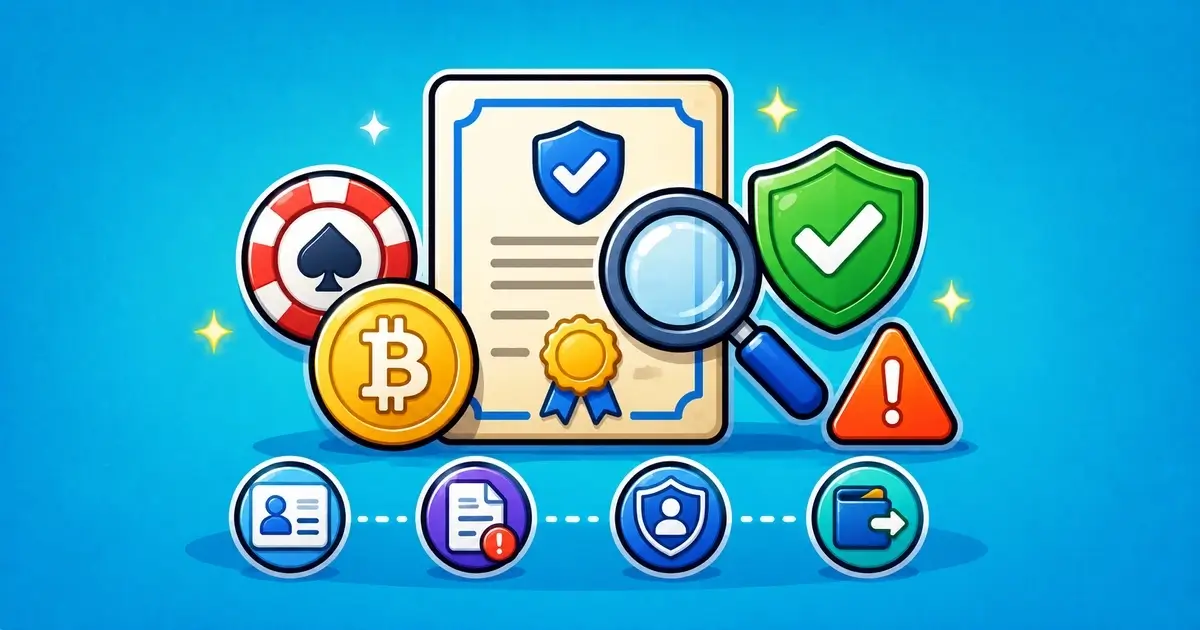
A crypto platform licence can be useful, but it should not be treated as a safety guarantee.
A licence may show that an operator is registered somewhere, allowed to offer a specific service, or subject to some level of supervision. That can matter.
But the level of oversight varies a lot.
Some licences come with clearer rules, complaint routes, and stronger supervision. Others may only confirm that a company is registered in a certain place. Some platforms display badges that are outdated, copied, hard to verify, or linked to a different company than the one users actually deal with.
This guide explains how to check a crypto platform or crypto casino licence, what a licence can prove, what it cannot prove, and which extra checks still matter before sending funds.
Related safety pages include How to Check a Crypto Platform, Crypto Casino Safety Guide, Crypto Platform Complaints: How to Check, Solve a Problem, and Editorial Policy.
Key Takeaways
- A licence is a useful signal, but it is not proof that a platform is safe
- Check the licence number, operator name, domain, jurisdiction, and current status
- A copied licence badge or logo is not enough
- The legal operator in the terms should match the licence record
- Different jurisdictions offer different levels of supervision and complaint handling
- A licensed platform can still have strict KYC, withdrawal, bonus, or account-review rules
- Public complaints and payout history still matter
- Always check withdrawal terms and support quality before depositing
What Does a Platform Licence Mean?
A licence usually means a company has permission, registration, or approval from a specific authority to carry out a certain activity.
That activity may be:
- online gambling
- crypto exchange services
- payment processing
- wallet or custody services
- company registration
- anti-money-laundering registration
- financial services activity
- offshore gaming operation
The important phrase is “certain activity.”
A platform may have one licence or registration, but that does not mean every product on the website is covered in the same way.
For example, a company registration does not automatically mean strong consumer protection. A crypto registration may not mean gambling activity is supervised. A gambling licence may not cover every crypto payment issue.
So the question is not only:
Does the platform show a licence?
The better question is:
What does that licence actually cover, and who can help if something goes wrong?
What to Check First
Start with the basic licence details.
A legitimate platform should usually make these easier to find in its footer, terms, about page, or legal section.
Crypto Platform Licence Checks
| Check | What It Shows | What to Do |
|---|---|---|
| Licence number | The platform claims to be registered or licensed | Check it on the regulator or licence authority website |
| Operator name | Shows which company is behind the platform | Match it with the terms, footer, and licence record |
| Jurisdiction | Shows where the licence or registration is based | Check what that jurisdiction actually supervises |
| Status | The licence may be active, expired, suspended, or copied | Confirm the current status from the official source |
| Covered activity | The licence may not cover every service offered | Check whether gambling, exchange, payments, or wallet services are included |
If a site only shows a licence logo with no number, no company name, no link, and no legal text, that is weak evidence.
It may still be worth checking, but do not treat it as proof.
Licence Badge vs Verified Record
A licence badge is easy to copy.
A verified record is harder to fake.
Many users stop after seeing a logo in the footer. That is not enough. A badge may be outdated, copied from another operator, linked to a different domain, or used in a way that creates more trust than the licence actually provides.
A better check is to find the official record.
Look for:
- licence number
- company name
- trading name
- website/domain listed
- licence status
- issue date
- expiry date
- covered activity
- regulator or authority name
- complaint or dispute process
If the platform links to a licence page, check the URL carefully.
If the link looks suspicious, search the regulator or licence authority directly and search for the company name or licence number there.
Warning Signs Around Licence Claims
A weak licence claim does not always prove a platform is fake, but it should slow you down.
Licence Claim Warning Signs
| Warning Sign | What It May Mean | What to Check |
|---|---|---|
| Only a logo is shown | A licence badge can be copied | Look for a verifiable licence number and operator name |
| Company name does not match | The platform may be using another company’s details | Compare footer, terms, and official records |
| Licence link goes nowhere | The claim may not be easy to verify | Search the regulator site directly |
| Different domain listed | The licence may belong to another website | Check whether the inspected domain is included |
| No complaint route | Users may have limited practical protection | Check dispute and support procedures before depositing |
Be especially careful when the operator name does not match.
A platform may show one company in the footer, another in the terms, and a different name in the licence record. Sometimes that can be explained by group structure. Other times, it is a sign that the platform is borrowing trust from another entity.
If the platform does not explain the relationship clearly, treat the claim with caution.
Check the Legal Operator
The legal operator is the company users are actually contracting with.
You can usually find it in the terms and conditions.
Look for wording such as:
- “operated by”
- “owned by”
- “licensed to”
- “the company”
- “service provider”
- “contracting entity”
- “merchant of record”
- “payment processor”
Then compare that name with the licence record.
Ask:
- Is the company name the same?
- Is the website domain listed?
- Is the licence still active?
- Does the licence cover the service being offered?
- Does the platform explain any difference between brand name and legal operator?
- Is the company address consistent across documents?
- Are restricted countries listed clearly?
If the terms are vague or the operator is hard to identify, that is a trust problem.
A user should not need detective work to know who holds their funds or processes withdrawals.
Different Licences Offer Different Protection
Licences are not equal.
Some authorities publish clear records, require responsible gambling tools, and provide some complaint routes. Others may offer lighter supervision or mainly confirm that an operator is registered.
What Different Licence Types May Mean
| Licence Type | What It May Show | How to Read It |
|---|---|---|
| Registration only | May confirm a company exists, but not strong consumer protection | Do not treat it as full safety proof |
| Gambling licence | May supervise casino activity in a specific jurisdiction | Check player complaint and dispute options |
| Crypto asset registration | May relate to AML or business registration | Check whether it covers custody, trading, or payments |
| Offshore licence | May allow operation but offer limited user remedies | Read the terms and complaint process carefully |
| No clear licence | The platform may still operate, but risk is harder to judge | Look for stronger proof before sending funds |
This matters because users often read the word “licensed” as if it means protected.
That is not always true.
A licence can be part of the trust picture. It should not be the whole picture.
Offshore Crypto Casino Licences
Many crypto casinos operate under offshore licences.
That does not automatically mean the casino is unsafe. Some offshore-licensed platforms may still pay users, offer clear rules, and maintain reasonable support.
But users should understand the trade-off.
An offshore licence may offer less practical protection than a stronger local regulator. Complaint handling may be limited. Enforcement may be slow. Player remedies may be unclear. Some licences may not provide the same oversight that users expect from more established gambling markets.
So check the licence, but also check:
- withdrawal history
- KYC rules
- complaint patterns
- bonus restrictions
- support quality
- responsible gambling tools
- restricted country rules
- how disputes are handled
If a platform says it is licensed but has repeated unresolved withdrawal complaints, the licence does not erase those reports.
Crypto Registrations Are Not Always Consumer Protection
Some crypto platforms mention registration for anti-money-laundering or virtual asset activity.
That can be relevant, but it may not mean what users think.
A crypto registration may show that a business is known to a regulator for compliance purposes. It may not guarantee funds are insured, withdrawals are protected, or every product on the website has been approved.
Read the wording carefully.
There is a difference between:
- registered as a company
- registered for AML purposes
- licensed for gambling
- authorised for financial services
- regulated as a payment institution
- supervised for custody or exchange activity
If the platform uses broad wording like “fully regulated” or “licensed worldwide,” look for the exact record and the exact activity covered.
What a Licence Cannot Prove
A licence cannot prove everything.
It does not automatically prove that:
- withdrawals will be fast
- KYC will be simple
- support will answer clearly
- bonus terms are fair
- complaints will be resolved
- all countries are allowed
- crypto deposits will be credited correctly
- the platform will never change terms
- the platform is safe for every user
A licensed platform can still have strict rules.
It can still request verification.
It can still hold withdrawals for review.
It can still close accounts under its terms.
It can still have poor support.
This is why licence checks should sit next to practical checks, not replace them.
What to Check Beyond the Licence
After checking the licence, check the platform itself.
Checks That Matter Beyond the Licence
| Check | Why It Matters | What to Do |
|---|---|---|
| Official regulator site | Best source for licence status | Avoid relying only on platform screenshots |
| Terms and conditions | Usually names the legal operator | Compare with the licence record |
| Footer details | Often contains company, licence, and address claims | Check for mismatches |
| Complaint history | Shows whether users had practical problems | Look for repeated unresolved patterns |
| Withdrawal and KYC rules | These affect users more directly than a logo | Read before depositing |
For casino users, withdrawal and bonus rules often matter more in practice than the licence badge.
For crypto platform users, deposit routes, token support, custody rules, account restrictions, and complaint handling can matter more than a broad registration claim.
Public Complaints Still Matter
A licence should be weighed against user reports.
Look for complaints about:
- delayed withdrawals
- missing deposits
- unexpected KYC
- account freezes
- support not replying
- bonus confiscation
- locked balances
- copied support channels
- changing explanations
- repeated payment failures
Do not believe every complaint blindly.
But do not ignore repeated patterns either.
A single unresolved complaint may not tell the full story. Repeated complaints with screenshots, TXIDs, support replies, and similar timing deserve more attention.
Read Crypto Platform Complaints: How to Check for a deeper checklist.
Check Whether the Domain Is Covered
This is an easy detail to miss.
A licence may list one domain, while the platform you are using operates on another.
Check whether the exact domain appears in the official record.
Be careful with:
- mirror domains
- regional domains
- shortened domains
- old domains
- app-only brands
- copied brand websites
- casino skins under one operator
- platforms using a licence from a related but different company
If the domain is not listed, search the legal operator and terms.
Sometimes a brand may operate under a parent company. That should be explained clearly.
If it is not explained, do not assume the licence applies.
If the Platform Has No Clear Licence
Not every crypto platform has a clear licence.
That does not automatically mean every user will have a bad experience, but it does make risk harder to judge.
If there is no clear licence, the other checks become more important:
- who operates the platform
- where the company is based
- how withdrawals work
- what happens during disputes
- whether KYC can be requested
- whether deposits are held by the platform
- whether users report unresolved problems
- whether support gives clear answers
- whether the terms explain account restrictions
If the platform holds user funds and offers no clear operator, no licence, no complaint route, and no meaningful support, be careful.
Mistakes to Avoid
Licence checks are useful only if they are read carefully.
Mistakes to Avoid When Checking a Licence
| Mistake | Why It Can Mislead You |
|---|---|
| Trusting a licence badge alone | Badges can be copied or outdated |
| Ignoring the operator name | A licence may belong to a different company |
| Assuming all licences are equal | Supervision and user protection vary widely |
| Skipping withdrawal terms | A licensed platform can still have strict payout rules |
| Ignoring recent complaints | A valid licence does not erase current user problems |
The biggest mistake is treating the word “licensed” as the end of the check.
It should be the start.
How TrendCrypt Uses Licence Information
TrendCrypt treats licensing as one trust signal.
It can improve the trust picture when the claim is clear, current, and verifiable.
It can weaken the trust picture when the licence is vague, expired, copied, mismatched, or used to imply more protection than it provides.
In casino reviews, licensing is considered alongside withdrawals, KYC rules, bonus terms, payment reliability, support quality, public complaints, responsible gambling tools, and operator transparency.
A licence can support a positive review.
It cannot override serious warning signs by itself.
For more detail, read How We Review and Editorial Policy.
If You Are Already in a Dispute
If you are checking the licence because a platform has delayed a withdrawal, blocked an account, or refused to credit funds, save evidence first.
Keep:
- platform URL
- legal operator name
- licence claim screenshot
- terms and conditions screenshot
- account notice
- support messages
- deposit or withdrawal TXIDs
- wallet addresses
- dates and times
- KYC request wording
- bonus terms, if relevant
- any regulator or complaint contact listed by the platform
Do not send seed phrases, private keys, passwords, authentication codes, or full identity documents to unofficial contacts.
If the dispute involves a missing deposit, read Crypto Deposit Not Showing? What to Check.
If it involves a delayed crypto casino withdrawal, read Delayed Crypto Casino Withdrawals.
Report a Suspicious Licence Claim
If you found a copied licence badge, mismatched operator name, fake platform, suspicious casino clone, unclear licence claim, or repeated complaint pattern, you can send a redacted report to [email protected].
Useful details may include:
- platform URL
- licence number shown
- operator name shown
- regulator or licence authority claimed
- screenshots of the footer and terms
- official licence record link, if found
- complaint links
- transaction hashes, if funds are involved
- support messages
- a short timeline
Do not send seed phrases, private keys, wallet passwords, authentication codes, full identity documents, or anything that could give access to your wallet or accounts.
TrendCrypt can review patterns and publish safety warnings, but we cannot access accounts, reverse blockchain transactions, recover funds, force withdrawals, or guarantee action from a regulator or platform.
Final Thoughts
A licence is worth checking, but it is not the whole safety picture.
It may confirm that an operator is registered or licensed somewhere. It may also show which company is behind the platform and what activity is covered.
But the practical question is bigger.
Can users withdraw? Are the rules clear? Does support respond? Are complaints resolved? Is the operator name consistent? Does the licence record match the domain? Does the platform explain what happens when something goes wrong?
A licence can help answer those questions.
It cannot replace them.
FAQ
Does a crypto platform licence mean the platform is safe?
No. A licence can be a useful trust signal, but it does not guarantee fast withdrawals, fair support, simple KYC, or strong consumer protection.
How do I verify a crypto platform licence?
Check the licence number, operator name, domain, status, jurisdiction, and covered activity. Use the official regulator or licence authority website when possible.
Can a licence badge be fake?
Yes. A badge or logo can be copied. Look for a verified licence record, matching operator name, and the exact website domain.
Why does the operator name matter?
The operator name shows which company users are dealing with. If the operator in the terms does not match the licence record, the relationship should be explained clearly.
Are offshore crypto casino licences always bad?
No. Some offshore-licensed casinos may operate responsibly. But practical consumer protection, complaint handling, and enforcement may be more limited, so extra checks matter.
What if the platform has no licence?
That increases uncertainty. Check ownership, terms, withdrawal rules, support quality, complaint history, and whether the platform holds user funds.
Can a licensed platform still delay withdrawals?
Yes. A licensed platform can still have pending periods, KYC reviews, account checks, payment delays, or strict bonus rules.
Should I trust a platform only because it says “regulated”?
No. Look for the exact licence or registration, what activity it covers, whether the status is active, and whether the claim matches the platform’s domain and legal operator.

Unexpected KYC During Withdrawal: What to Check
Learn what to check when a crypto platform or crypto casino asks for KYC during withdrawal, including verification timing, requested documents, privacy rules, support channels, and payout status.
Crypto Casino and Betting Scams: Warning Signs
Learn how crypto casino and betting scams use unclear ownership, fake bonuses, cloned sites, withdrawal release fees, private support messages, fake KYC links, and wallet-drainer tactics.

Fake Crypto Support Scams: Warning Signs
Learn how fake crypto support accounts target users after wallet, withdrawal, deposit, KYC, or account problems by pretending to represent platforms, exchanges, casinos, wallets, or recovery teams.