
TrendCrypt Guide
World Cup Crypto Betting Scams Explained
Learn how World Cup crypto betting scams work, including fake sites, phishing links, wallet drainers, fake bonuses, and impersonation risks.
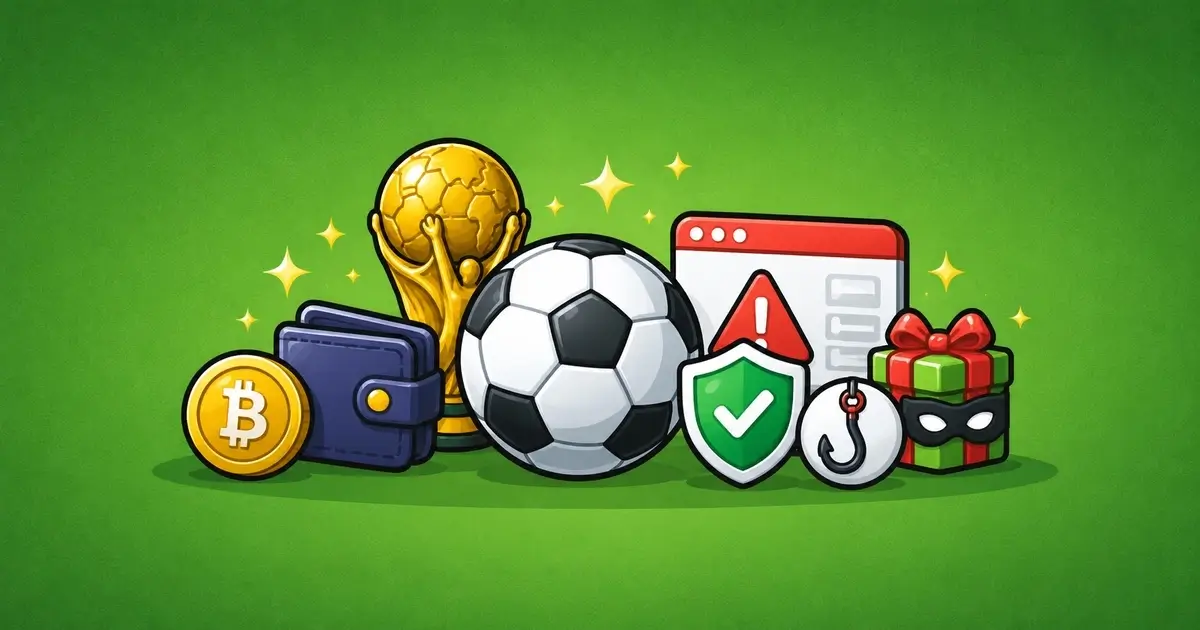
World Cup crypto betting scams are fake or misleading schemes that use tournament hype to push users into unsafe deposits, phishing links, fake bonuses, wallet connections, or guaranteed-win offers. The risk is higher during major events because scammers can copy football branding, create urgent promotions, and target users who are already looking for match-related content.
This guide is not about betting strategy, odds, predictions, or picks. It explains how World Cup crypto betting scams usually work, what warning signs to watch for, and what to do if a link, wallet request, or payment feels suspicious.
For the broader safety overview, read World Cup Crypto Gambling Safety Guide. This article goes deeper on scams specifically.
Helpful related resources include World Cup Crypto Scams Are Already Rising, How to Store Crypto Safely, Compromised Crypto Wallet: What to Do, Crypto Casino Bonuses, Crypto Casino Withdrawal Times, KYC vs No KYC Crypto Casinos, Are Crypto Casinos Safe?, Editorial Policy, and Responsible Gaming.
Key Takeaways
- World Cup scams often use urgency, fake bonuses, fake accounts, and football-themed branding
- A fake crypto betting site can copy the look of a real platform while sending deposits elsewhere
- No real support agent should ask for a seed phrase, private key, or wallet recovery words
- Wallet drainers may appear as bonus pages, verification tools, or fake revoke pages
- Guaranteed betting picks and “sure win” groups are major red flags
- Crypto payments are usually difficult to reverse, so checking first matters
- Users should save TXIDs, URLs, screenshots, and messages if something goes wrong
- The safest response to pressure is to stop, verify, and avoid signing anything unclear
Why World Cup Crypto Betting Scams Increase
Scammers follow attention.
When a major tournament starts, people search for match schedules, promotions, streams, tickets, football news, and betting-related content. That creates a crowded environment where fake pages can blend in.
A scam does not need to fool everyone.
It only needs to catch users who are in a hurry.
World Cup scams often rely on timing:
- “claim before kick-off”
- “limited match bonus”
- “VIP odds closing soon”
- “connect wallet to unlock”
- “withdrawal verification required”
- “free bet expires in minutes”
The pressure is the point.
If a page or account wants a quick crypto payment before the user has time to check the details, that is a warning sign.
Common World Cup Crypto Betting Scams
Most scams are not complicated.
They usually combine a familiar football theme with a crypto payment, fake support message, or wallet request.
Common World Cup Crypto Betting Scams
| Scam Type | How It Works | Main Risk |
|---|---|---|
| Fake Betting Sites | Scammers copy sportsbook or casino pages | Deposits may go directly to criminals |
| Fake Bonus Pages | Promotions promise free bets or matched deposits | Users may be pushed into unsafe payments |
| Wallet Drainers | Fake pages ask users to connect and approve a wallet | Funds or token permissions can be exposed |
| Fake Support Accounts | Impersonators offer help through DMs or chat groups | Users may reveal private details or seed phrases |
| Guaranteed Pick Schemes | Scammers sell “sure wins” or insider tips | Users may lose money before any real bet happens |
Fake Betting Sites and Clone Pages
A fake betting site may look polished at first glance.
It might use football graphics, team names, fake odds tables, bonus banners, and crypto deposit buttons. Some clone pages copy the layout of real gambling platforms or use a very similar domain name.
The goal is simple: make the user deposit before noticing the site is not legitimate.
Common warning signs include:
- slightly misspelled domains
- no clear company information
- weak or missing terms and conditions
- no responsible gambling page
- no real support channel
- only Telegram or Discord contact
- copied review badges
- fake trust logos
- broken legal pages
- unrealistic bonus offers
- no clear withdrawal rules
A fake site may still have a working deposit page.
That does not make it safe.
Crypto payment forms are easy to create, and a scam page can display a wallet address even if there is no real account system behind it.
Before sending funds, users should check the URL carefully, search for independent complaints, read withdrawal terms, and avoid links from ads, replies, DMs, or unofficial groups.
Fake Bonus and Free Bet Scams
World Cup bonus scams usually promise something that feels too good to miss.
Examples include:
- huge matched deposits
- “risk-free” World Cup bets
- fake free bet credits
- VIP access codes
- early payout promotions
- token airdrops tied to betting
- deposit multipliers for specific matches
- “limited country supporter bonus” offers
The problem is not that every promotion is fake.
The problem is that scammers use bonus language to make people act quickly.
A fake bonus page may ask users to:
- send crypto first
- connect a wallet
- pay a small “activation fee”
- deposit more to unlock withdrawals
- verify a wallet through a suspicious link
- message a fake support agent
- join a Telegram group for instructions
A legitimate promotion should have clear terms.
If the rules are hidden, vague, or only explained in private chat, the offer should be treated carefully.
For general bonus terms, see Crypto Casino Bonuses.
Phishing Links and Wallet Drainers
Phishing is one of the biggest risks for crypto users during major events.
A phishing page tries to make users reveal information or sign something unsafe.
A wallet drainer is more direct. It tries to get wallet permissions or signatures that can expose funds.
During the World Cup, wallet drainer pages may be disguised as:
- betting bonus pages
- fake free bet claims
- fake wallet verification tools
- fake withdrawal unlock pages
- fake token airdrops
- fake revoke tools
- fake support portals
- fake loyalty reward pages
The wording may look harmless.
It may say:
- “connect to verify”
- “approve to claim”
- “sync wallet”
- “unlock bonus”
- “revoke unsafe permissions”
- “confirm ownership”
- “activate payout”
Users should not sign wallet requests they do not understand.
They should also avoid entering seed phrases anywhere online. A seed phrase is not needed to claim a bonus, verify a betting account, or speak to support.
If a website asks for recovery words, close it.
Fake Telegram, Discord, and Support Accounts
Scammers often move users away from public websites and into private chats.
That is where pressure becomes easier.
Fake support accounts may say they can help with:
- stuck deposits
- blocked withdrawals
- KYC problems
- bonus activation
- wallet errors
- account restrictions
- “manual payout” requests
The scam usually becomes dangerous when the account asks for something unusual.
Examples include:
- seed phrase
- private key
- wallet connection
- remote access software
- extra deposit
- verification fee
- tax payment before withdrawal
- gas fee sent to a random wallet
- screenshots containing sensitive details
A real support channel should not need recovery words.
A real support agent should not ask users to install remote access tools to fix a wallet.
If support starts in a DM after a public comment, be careful. Scammers often watch public complaints and then impersonate the platform.
Fake Influencer Picks and Guaranteed-Win Claims
World Cup betting scams do not always start with a fake casino.
Sometimes they start with a person.
The account may claim to be:
- a football insider
- a betting analyst
- a VIP capper
- a former player
- a crypto trader
- a sportsbook employee
- a private group owner
The pitch is usually simple: pay crypto to access guaranteed picks.
The account may show fake screenshots of wins, edited betting slips, paid comments, or a private group full of fake success stories.
Guaranteed-win claims should be treated as a red flag.
No one can honestly guarantee the result of a football match, live bet, player prop, or tournament market.
Some scammers do not even care whether users place a bet. They make money by selling fake access, fake signals, or fake VIP subscriptions.
Others use the group to push users toward unsafe betting links.
Crypto Payment Red Flags
Crypto payments are useful for fast transfers, but they can also make scams harder to undo.
Once a payment is sent, recovery may be difficult or impossible.
That makes pre-payment checks important.
Be careful when a platform or person asks for:
- a deposit to unlock another deposit
- a fee to release winnings
- a tax payment before withdrawal
- a gas fee sent to a personal wallet
- a manual payout fee
- a bonus activation fee
- a refund processing fee
- a verification payment
- payment only through a private wallet address
Scammers often invent extra fees after the first payment.
The first deposit proves the user is willing to send crypto. Then the scammer may ask for more.
If a payment request appears only in chat and not inside a verified account dashboard, stop and check carefully.
Warning Signs Before You Deposit
A few warning signs should be enough to slow down.
You do not need to prove something is a scam before refusing to send money.
If the setup feels rushed or unclear, that is already a reason to pause.
Warning Signs Before You Deposit
| Warning Sign | Why It Matters |
|---|---|
| Urgent Deposit Pressure | Scammers often use countdowns, kick-off deadlines, or limited bonus claims |
| Seed Phrase Request | No legitimate betting site, wallet, or support agent needs recovery words |
| Unclear Ownership | A site with no company details, terms, or support information is harder to trust |
| DM-Only Support | Real support should be reachable through official website channels |
| Guaranteed Profit Claims | No one can honestly guarantee World Cup betting profits |
What to Do If You Clicked a Suspicious Link
Clicking a suspicious link does not always mean funds are lost.
The next steps matter.
If you clicked a link but did not enter information or sign anything:
- close the page
- do not download files
- do not enter login details
- do not connect a wallet
- do not approve browser notifications
- clear the tab from your browser
- use the official website if you need to check an account
If you entered a password, change it through the real website.
If the same password is used elsewhere, change it there too.
If the account supports two-factor authentication, review it.
If you connected a wallet, disconnect the site and review permissions using trusted wallet tools or official wallet guidance.
Do not use a random “revoke” link sent by the same account that may have scammed you.
Fake revoke pages are also used to steal funds.
What to Do If You Already Sent Crypto
If crypto was sent to a scam address, there may not be an easy way to reverse it.
That is why records matter.
Save:
- transaction ID
- receiving wallet address
- sending wallet address
- date and time
- website URL
- screenshots of the page
- chat messages
- email headers if relevant
- social media usernames
- payment instructions
- bonus or withdrawal claims
- platform account details
Do not send more money to “unlock” the first payment.
This is a common second-stage scam.
Also be careful with recovery scammers.
After a crypto loss, users may be contacted by people claiming they can recover funds for a fee. Some are just another scam.
Use official reporting channels and official platform support only.
What to Do After a Suspicious Link or Payment
The right response depends on what happened.
A suspicious link is different from a signed wallet approval, and a signed approval is different from a confirmed crypto payment.
What to Do After a Suspicious Link or Payment
| Situation | What to Do First |
|---|---|
| Clicked a Suspicious Link | Close the page, do not enter details, and avoid signing wallet requests |
| Connected a Wallet | Disconnect the site and review approvals if the wallet supports it |
| Entered a Seed Phrase | Treat the wallet as compromised and move only with careful security steps |
| Sent Crypto | Save the TXID, screenshots, URL, wallet address, and all messages |
| Spoke to Fake Support | Stop replying and contact the real platform only through official channels |
How to Reduce Scam Risk During the World Cup
The safest habits are boring, but they work.
Use official URLs.
Bookmark important pages.
Avoid links from DMs.
Do not trust screenshots as proof.
Do not trust guaranteed picks.
Do not connect wallets to bonus pages.
Do not keep large balances on gambling accounts.
Use a separate wallet for higher-risk activity.
Send small test transactions before larger transfers.
Read the withdrawal terms before depositing.
Keep records from the beginning, not only after something goes wrong.
Most importantly, slow down.
Scammers want users to act quickly because a rushed user checks less.
A missed bonus is not a serious problem.
A compromised wallet can be.
Final Thoughts
World Cup crypto betting scams work because they mix excitement with urgency.
A fake site can look professional.
A fake support agent can sound helpful.
A fake bonus can look time-sensitive.
A fake influencer can show convincing screenshots.
None of that proves the offer is real.
The safest approach is to treat every tournament-themed crypto promotion as something that needs verification before payment.
Do not share seed phrases.
Do not sign unclear wallet requests.
Do not send extra fees to release withdrawals.
Do not follow private-chat payment instructions.
Do not trust guaranteed-win claims.
Crypto scams are easier to avoid before a payment than fix after one.
During the World Cup, patience is one of the best safety tools a user has.
FAQ
What are World Cup crypto betting scams?
World Cup crypto betting scams are fake or misleading schemes that use tournament attention to push users into unsafe crypto payments, phishing links, fake bonuses, or wallet approvals.
Why do scammers target World Cup bettors?
Scammers target World Cup bettors because major events create urgency, high search interest, social media hype, and emotional decision-making.
Are guaranteed World Cup betting picks real?
Guaranteed betting picks should be treated as a red flag. No person or group can honestly guarantee football betting results.
Can a fake betting site steal crypto?
Yes. A fake betting site can display a crypto deposit address, collect funds, and never provide real withdrawals or account support.
What is a wallet drainer?
A wallet drainer is a malicious page or contract designed to get wallet permissions or signatures that can expose crypto assets.
What should I do if I entered my seed phrase?
Treat the wallet as compromised. Do not enter the phrase anywhere else, avoid further interaction with the scam page, and move carefully using trusted wallet security guidance.
Can crypto sent to a scam be recovered?
Sometimes investigators or platforms can track funds, but recovery is not guaranteed. Users should save TXIDs, screenshots, URLs, and messages, then report through official channels.
How can I avoid fake World Cup betting promotions?
Use official URLs, avoid direct-message links, check terms before depositing, ignore guaranteed-profit claims, never share seed phrases, and do not connect wallets to suspicious bonus pages.
Crypto Casino and Betting Scams: Warning Signs
Learn how crypto casino and betting scams use unclear ownership, fake bonuses, cloned sites, withdrawal release fees, private support messages, fake KYC links, and wallet-drainer tactics.
Crypto Casino VPN Rules: What to Check
Learn how crypto casino VPN and country rules can affect account access, KYC, bonuses, withdrawals, restricted locations, and platform risk reviews.

Crypto Casino Licensing Explained
Learn how crypto casino licensing works, what a licence can and cannot prove, how protection varies by jurisdiction, and what to check before trusting licence claims.