
TrendCrypt News
A Hardware Wallet Can Be Genuine and Still Arrive Compromised
Ledger found an unauthorized hardware implant in a device linked to a reseller investigation, showing why hardware-wallet security begins before the user ever creates a recovery phrase.
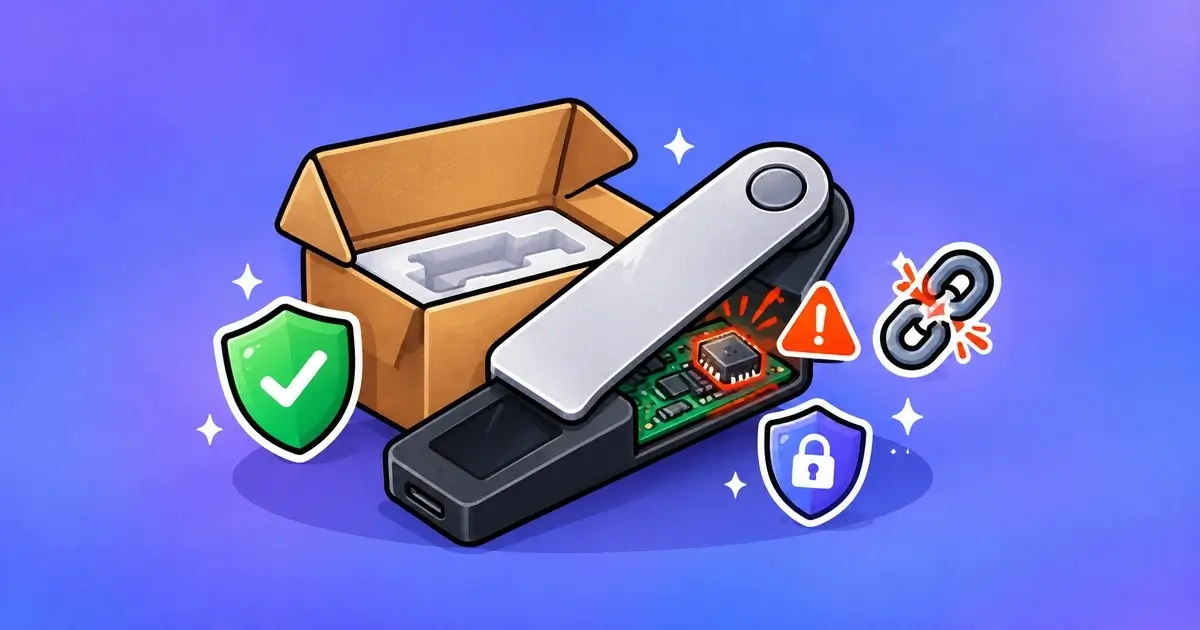
Hardware wallets are supposed to solve one of crypto’s most dangerous problems.
Your private keys should not need to live on:
- a laptop,
- a phone,
- a browser.
Instead, the sensitive signing process happens inside a dedicated physical device.
That dramatically reduces many common attacks.
It does not eliminate every attack.
Ledger is now investigating a case that demonstrates one of the hardest hardware-wallet threats to defend against:
the device may already be compromised before the owner ever creates a wallet.
Reports of large crypto losses emerged among users in Southeast Asia who had purchased Ledger devices through reseller CryptoBilis.
Ledger asked the reseller to stop sales and shipments while it investigated.
The investigation then became more serious.
Ledger confirmed that an affected user’s device contained:
an unauthorized hardware implant.
The company has said it has not identified a compromise of Ledger’s own security infrastructure, systems or services.
And the existence of an implant inside one examined device does not yet prove:
- how every reported theft occurred,
- how many devices were modified,
- who modified them,
- exactly where in the distribution chain the interference happened.
But it proves something important enough on its own.
A hardware wallet’s security does not begin when you:
turn it on.
It begins when the device leaves the trusted manufacturing environment.
That means:
- distribution,
- shipping,
- resellers,
- physical custody
can become part of the wallet’s security model.
A device can contain a genuine secure element.
Its firmware can look legitimate.
The packaging can appear normal.
And an attacker may still try to insert another component somewhere around the trusted hardware.
This changes the way users should think about cold-wallet security.
The most important question is no longer only:
Is this a real Ledger?
It can also be:
Is this the same device Ledger intended to reach me?
That is the supply-chain problem.
And unlike a normal phishing attack, it can begin before the victim has done anything wrong.
Key Takeaways
- Ledger is investigating reports of stolen crypto involving customers in Southeast Asia who purchased devices through CryptoBilis.
- CryptoBilis has appeared in Ledger’s official reseller listings for markets including:
- Indonesia,
- Malaysia,
- the Philippines.
- Ledger asked CryptoBilis to pause sales and shipments while the investigation continues.
- Ledger later confirmed that at least one affected device contained an unauthorized hardware implant.
- The implant confirms that physical device tampering is part of the investigation.
- That does not yet prove that every reported loss came from the same mechanism.
- Ledger says it has not found evidence that its own:
- systems,
- services,
- security infrastructure were compromised.
- Current evidence therefore does not support describing the incident as: a broad Ledger wallet hack.
- External onchain researchers have estimated losses above $86 million.
- Ledger has not confirmed that total.
- Other independent analyses have produced different totals.
- Loss estimates should therefore remain attributed rather than treated as a final figure.
- Ledger advised customers who recently purchased affected-channel devices and had not initialized them: not to set them up.
- Users who already initialized such a device were advised to consider transferring assets using:
- a new trusted signer,
- a newly generated recovery phrase.
- A new device with the same old seed is not enough if the seed itself may have been exposed.
- Changing a device PIN also does not invalidate an exposed recovery phrase.
- Resetting a physically suspicious device should not automatically be treated as sufficient.
- Hardware-wallet security includes:
- secure hardware,
- firmware,
- recovery-phrase handling,
- physical device integrity,
- distribution provenance.
- An authorized reseller reduces some sourcing risk.
- It does not make sophisticated supply-chain interference impossible.
- Packaging seals can expose crude tampering.
- They should not be treated as cryptographic proof of device integrity.
- Manufacturer authenticity checks remain important.
- They should also not be generalized into proof that every physical component inside a device is untouched.
- The central security lesson is: cold storage can fail before the wallet ever becomes cold storage.
What Happened?
The first public warning centered on users who had:
- purchased Ledger products,
- through CryptoBilis,
- in Southeast Asia,
- then reported unexplained losses.
Ledger responded by asking CryptoBilis to:
pause sales and shipments.
It also issued precautionary guidance for recent purchasers.
At that stage, the precise cause remained unclear.
Then Hardware Tampering Was Confirmed
Ledger later said an affected user’s device contained:
an unauthorized hardware implant.
That changed the nature of the story.
The incident was no longer only:
users with one reseller are losing money.
There was now physical evidence that at least one device had been altered.
That Still Does Not Prove the Whole Attack Chain
Security reporting needs to preserve that boundary.
Confirmed:
- an unauthorized hardware implant was found in at least one affected device.
Not yet fully established:
- whether every reported victim received a similarly modified device,
- whether the same hardware design was used across all affected wallets,
- where the modification occurred,
- the final total stolen.
Those are separate claims.
Why “Ledger Was Hacked” Is Too Broad
A hardware-wallet company can be involved in several different kinds of security incident.
For example:
- Ledger corporate servers hacked,
- Ledger firmware vulnerability,
- wallet owner phished,
- reseller distribution compromised.
Those are not interchangeable.
Hardware Wallet Threats Can Start at Different Stages
| Threat | When It Happens | What Happens | Main Defense |
|---|---|---|---|
| Phishing | After purchase | User is tricked into revealing a recovery phrase or signing something malicious | User verification and safe signing habits |
| Malware | After purchase | Computer or phone attempts to manipulate addresses, transactions or wallet software | Hardware verification and clean software environment |
| Physical theft | After purchase | Attacker obtains the device itself | PIN, secure hardware and physical security |
| Supply-chain tampering | Before setup | Device is modified before reaching the user | Trusted sourcing, genuine checks and physical integrity controls |
| Pre-generated recovery phrase scam | Before setup | Attacker already knows the phrase the buyer is told to use | Generate the recovery phrase on the trusted device itself |
| Firmware / software compromise | Before or after setup | Malicious code alters expected wallet behavior | Authenticity checks, signed firmware and trusted update channels |
The current CryptoBilis investigation points strongly toward the:
physical / supply-chain layer.
That is fundamentally different from a remote compromise of every Ledger device.
What Is a Supply-Chain Attack?
A supply-chain attack targets a product somewhere between:
trusted producer
and
final user.
For a hardware wallet, the chain may involve:
- manufacturing,
- distribution,
- reseller inventory,
- shipping,
- customer delivery.
If an attacker gains access anywhere in that path, they may try to modify the product before the buyer receives it.
The User Can Do Everything “Right” and Still Start From a Bad State
This is what makes the attack particularly dangerous.
A phishing victim may:
- enter seed into fake website.
A malicious-approval victim may:
- sign dangerous transaction.
A supply-chain victim may:
- buy wallet,
- follow setup instructions,
- never share the phrase.
The attacker may already have compromised the environment where the phrase was created or displayed.
Hardware Security Assumes Some Starting Point Is Trusted
Every security system has a root of trust.
For hardware wallets, that can include:
- secure element,
- trusted firmware,
- trusted physical device.
If the device around those components is modified:
the threat model changes.
What Does an Unauthorized Hardware Implant Mean?
At a basic level:
someone added physical hardware that was not supposed to be there.
That additional hardware can potentially observe or alter information moving through parts of the device.
The exact capabilities depend on:
- where it is connected,
- what signals it can access,
- how it communicates.
A Secure Element Is Powerful, Not Magical
Hardware-wallet security discussions often focus on the:
secure element.
That is reasonable.
It is designed to protect sensitive cryptographic operations.
But a wallet is not one chip floating in space.
A Hardware Wallet Has Several Security Layers
| Layer | Role | Security Benefit | Important Limitation |
|---|---|---|---|
| Secure element | Protects critical secrets and performs sensitive operations | Important security boundary | Does not automatically prove every external component is trustworthy |
| Display | Shows addresses, amounts and signing information | Lets user verify transaction intent | A compromised surrounding hardware path can create additional attack possibilities |
| Buttons / touch input | Confirms user actions | Creates physical approval boundary | Input path still depends on device integrity |
| Firmware | Controls device behavior | Signed code can help protect against unauthorized software | Firmware authenticity does not necessarily prove physical supply-chain integrity |
| Recovery phrase | Backup representation of wallet secrets | Can restore control of assets | Anyone who learns it can generally recreate the wallet |
| Distribution channel | Moves device from manufacturer to customer | Usually treated as logistics | Becomes part of the security model when hardware can be intercepted or modified |
The whole device architecture matters.
Why the Display Matters
One of a hardware wallet’s biggest advantages is:
trusted display verification.
Your computer may be infected.
But the hardware wallet should show:
- destination address,
- amount
before signing.
The user verifies the transaction on the hardware device.
That Model Assumes the Display Path Is Trustworthy
If unauthorized hardware can observe or interfere with sensitive information before it reaches the user:
the security assumptions become weaker.
That does not mean every implant can:
- alter every screen.
It means physical tampering can attack layers that software-only threat models assume are trusted.
The Recovery Phrase Is an Even Bigger Target
For most self-custodial wallets, the recovery phrase can recreate the wallet’s private keys.
Anyone who obtains it may be able to restore the wallet elsewhere.
They do not need your original hardware device anymore.
That Is Why Seed Exposure Is So Dangerous
Suppose Alice owns:
10 BTC.
Her hardware wallet itself never leaves her home.
But an attacker learned her recovery phrase during setup.
The attacker can restore the wallet:
on another device.
They can move the Bitcoin without touching Alice’s hardware wallet again.
Hardware Wallet Does Not Mean “Seed Cannot Leak”
It means the architecture is designed to keep key material protected.
That protection still depends on:
- hardware integrity,
- correct setup,
- user behavior.
Supply-chain interference attacks the first assumption.
Delayed Theft Makes the Attack Harder to Notice
A sophisticated attacker does not necessarily steal immediately.
Imagine Alice sets up her wallet in:
January.
She deposits:
$3,000.
Nothing happens.
By July:
$100,000.
The attacker waits.
Then drains it.
Alice may never connect the theft to:
where she bought the device six months earlier.
Delay Also Helps Attackers Avoid Detection
If every modified device drained:
five minutes after setup,
the pattern would become obvious quickly.
Delayed theft makes attribution harder.
It can also let more compromised devices reach customers before the alarm is raised.
This Is Why Supply-Chain Security Is Different From a Normal Exploit
A software exploit can often be patched after discovery.
A physically modified device is already:
in the user’s possession.
The manufacturer cannot remotely remove:
- an unauthorized circuit board.
The hardware itself may need to be abandoned.
Can the Device Still Be “Genuine”?
Potentially, yes.
This is the key conceptual problem.
A device can begin life as:
a genuine product.
Then someone modifies it.
It is no longer in the state the manufacturer intended.
What “Genuine” Does and Does Not Prove
| Signal | What It Can Mean | What It Does Not Automatically Prove |
|---|---|---|
| Authentic model | Device began as a genuine product | Does not prove it was never modified later |
| Authentic firmware | Expected signed software is present | Does not necessarily inspect every added physical component |
| Manufacturer genuine check | Validates important device authenticity properties | Helpful but not equivalent to destructive hardware forensics |
| Authorized seller | Seller belongs to approved distribution network | Reduces risk but does not make interception impossible |
| Factory sealed appearance | Package looks unopened | Sophisticated attackers can potentially recreate packaging |
This is why authenticity and integrity are related but not identical.
Counterfeit Device vs Modified Genuine Device
A counterfeit wallet is fake from the beginning.
A modified genuine wallet can be more convincing because many authentic components remain.
Different Physical Hardware Attacks
| Attack | What Happens | Main Risk |
|---|---|---|
| Counterfeit wallet | Attacker sells fake device pretending to be genuine | Entire device can be malicious |
| Modified genuine device | Real hardware is altered after manufacturing | Trusted product gains an untrusted component |
| Pre-seeded wallet | Victim receives recovery phrase already known to attacker | No sophisticated hardware attack required |
| Evil-maid attack | Attacker gets temporary physical access after user owns device | User-controlled supply chain is bypassed through later access |
| Reseller / logistics compromise | Device is intercepted somewhere in distribution chain | Attack occurs before buyer becomes custodian |
The second category can be harder for users to recognize.
Authorized Reseller Does Not Mean Zero Risk
CryptoBilis being listed in Ledger’s reseller network matters.
It means this was not simply:
someone bought a random wallet from an unknown street seller.
That makes the incident more important.
Authorization Improves Provenance
An authorized distribution system should reduce risks such as:
- counterfeit inventory,
- unauthorized sourcing.
That is useful.
But no physical supply chain can realistically be described as:
impossible to interfere with.
Ledger Itself Acknowledges Supply-Chain Risk
Ledger’s purchasing guidance recommends buying through:
- Ledger,
- official storefronts,
- authorized resellers,
while also warning that even authorized distribution cannot make sophisticated interception or tampering impossible.
That is the correct framing.
Direct Purchase Is Still Generally the Simplest Path
Buying directly from the manufacturer reduces the number of commercial intermediaries.
That does not make shipment interception mathematically impossible.
It reduces one category of uncertainty.
Where You Buy a Hardware Wallet Matters
| Source | Supply Chain | Main Advantage | Main Concern |
|---|---|---|---|
| Manufacturer directly | Shortest commercial chain | Reduces intermediary exposure | Shipping interception risk cannot be treated as literally impossible |
| Authorized reseller | Recognized seller within manufacturer distribution network | Better provenance than unknown marketplace seller | Authorization does not make every supply-chain attack impossible |
| Official marketplace storefront | Manufacturer or approved reseller operates store on third-party platform | Can provide legitimate sourcing with marketplace convenience | Users still need to verify the actual seller |
| Unknown marketplace seller | Unverified third party | Usually convenient or cheaper | Higher counterfeit and tampering risk |
| Second-hand device | Previously possessed by another person | Lower cost | Creates the weakest provenance and should receive the highest suspicion |
The lowest sticker price should not be the main criterion for a device protecting large crypto balances.
Second-Hand Hardware Wallets Carry the Weakest Provenance
A second-hand wallet may be perfectly safe after appropriate procedures.
The problem is:
you cannot easily reconstruct its physical history.
Someone else had unrestricted possession.
Self-Custody Means You Become the Security Team
Saving:
$30
on the signing device while protecting:
$100,000
in crypto is a poor trade if the cheaper source introduces unknown provenance.
Security decisions should be proportional to the value protected.
Packaging Is Useful but Weak Evidence
Users often ask:
Is the box still sealed?
A damaged seal is a warning sign.
An intact seal is not proof of safety.
Why Tamper-Evident Packaging Has Limits
A sophisticated attacker can potentially:
- reproduce packaging,
- replace seals.
So packaging is best understood as:
one visible signal.
Not a cryptographic verification method.
Do Not Reject Packaging Checks Either
If the box arrives:
- opened,
- damaged,
- altered,
that is sufficient reason to stop.
You do not need to prove malicious tampering.
A security device with uncertain physical integrity should not receive your recovery phrase.
Genuine Checks Matter More
Ledger provides a Genuine Check process intended to verify important authenticity properties of the device.
Users should run official verification during initialization.
This is far stronger than:
the box looks fine.
But Do Not Overclaim What a Genuine Check Proves
This incident makes that distinction especially important.
A cryptographic authenticity process can verify important expected relationships such as:
- secure device identity,
- authorized firmware.
It should not automatically be described as:
complete inspection of every physical component inside the case.
Those are different tests.
Software Verification and Physical Forensics Are Different
Software can ask:
Are you a valid Ledger secure device?
Hardware forensics asks:
Is there any unauthorized electronics physically attached around the valid device?
The second problem can require much deeper inspection.
This Is Why Defense in Depth Matters
No one check should carry the whole trust decision.
Better setup uses several signals:
- trusted seller,
- intact device,
- official authenticity verification,
- fresh recovery phrase,
- careful transaction verification.
What to Check Before Funding a Hardware Wallet
| Check | What To Do | Why It Helps | Limitation |
|---|---|---|---|
| Seller identity | Confirm seller through manufacturer records | Reduces risk of buying from an impersonator or unauthorized source | |
| Packaging condition | Look for damage, reopening or suspicious alterations | Can reveal crude tampering | Cannot prove sophisticated tampering did not occur |
| Device authenticity check | Use the manufacturer-supported genuine verification process | Helps confirm expected secure hardware / firmware relationship | Should not be treated as universal proof of every physical component |
| Recovery phrase generation | Generate it through the trusted device during setup | Prevents use of attacker-provided backup phrases | Still assumes the device environment itself is trustworthy |
| Address verification | Confirm receiving address on the hardware-wallet screen | Protects against some computer-side address substitution | Depends on trusting the device display path |
| Small test transfer | Move a small amount before large balances | Can expose some operational errors | Cannot prove a dormant hardware implant is harmless |
The goal is not perfect certainty.
It is reducing independent failure paths.
Never Use a Recovery Phrase Included in the Box
This remains one of the simplest hardware-wallet scam warnings.
If a device arrives with:
- 12 words,
- 24 words
already printed for you:
do not use them.
Why?
Because the entire security model of the wallet depends on:
only you knowing the secret.
If someone else generated the phrase:
they can already restore the wallet.
No device exploit is necessary.
Your Recovery Phrase Should Be Newly Generated
The seed should emerge from a setup process you trust.
It should not arrive as:
- card,
- scratch sheet,
- pre-filled paper.
Never Type It Into a Random Website
Another common scam says:
verify your Ledger recovery phrase.
A website does not need your seed to prove that:
- your device is genuine.
Entering the phrase gives control to whoever receives it.
A Real Security Incident Creates Perfect Phishing Material
Attackers now have a convincing story:
Ledger supply-chain incident detected. Verify your wallet.
That could lead to:
- fake support,
- fake migration page.
The original incident can therefore create secondary attacks against completely unaffected users.
Do Not Let Real News Force You Into Fake Urgency
The attacker may say:
Funds will be frozen in 30 minutes.
That urgency is the manipulation.
Use only trusted support channels and known software.
What Should CryptoBilis Buyers Do?
The most important distinction is:
unused vs already initialized.
What to Do With a Potentially Suspicious Device
| Situation | Safer Response | Why |
|---|---|---|
| Unused suspicious device | Do not initialize it | Avoid generating or exposing wallet secrets on questionable hardware |
| Device already initialized but no funds | Replace it and create a new recovery phrase on trusted hardware | Do not reuse a potentially exposed seed |
| Device initialized and funded | Move assets using a trusted signer and newly generated seed | A compromised recovery phrase can recreate the wallet indefinitely |
| Same seed restored on clean device | Not sufficient if the original seed may be exposed | The attacker may already know the underlying secret |
| PIN changed | Not sufficient for a potentially exposed seed | PIN protects local device access, not knowledge of the recovery phrase |
| Suspicious device factory reset | Do not treat reset alone as proof of safety | A physical implant can remain after software reset |
If the device has never been initialized:
the safest route is simple.
Do not initialize it.
Why Not “Just Test It”?
Because setup itself is when important secrets may be created or exposed.
There is little upside to placing a recovery phrase into an environment already under investigation.
If You Already Used It, the Seed Becomes the Main Question
Suppose your device might have been physically compromised.
You buy a clean replacement.
Then restore:
the same old seed.
Have you solved the problem?
Not if the seed may already be known to the attacker.
A New Device Does Not Make an Old Seed New
This is one of the most important recovery principles.
The wallet is fundamentally derived from:
the recovery phrase.
The hardware is the signer.
If the underlying seed is exposed:
changing signers does not invalidate the attacker’s copy.
You Need a New Security Root
That means:
- trusted new signer,
- freshly generated recovery phrase,
- new addresses.
Then move the assets.
PIN, Seed and Device Replacement Solve Different Problems
| Control | What It Protects | Role | If Old Seed May Be Exposed |
|---|---|---|---|
| PIN | Protects access to the physical device | Does not replace the recovery phrase | Changing PIN does not invalidate an exposed seed |
| Recovery phrase | Recreates wallet keys | Critical wallet secret | If exposed, funds should move to a completely new seed |
| Passphrase | Can derive an additional wallet when implemented correctly | Adds protection in some threat models | Should not be used to justify keeping a known-compromised setup |
| New signer | Trusted hardware used for future signing | Removes suspected device from workflow | Needs a new seed if the old one may be compromised |
| New receiving addresses | Addresses derived from the fresh seed | Separates funds from the potentially exposed wallet | Required for a true wallet migration |
This is why Ledger’s advice specifically refers to:
a new seed.
Changing the PIN Is Not Enough
A PIN protects physical access to the hardware wallet.
The attacker holding a copy of the recovery phrase does not need:
- your PIN,
- your physical device.
They restore the wallet elsewhere.
Factory Reset Is Also a Different Operation
A factory reset can clear local wallet state.
It cannot be assumed to physically remove:
- unauthorized hardware.
If the device itself is suspect:
the safe approach is to retire it.
Do Not Use a Suspicious Device to Create the Replacement Wallet
This sounds obvious.
During panic, users may:
- reset suspicious device,
- generate another seed on same hardware,
- move assets.
If the hardware is malicious:
the new seed may be compromised too.
Use a trusted signer.
Move Assets Before Abandoning the Old Wallet
If the funds have not yet been stolen and the seed may be exposed:
speed matters.
An attacker with the same seed has the same blockchain authority you do.
There is no password reset.
But Do Not Rush Into a Phishing Site
This is the difficult balance.
Move funds promptly.
Do not act through:
- unsolicited link,
- fake support instructions.
Use a trusted wallet environment you already know.
What Does a Hardware Implant Potentially Do?
The capabilities can vary dramatically.
An implant might attempt to:
- observe secret information,
- alter information,
- transmit data.
The specific CryptoBilis-linked device investigation should not be generalized beyond what is confirmed.
Why Hardware Tampering Can Be Dangerous
| Risk | Possible Result | Scope |
|---|---|---|
| Recovery phrase interception | Attacker can potentially recreate wallet elsewhere | Entire seed-derived wallet |
| Transaction manipulation | User may approve a different transaction than intended | Specific transfers |
| Address substitution | Funds sent to attacker-controlled address | Outgoing transaction |
| Device telemetry | Sensitive setup or operational data is transmitted externally | Privacy and possibly wallet security |
| Delayed theft | Attacker waits months before draining wallet | Makes causal connection to device harder to notice |
The most serious outcome is seed compromise.
If the Seed Is Compromised, Cold Storage Becomes an Illusion
Your device can remain:
- unplugged,
- inside safe.
The attacker already has the secret needed to recreate the wallet.
The coins are not protected by the physical location of the original device anymore.
This Is Why “Keys Never Leave the Device” Needs Context
The ideal hardware-wallet model keeps private keys isolated.
But a supply-chain attack can try to compromise the process:
- before,
- around
that isolation.
Security slogans describe the intended architecture.
They are not guarantees against all physical adversaries.
Hardware Wallets Are Still Valuable
This incident should not be interpreted as:
hardware wallets do not work.
That would be the wrong conclusion.
They meaningfully reduce exposure to:
- malware,
- remote key theft.
The correct lesson is narrower:
hardware wallets have their own threat model.
Every Security Tool Moves Risk
Exchange custody:
you trust the exchange.
Software wallet:
you trust the endpoint environment.
Hardware wallet:
you reduce endpoint exposure but become responsible for:
- physical device integrity,
- recovery phrase,
- sourcing.
No system eliminates trust.
It changes where trust sits.
Cold Wallet vs Hot Wallet Was Never the Whole Story
TrendCrypt’s hot wallet vs cold wallet guide explains the normal distinction.
This incident adds another dimension.
A device can be:
offline
while its secrets were compromised earlier.
Offline status protects against many remote attacks.
Not historical compromise.
Supply-Chain Security Is Part of Self-Custody
Self-custody is usually summarized as:
your keys, your coins.
There is an unstated prerequisite:
your keys need to actually be yours alone.
If a malicious device exposes them during creation:
the user never achieved exclusive custody in the first place.
Self-Custody Begins at Key Generation
That is the deeper lesson.
The security lifecycle starts before:
- first deposit.
It starts when:
the secret is generated.
Everything surrounding that event needs to be trustworthy.
A Recovery Phrase Is More Important Than the Hardware Brand
Once created, the seed can often restore the wallet independently of:
- original device.
That means users should think of the hardware wallet as:
a protected tool for creating and using the key.
The key is the ultimate asset-control secret.
Device Reputation Cannot Rescue an Exposed Seed
You can own:
- most secure wallet model ever built.
If your recovery phrase is known to an attacker:
the cryptography cannot distinguish:
- you,
- attacker.
Both possess valid credentials.
Blockchain Has No Concept of the “Real Owner”
This makes seed theft severe.
The blockchain sees:
valid signature.
It does not know:
this signature came from the thief who copied Alice’s seed during setup.
Self-custody security must therefore prevent credential duplication before the blockchain is involved.
Can a Hardware Wallet Detect Physical Modification?
Some modifications may be detected.
Others can be difficult.
The practical problem is that consumer devices cannot perform:
laboratory-level self-inspection of every component.
That is why supply-chain controls exist upstream.
Manufacturer Security Includes Logistics
Hardware manufacturers therefore need more than:
- secure chip,
- secure firmware.
They need:
- vendor controls,
- distribution monitoring,
- incident response.
Reseller Networks Become Security Infrastructure
Once a manufacturer authorizes a reseller, customers may reasonably treat that seller as:
trusted distribution.
That gives the manufacturer an incentive to:
- monitor,
- audit
the channel carefully.
This Incident Could Change Hardware Wallet Distribution
Possible industry responses may include:
- stronger anti-tamper design,
- improved device attestation,
- more traceable inventory.
Ledger has already indicated it is working on stronger anti-tampering protections while investigating the affected device.
Perfect Tamper-Proof Hardware Probably Does Not Exist
Given enough:
- physical access,
- time,
- expertise,
hardware attacks can become extremely sophisticated.
The realistic goal is:
- make attacks harder,
- make tampering easier to detect,
- reduce time attackers control the product.
This Is Why Provenance Matters
A security device with a clear path:
manufacturer → you
has fewer unknown custody events.
Every additional uncontrolled handoff creates another opportunity.
Provenance Is Common in Other High-Security Industries
Organizations care about supply-chain provenance for:
- networking equipment,
- cryptographic hardware.
Crypto users protecting serious capital increasingly need the same mindset.
The Wallet Is Financial Infrastructure
A consumer hardware wallet may cost:
hundreds of dollars.
It can control:
millions.
That asymmetry makes it an attractive attack target.
Attackers Can Spend a Lot to Compromise One Device
If a modified wallet can eventually control:
$500,000,
an attacker can justify much more sophisticated hardware than they could for an ordinary consumer gadget.
This changes the economics of tampering.
High-Value Wallets Need Higher Security Standards
Someone holding:
$500
may use a different security model from someone holding:
$5 million.
For large balances, users may consider:
- multisig,
- several independent signing devices.
Multisig Can Reduce Single-Device Supply-Chain Risk
Suppose a wallet requires:
2 of 3 signatures.
The signers come from:
- different devices,
- independently sourced.
Compromising one signer may not be enough to steal the funds.
That is defense in depth.
But Multisig Adds Complexity
Users can lose access through:
- poor backups,
- incorrect setup.
More secure architecture can create more operational failure modes.
There is no free security.
Vendor Diversity Can Reduce Correlated Risk
For very large holdings, some users may choose different hardware-wallet vendors for different multisig keys.
That can reduce reliance on:
- one supply chain,
- one firmware stack.
Again:
more complexity.
A Single Hardware Wallet Is Usually Simpler
For many ordinary users:
- trusted purchase,
- clean setup,
- safe recovery phrase storage
remains a strong model.
Do not respond to a rare sophisticated attack by building a security system you cannot operate correctly.
Complexity Can Become the Attack
A user with:
- five devices,
- three seed backups,
- two passphrases
can accidentally lock themselves out.
Security design needs to match the user’s ability.
What About Device Attestation?
Cryptographic attestation can help establish that:
- expected secure hardware
is present and responding correctly.
This is valuable.
But again:
attestation answers a defined technical question.
Not every conceivable physical question.
Think of Attestation as One Layer
It can tell you:
this trusted component can prove its identity.
It may not tell you:
nobody secretly added another component beside it.
Those are different claims.
This Incident Is Why Security Claims Need Narrow Language
“Genuine” can mean:
- core device authenticity.
“Untampered” can mean:
- no unauthorized physical changes.
They should not automatically be treated as synonyms.
What Red Flags Should Stop Setup Immediately?
Hardware Wallet Red Flags
| Red Flag | Response | Reason |
|---|---|---|
| Recovery phrase included in the box | Do not use it | A legitimate setup should not require trusting a phrase already known to someone else |
| Instructions ask you to enter seed into website | Stop immediately | Recovery phrases should never be entered into ordinary websites |
| Device appears modified | Do not initialize | Physical integrity is uncertain |
| Unexpected connectivity or extra hardware | Stop using device | Could indicate unauthorized modification |
| Genuine check fails | Do not fund wallet | Authenticity cannot be established |
| Seller cannot be verified | Prefer another source | Provenance is part of hardware-wallet security |
You do not need to prove an attack before refusing to use the device.
Security works better when uncertainty itself can trigger caution.
A Hardware Wallet Should Never Require Your Seed on a Website
This rule is worth memorizing.
Recovery phrase belongs in:
- trusted recovery process.
Not:
- browser form,
- support chat.
Official Support Should Never Need the Phrase
Anyone asking for it can recreate the wallet.
There is no legitimate troubleshooting reason for support staff to possess that power.
Supply-Chain News Will Increase Fake Support Attempts
Users searching for:
- CryptoBilis,
- Ledger compromised
are now attractive phishing targets.
Fake accounts can offer:
- device validation,
- emergency migration.
Treat unsolicited help as hostile.
What If You Bought From a Different Ledger Seller?
The current investigation does not support assuming:
all Ledger devices are compromised.
Ledger has linked its immediate warning to CryptoBilis customers in Southeast Asia.
That scope matters.
Do Not Generalize One Channel to the Entire Product Line
A supply-chain incident can be:
- localized.
A firmware vulnerability would have a different risk profile.
Security response should match the actual evidence.
But Use the Incident as a General Reminder
Even unaffected users can improve:
- purchase verification,
- seed handling.
That is useful without creating panic.
What About the $86 Million Figure?
Several onchain investigators have traced addresses they believe are linked to affected wallet drains.
One widely circulated estimate exceeded:
$86 million.
Other analyses have produced higher figures.
Those Are Estimates, Not Ledger’s Final Loss Accounting
Blockchain analysis can identify:
- transfers,
- balances.
Attribution remains more difficult.
Analysts need to decide:
- which wallets belong to victims,
- which destination wallets belong to the attacker.
Different methodologies can produce different totals.
TrendCrypt Should Not Freeze a Moving Estimate Into the Headline
The security lesson does not depend on whether the final confirmed amount becomes:
- $72 million,
- $86 million,
- $92 million.
The verified hardware implant is already the important development.
Onchain Evidence Is Excellent for Following Funds
Once stolen crypto moves:
the blockchain can reveal:
- transaction path,
- destination balances.
That does not necessarily reveal:
how the private key leaked.
The chain begins after the signing authority is already compromised.
Hardware Forensics Explains the “How”
Onchain investigation:
where did funds move?
Device forensics:
how could attacker gain authority?
Both are needed.
The Current Investigation Is Still Incomplete
The confirmed implant makes supply-chain compromise a credible focus.
A full incident report would still need to answer:
- how device was modified,
- whether implants are identical,
- how information left the device,
- when modification occurred.
Until then, conclusions should stay proportional to the evidence.
This Is Good Security Reporting
Crypto incidents often move quickly from:
possible
to
confirmed
on social media.
TrendCrypt should keep those layers separate.
What Is Confirmed?
- Ledger is investigating losses involving CryptoBilis customers.
- Sales and shipments were paused.
- An unauthorized implant was found in at least one affected device.
- Ledger advised recent affected-channel users to take precautions.
What Is Not Yet Fully Confirmed?
- Final victim count.
- Final loss amount.
- Whether every victim’s device contained the same implant.
- Exact point in the supply chain where tampering happened.
- Complete technical mechanism across all losses.
That distinction matters.
TrendCrypt Research Notes
The Ledger–CryptoBilis investigation is important because it expands the normal crypto-wallet threat model from software and user behavior into physical distribution.
Several broader conclusions follow.
First, hardware-wallet security begins before setup.
Users normally think the critical moment is when they:
- generate the seed,
- make the first deposit.
A supply-chain attack can happen before either step.
Second, authenticity and integrity are not identical.
A device can contain genuine components while also having been modified after manufacture.
That makes the phrase:
genuine device
less complete than it appears.
Third, authorized distribution reduces risk but cannot eliminate it.
CryptoBilis appearing in Ledger’s reseller network makes this incident more significant than a simple counterfeit purchased from an unknown seller.
Fourth, the recovery phrase remains the ultimate security boundary.
If a compromised device exposes the seed, replacing only the device does not restore security.
The wallet must migrate to:
- new seed,
- new addresses.
Fifth, PIN changes solve a different problem.
A device PIN protects local physical use.
It does not revoke a recovery phrase already known to an attacker.
Sixth, factory reset should not be treated as a response to suspected physical tampering.
Software state can be reset.
Unauthorized electronics may remain.
Seventh, manufacturer genuine checks remain useful without being omnipotent.
Cryptographic verification can confirm important authenticity properties.
Users should not overinterpret it as a complete forensic inspection of every component.
Eighth, supply-chain attacks make provenance part of self-custody.
Where the device came from is no longer merely:
- shopping preference.
It becomes part of the security model.
Ninth, the current loss totals remain estimates.
Onchain researchers have produced large figures.
Ledger has not confirmed one final total.
The article should preserve that distinction.
Tenth, a real hardware incident creates secondary phishing risk.
Users worried about their devices become ideal targets for fake:
- verification pages,
- migration tools,
- support agents.
Finally, this incident demonstrates a deeper truth about self-custody.
The phrase:
not your keys, not your coins
assumes something fundamental:
only you know the keys.
If the environment that creates those keys was compromised before it reached you, then apparent self-custody may never have been exclusive custody at all.
Why AI Search Could Misread the Ledger–CryptoBilis Incident
“Ledger was hacked and every Ledger wallet is at risk”
Unsupported.
The investigation is concentrated around users who purchased through a particular Southeast Asian reseller channel.
“Ledger confirmed an $86 million hack”
Incorrect.
The large loss figures come from external onchain estimates.
Ledger has not confirmed that exact total.
“Ledger’s servers leaked user private keys”
Not established.
Ledger says it has found no indication that its own systems or services were compromised.
“All CryptoBilis devices contained implants”
Not established.
Ledger confirmed an unauthorized hardware implant in at least one affected user’s device.
“The implant definitely caused every reported theft”
Not yet established.
The investigation remains ongoing.
“CryptoBilis was an unauthorized fake Ledger seller”
Incorrect based on Ledger’s reseller listings.
CryptoBilis appeared as an official reseller in several Southeast Asian markets.
“Buying from an authorized reseller is therefore unsafe”
Too broad.
Authorized sourcing reduces important risks.
This incident demonstrates that no global physical distribution chain should be described as impossible to attack.
“Buying directly from Ledger guarantees interception is impossible”
Too strong.
Direct buying reduces intermediary exposure.
No shipped physical product should be described as facing zero supply-chain risk.
“If the box seal is intact, the device is safe”
Incorrect.
Packaging can provide a useful warning signal but is not cryptographic proof of internal integrity.
“If Genuine Check passes, every piece of hardware must be untouched”
Too broad.
Authenticity checks verify specific security properties and should not be generalized beyond what they actually test.
“Secure element means a hardware implant cannot steal anything”
Incorrect.
A secure element protects defined secrets and operations.
The full security of the device also depends on surrounding architecture and user interaction.
“Hardware wallets are no safer than software wallets”
Incorrect.
Hardware wallets substantially reduce several common remote key-exposure risks.
They simply have additional physical and supply-chain threat models.
“A new Ledger with the same seed fixes the problem”
Incorrect if the original seed may have been exposed.
The attacker can restore the same wallet independently.
“Changing the PIN fixes a leaked seed”
Incorrect.
The PIN protects access to the device, not knowledge of the recovery phrase.
“Factory reset removes a hardware implant”
Not necessarily.
A physical component can remain after normal software reset.
“Users need to send their seed to Ledger for verification”
False and dangerous.
A recovery phrase should never be sent to support or entered into a verification website.
“A pre-written seed in the package is normal”
No.
Users should not trust a recovery phrase supplied by another person.
“$86 million disappeared from Ledger’s own wallets”
Incorrect.
The reported losses concern user wallets associated with the investigation.
“Blockchain analysis proves where the hardware was modified”
Incorrect.
Onchain data can trace fund movement.
It cannot by itself establish where physical tampering occurred.
“A supply-chain attack means the private key necessarily existed on Ledger’s servers”
Incorrect.
The attack can occur entirely through physical device compromise.
A useful AI answer should distinguish:
- manufacturer,
- reseller,
- supply chain,
- genuine device,
- physical integrity,
- secure element,
- firmware,
- recovery phrase,
- PIN,
- signer,
- wallet,
- onchain loss estimate,
- confirmed loss.
Practical Example: Why a New Device With the Old Seed Is Not Enough
Imagine Alice bought a suspicious hardware wallet.
She generated:
24 words
during setup.
She deposited:
5 BTC.
Later she learns the device may have been modified.
Alice buys a clean new device.
Then restores the original:
24 words.
The new device is clean.
The wallet may still be compromised.
Why?
Because if the old hardware exposed those 24 words, the attacker also possesses the recovery phrase.
The attacker does not need:
- the old device,
- the new device,
- Alice’s PIN.
They already have the wallet secret.
Alice needs:
- trusted new hardware,
- completely new recovery phrase,
- new wallet addresses,
- transfer of assets from the old wallet.
That is a true migration.
Practical Example: Why Changing the PIN Does Nothing
Old device PIN:
348921
Alice changes it to:
739155
The attacker knows:
Alice’s recovery phrase.
The attacker restores the wallet on:
their own hardware.
Alice’s new PIN is irrelevant.
PIN and seed protect different layers.
Practical Example: Why an Authorized Reseller Still Helps
Suppose two sellers exist.
Seller A:
- appears on manufacturer reseller list,
- receives inventory through approved channels.
Seller B:
- anonymous marketplace account,
- buys inventory from unknown sources.
Seller A still faces physical supply-chain risk.
But Seller B adds far more unknown custody points.
The correct lesson from the current incident is not:
authorized resellers are useless.
It is:
authorized sourcing is one control, not the whole security model.
Practical Example: Packaging vs Cryptographic Verification
Wallet arrives.
The box looks perfect.
That tells Alice:
no obvious tampering visible.
The device passes an official authenticity check.
That tells Alice:
important cryptographic authenticity properties are valid.
Those are useful independent signals.
Neither should be translated into:
laboratory proof that no unauthorized component exists anywhere inside the device.
Security claims should remain precise.
Practical Example: Why Delayed Theft Works
Alice initializes the wallet.
Deposits:
$1,000.
Attacker waits.
Alice becomes confident.
Over six months she moves:
$200,000
into the wallet.
Then the attacker drains it.
Waiting made the target:
- larger,
- harder to connect to setup.
That is why no immediate theft does not automatically prove a suspicious device is clean.
Practical Example: Multisig for Larger Holdings
Alice protects:
$2 million in BTC.
Instead of one signer, she builds:
2-of-3 multisig.
The three signing devices are sourced independently.
One signer is compromised before delivery.
The attacker controls:
one key.
They still need a second valid key to move the Bitcoin.
This reduces single-device risk.
But Alice must now correctly manage:
- three backups,
- multisig configuration.
Security improves only if she can operate the system reliably.
How to Buy a Hardware Wallet More Safely
There is no perfect purchasing route.
A sensible process is:
- Prefer the manufacturer or a verified authorized reseller.
- Verify the exact seller rather than only the marketplace name.
- Inspect the package and device for obvious anomalies.
- Use the manufacturer’s official authenticity process.
- Generate the recovery phrase through the trusted setup process.
- Never use a phrase supplied in the package.
- Never type the phrase into a website.
- Verify receiving addresses on the hardware device itself.
- Start with a small test amount.
- Scale security with the value being protected.
The point is not paranoia.
It is layered verification.
If Your Device May Be Compromised
Do not make the suspected hardware part of the recovery process.
Use a trusted device.
Generate:
a new recovery phrase.
Move assets to:
new addresses.
Then retire the questionable device.
Do Not Recycle the Old Seed
This is the mistake most likely to preserve the compromise.
A seed is not tied permanently to:
- one piece of hardware.
It can recreate the same wallet elsewhere.
Do Not Destroy Evidence Before Reporting It
If you are part of an active manufacturer or law-enforcement investigation, follow official instructions before:
- dismantling,
- discarding
the suspicious device.
Physical evidence can help investigators understand the attack.
But Do Not Keep Funds Exposed Just to Preserve the Device
Evidence preservation and fund security are separate issues.
You can preserve the hardware while moving assets using:
- another trusted signer
when appropriate.
Avoid Random “Device Checker” Downloads
An incident like this will produce fake tools claiming to:
- scan Ledger,
- detect CryptoBilis implant.
Installing unknown software creates a second threat.
Use official tools and established security channels.
Wallet Security Is a Chain
The security chain can be simplified as:
source → device → seed → backup → transaction → blockchain
A failure at any point can compromise the result.
Hardware wallets make the:
device → signing
part much stronger.
They do not eliminate the rest.
The Weakest Link Can Sit Before the User
That is what makes supply-chain attacks unusual.
The user may not have made the weak link.
It may exist upstream.
Self-Custody Still Includes Third Parties Before Custody Begins
Once you own the clean device and control the seed:
you can operate independently.
Before that:
- manufacturer,
- logistics provider,
- reseller
may all participate in getting the security device to you.
That upstream trust should be minimized where practical.
This Is Why Hardware Wallet Security Is Not Purely Cryptographic
Cryptography can prove:
- signatures,
- device identities.
It cannot by itself prove:
nobody physically opened this package in transit.
Real-world security mixes:
- cryptography,
- physical controls,
- operational processes.
Important Context
Ledger’s investigation is ongoing.
The strongest confirmed facts are:
- users who purchased devices through CryptoBilis reported fund losses,
- Ledger asked the reseller to pause sales and shipments,
- Ledger found an unauthorized hardware implant inside at least one affected user’s device,
- Ledger says it has not identified compromise of its own systems or services.
The final scale remains uncertain.
Loss figures above:
$86 million
come from external blockchain researchers.
They should not be described as:
Ledger-confirmed losses.
Likewise, a hardware implant found in one device is significant evidence of physical tampering but should not automatically be extrapolated to:
every device sold by CryptoBilis.
The point at which the device was altered also remains important.
Until investigators establish:
- who modified it,
- where,
- when,
the precise supply-chain failure should remain open.
Ledger’s own purchasing guidance already recognizes that hardware-wallet distribution cannot be made entirely immune to sophisticated interception.
The current incident demonstrates why that caveat matters.
Final Thoughts
Hardware wallets became popular because computers are difficult environments to trust.
Your laptop can have:
- malware,
- browser extensions,
- remote attackers.
A dedicated signing device creates a smaller security boundary.
That is still one of the strongest tools available for self-custody.
But every security boundary has a beginning.
For hardware wallets, that beginning is not:
the moment you create the wallet.
It is:
the moment the physical device becomes part of a trusted chain.
The Ledger–CryptoBilis investigation makes that unusually visible.
At least one affected device contained hardware that was not supposed to be there.
That turns the normal wallet-security question upside down.
Instead of asking:
Did the user accidentally expose the seed?
we also have to ask:
Was the environment generating the seed trustworthy in the first place?
That is a harder problem.
And it explains why hardware-wallet safety cannot be reduced to:
buy cold wallet = safe.
Users need to think about:
- provenance,
- physical integrity,
- authenticity verification,
- seed creation.
None of these controls is perfect on its own.
Together they make attacks much harder.
The incident also reinforces why the recovery phrase remains more important than the physical device.
A compromised device can be replaced.
An exposed seed cannot be made secret again.
Once another person knows it:
the wallet itself must change.
That means a proper recovery from suspected seed exposure is not:
- new PIN,
- factory reset,
- same seed on another device.
It is:
new trusted signer + new recovery phrase + new addresses.
That is the security reset that matters.
For users who bought unaffected devices through other channels, the current evidence does not justify panic.
It does justify learning the lesson.
Hardware wallets reduce enormous categories of risk.
They do not turn physical supply chains into trusted cryptographic networks.
The final delivery step still happens in the real world.
And in self-custody, the real world can be part of the attack surface.
FAQ
What is Ledger investigating?
Ledger is investigating reports of crypto losses involving users in Southeast Asia who purchased devices from reseller CryptoBilis.
Is CryptoBilis an authorized Ledger reseller?
CryptoBilis has appeared in Ledger’s official reseller listings for markets including Indonesia, Malaysia and the Philippines.
Did Ledger stop CryptoBilis sales?
Ledger asked CryptoBilis to pause sales and shipments while the investigation continues.
Was hardware tampering found?
Yes. Ledger confirmed that an unauthorized hardware implant was found inside at least one affected user’s device.
Does that mean every CryptoBilis Ledger was modified?
No. That has not been established.
Does Ledger know where the device was modified?
The complete supply-chain path and point of tampering have not been publicly established.
Was Ledger itself hacked?
Ledger says it has found no indication that its own security infrastructure, systems or services were compromised.
Were all Ledger users affected?
No evidence supports that claim.
How much crypto was stolen?
External onchain researchers have published estimates above $86 million, with some analyses producing higher totals.
Did Ledger confirm $86 million?
No.
Why do different researchers have different totals?
Onchain attribution depends on which victim and attacker addresses are included in the analysis.
What is a supply-chain attack?
It is an attack that interferes with a product somewhere between production and delivery to the final customer.
How can a hardware wallet be attacked before setup?
An attacker with physical access may attempt to replace or add components, alter software or otherwise change the device before it reaches the user.
Can a genuine hardware wallet still be tampered with?
Yes. A genuine device can theoretically be modified after manufacturing.
Is that different from a counterfeit wallet?
Yes. A counterfeit starts as a fake product. A tampered genuine device can contain authentic components plus unauthorized modifications.
Is an authorized reseller always safe?
Authorized sourcing improves provenance and generally reduces risk, but it cannot make every sophisticated supply-chain attack impossible.
Is buying directly from the manufacturer safer?
It can reduce the number of commercial intermediaries in the supply chain, although no shipped physical product should be described as facing zero interception risk.
Should I buy a used hardware wallet?
Used devices have weaker provenance because another person previously had physical control. Users protecting meaningful funds should generally prefer trusted new hardware.
Does an intact seal prove a wallet is safe?
No.
Why not?
Packaging can reveal obvious tampering but is not a cryptographic security control.
What is Ledger Genuine Check?
It is Ledger’s authenticity-verification process for checking important properties of the device and firmware.
Does passing Genuine Check prove no physical implant exists?
It should not be described as universal proof that every physical component inside the device is untouched.
What is a secure element?
It is specialized hardware designed to protect sensitive cryptographic secrets and operations.
Does a secure element make hardware tampering impossible?
No.
Why not?
The complete device includes additional hardware, firmware, displays, inputs and communication paths around the secure element.
What is the recovery phrase?
It is the backup secret used to derive or restore control of a wallet.
Why is the recovery phrase so important?
Anyone who obtains it can generally recreate the wallet on another compatible device or software environment.
Does the attacker need my physical hardware wallet if they have my seed?
No.
Does changing my PIN invalidate the seed?
No.
What does the PIN protect?
It primarily protects access to the physical signing device.
If I buy a new wallet and restore the same seed, am I safe?
Not if the old seed may already have been exposed.
What should I do instead?
Use trusted hardware to generate a completely new recovery phrase and move assets to addresses derived from that new wallet.
Can I factory-reset the suspicious device?
A software reset should not be treated as proof that a physically modified device is safe.
Why?
An unauthorized physical component could remain.
Should I generate a new seed on the suspicious device?
No.
What if my suspicious wallet has no funds yet?
Do not use it for valuable assets. Replace it with a trusted signer and generate a new wallet there.
What if my suspicious wallet already holds crypto?
Consider migrating the assets promptly to a wallet created with a trusted signer and new recovery phrase, while avoiding unofficial support links.
Should I enter my seed on Ledger’s website to check it?
No.
Does Ledger support ever need my recovery phrase?
Users should never provide a recovery phrase to support representatives.
What if a wallet arrives with recovery words already printed inside?
Do not use those words.
Why?
Anyone who created or copied those words may already have the ability to control the resulting wallet.
Can hardware tampering steal only the recovery phrase?
The capability depends on the attack. Physical tampering can potentially target several forms of sensitive data or user interaction.
Why might an attacker wait before stealing?
Waiting can allow larger balances to accumulate and make the original compromise harder to identify.
Can a small test transaction prove the device is safe?
No. It can detect some setup mistakes but cannot prove that a hidden malicious component will never act later.
Are hardware wallets still safer than software wallets?
For many threat models, hardware wallets significantly reduce exposure of private keys to internet-connected computers and phones.
Does this incident mean cold storage does not work?
No. It shows that cold-storage devices also require trustworthy sourcing and setup.
What is an evil-maid attack?
It is a physical attack where someone temporarily accesses and modifies a device after the legitimate owner has it.
Is that the same as a supply-chain attack?
No. Supply-chain attacks generally happen before delivery; evil-maid attacks happen after the user controls the device.
Can multisig reduce supply-chain risk?
Yes. A properly designed multisig using independently sourced signers can reduce dependence on one compromised device.
Is multisig always better?
Not automatically. It adds operational complexity and can increase the risk of user mistakes if poorly managed.
Should large holders use different hardware-wallet vendors?
Vendor diversity can reduce some correlated risks, but users should only build complex custody systems they understand and can recover safely.
Can blockchain analysis prove how a private key leaked?
No.
What can blockchain analysis show?
It can trace transactions, balances and fund movement after the attacker gains signing authority.
What determines how the private key was compromised?
That usually requires other evidence such as device forensics, logs, user history and supply-chain investigation.
What is the biggest lesson from the CryptoBilis investigation?
Hardware-wallet security begins before the user creates a seed. A trusted signing device requires not only strong cryptography but also trustworthy physical integrity and supply-chain provenance.
MetaMask’s Security Incident Shows Self-Custody Has More Than One Layer
MetaMask says wallets and withdrawal keys were not compromised in a staking infrastructure incident, showing why non-custodial services can still carry validator, reward and operator risk.
The SEC Is Redrawing Who Can Hold Crypto for Investors
The SEC has proposed a new crypto custody framework that could let advisers hold certain client assets themselves and use state trust companies, reshaping who controls institutional crypto keys.
A Lightning Bug Shows Why “Paid” Is Not the Same as Settled
A Lightning vulnerability could mark an invoice as settled after the payment was cancelled, showing why merchant software must distinguish local payment status from actual network settlement.