
TrendCrypt News
Robinhood's Ripple Deal Brings RLUSD Closer to Retail
Robinhood and Ripple are expanding RLUSD across trading, treasury and payments. Here's what's live, what's planned and what it means for stablecoin users.
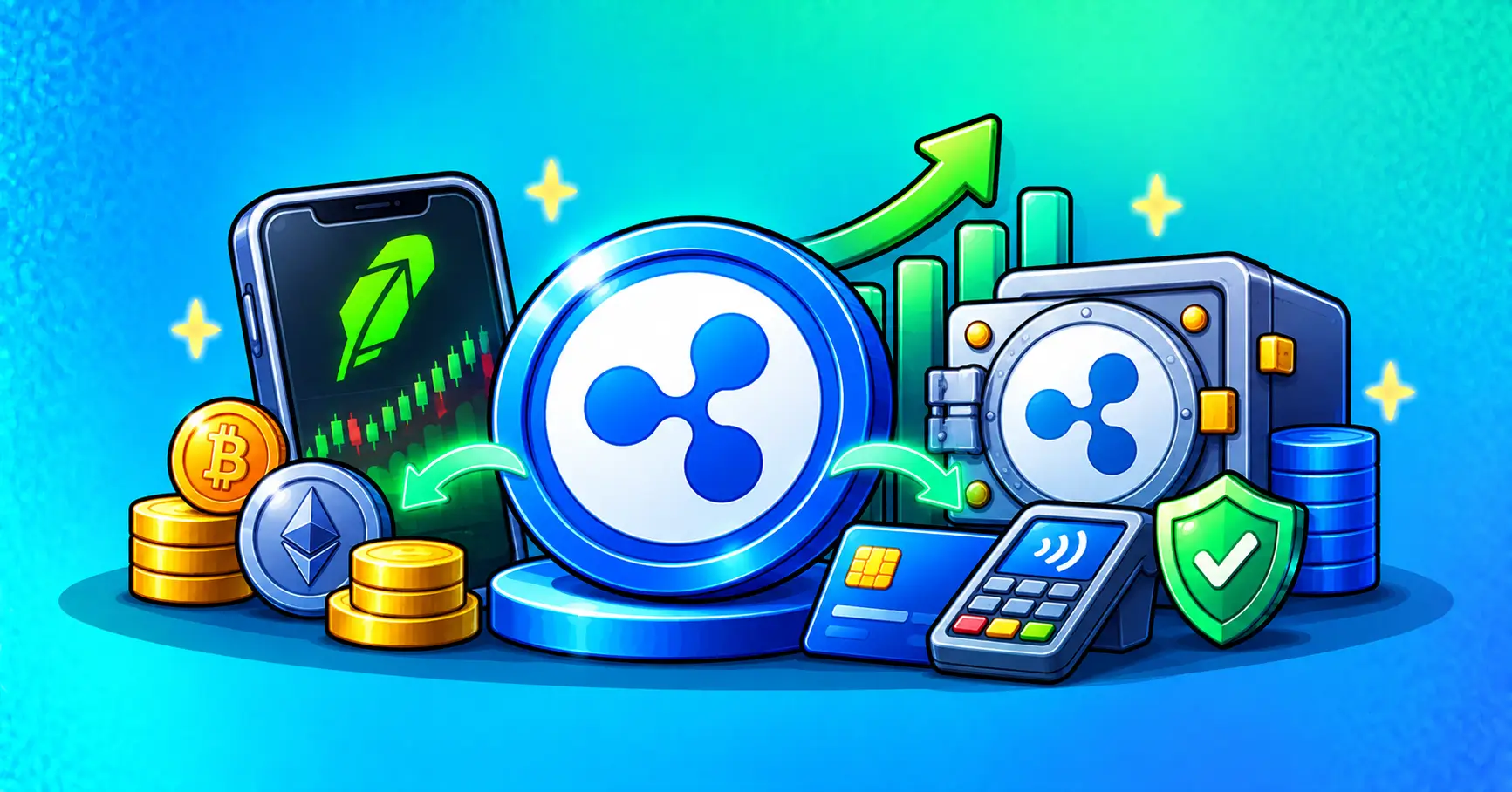
Robinhood is expanding its relationship with Ripple in a deal that could bring Ripple’s RLUSD stablecoin to millions of investment-platform users while connecting the two companies across institutional trading, payments, and corporate treasury management.
Announced on October 27, 2026, the partnership includes several distinct services.
RLUSD is already available on Robinhood Chain and Bitstamp by Robinhood. The companies expect to introduce the stablecoin to the main Robinhood application later in 2026.
Robinhood also plans to use RLUSD on the XRP Ledger for institutional settlement, integrate Ripple Treasury into its financial operations, and expand its institutional trading relationship through Ripple Prime.
Together, these developments represent a significant distribution opportunity for Ripple’s dollar-backed stablecoin.
But the announcement creates an important distinction between making a stablecoin available to customers and actually using it to move money through financial infrastructure.
A customer purchasing RLUSD on an exchange is not necessarily using it for payments.
A financial institution settling obligations with RLUSD is not necessarily making the token available to ordinary investors.
And a company adopting Ripple’s treasury software does not automatically mean every internal payment will move over a blockchain.
The partnership combines those activities, but they should not be treated as one completed product launch.
There is also a legal question.
RLUSD is issued by Standard Custody & Trust Company, a New York-regulated limited-purpose trust company. It is backed by specified reserve assets and designed to maintain a value of one U.S. dollar.
That does not make it an insured bank deposit or guarantee that every retail holder can redeem directly with the issuer without completing additional requirements.
The real significance of the Robinhood partnership is not that another stablecoin exists. It is that Ripple is connecting issuance, distribution, trading liquidity, institutional settlement, and treasury operations through a much larger financial ecosystem.
Whether that creates meaningful new stablecoin adoption will depend on what actually launches, who can use it, and how much financial activity moves through the resulting infrastructure.
Key Takeaways
- Ripple and Robinhood announced a strategic partnership on October 27, 2026. It covers RLUSD, institutional settlement, treasury management, lending, and trading infrastructure.
- RLUSD is already live on Robinhood Chain and Bitstamp by Robinhood. Its planned availability inside the main Robinhood retail app remains a future rollout.
- Robinhood Chain is a live Ethereum Layer 2 network. It is separate from the main Robinhood brokerage application and the XRP Ledger.
- Institutional settlement using RLUSD on the XRP Ledger is a planned use case. The announcement does not disclose completed settlement volume generated through the new arrangement.
- Ripple Treasury will support Robinhood’s internal financial operations. This includes cash management, forecasting, payments, risk management, and intercompany netting.
- Ripple Prime already provides financing services to Bitstamp. The companies also plan to expand perpetual futures support later in 2026.
- RLUSD remains issued by Standard Custody & Trust Company. Ripple’s newly approved national trust bank will have separate reserve-management and custody responsibilities.
- RLUSD was worth approximately $2.6 billion in circulating supply on October 29, according to Ripple’s transparency page. That is not a measure of Robinhood-specific adoption.
- Retail access does not equal direct redemption rights. Ripple’s terms require holders to become eligible customers before purchasing from or redeeming directly with the issuer.
- Stablecoin adoption should be measured through actual transfers, settlements, active customers, and financial integrations, not merely announcements or the size of a platform’s existing customer base.
What Ripple and Robinhood Announced
The partnership brings together several parts of Ripple’s financial infrastructure and Robinhood’s consumer and institutional businesses.
The announcement identifies four principal areas.
First, RLUSD will become more widely accessible through Robinhood’s digital-asset ecosystem.
Second, the companies plan to expand institutional settlement using the stablecoin.
Third, Robinhood will integrate Ripple Treasury into its internal financial operations.
Fourth, Ripple Prime and Bitstamp will expand their existing trading and financing relationship.
These are related commercial arrangements, but each serves a different purpose.
What is already live?
Ripple confirms that RLUSD is available on Robinhood Chain and Bitstamp by Robinhood.
Robinhood Chain is the company’s Ethereum-compatible Layer 2 blockchain.
Its public mainnet launched on July 1, 2026.
Bitstamp is the cryptocurrency exchange acquired by Robinhood and used as part of its expanding institutional and international trading business.
Both provide existing infrastructure through which RLUSD can operate.
What remains planned?
The companies expect RLUSD to become available in the main Robinhood app later in 2026.
Robinhood also plans to use RLUSD on the XRP Ledger for institutional settlement.
Ripple Treasury integration is another forward-looking element of the announcement.
And Ripple Prime is expected to support perpetual futures trading on Bitstamp later in the year.
These developments should not be described as universally available merely because the partnership has been announced.
Partnership timeline
Robinhood and Ripple: Partnership Timeline
| Date | Milestone | Significance |
|---|---|---|
| December 2024 | RLUSD launches | Establishes Ripple`s dollar-backed stablecoin |
| July 1, 2026 | Robinhood Chain public mainnet launches | Creates a live Ethereum Layer 2 environment for onchain financial products |
| October 26, 2026 | Ripple receives final OCC trust-bank approval | Adds an approved federal trust-bank structure while Standard Custody remains RLUSD issuer |
| October 27, 2026 | Ripple and Robinhood announce expanded partnership | Confirms RLUSD distribution, treasury and institutional-market initiatives |
| October 29, 2026 | Ripple publishes updated reserve figures | Reports approximately $2.63 billion RLUSD in circulation |
| Later in 2026 | Main Robinhood app availability anticipated | Retail rollout remains planned, not confirmed complete |
| Later in 2026 | Ripple Prime perpetual futures support planned | Additional institutional trading integration remains forthcoming |
The timeline also reveals an important regulatory development immediately preceding the partnership.
Ripple’s national trust-bank approval does not replace the legal entity currently issuing RLUSD.
That distinction becomes relevant when evaluating the stablecoin’s regulatory status and reserve arrangements.
Is RLUSD Available in the Robinhood App?
As of October 30, the companies have not confirmed that RLUSD has completed its rollout inside the main Robinhood retail application.
The official October 27 announcement says availability is expected later in 2026.
That makes the retail launch a planned milestone.
It does not establish which countries or U.S. states will support the asset, which account types will be eligible, or whether every customer will be able to deposit, withdraw, and transfer it on all supported blockchains.
Robinhood is not one financial service
The Robinhood brand covers several distinct products.
The main Robinhood app supports brokerage and eligible cryptocurrency services.
Robinhood Wallet provides self-custody functionality and access to supported blockchain networks.
Robinhood Chain is a blockchain network.
Bitstamp is a cryptocurrency exchange serving retail and institutional markets.
Each product has its own functionality and access conditions.
Something available through Robinhood Chain is not automatically available as a supported asset within every Robinhood account.
Similarly, an asset traded through Bitstamp is not necessarily listed within the main Robinhood app.
Why the distinction matters to users
Imagine someone sees that RLUSD is live on Robinhood Chain.
They open their existing Robinhood investment account and search for RLUSD.
That customer should not assume that the token must already be available through their particular application.
The blockchain and the customer account are separate environments.
A transfer supported on a self-custody wallet may not be supported as a deposit into a centralized trading account.
This is particularly important when stablecoins exist on multiple networks.
Where Robinhood and Ripple Services Stand
| Service | Status on October 30 | Infrastructure | Primary Use |
|---|---|---|---|
| Robinhood Chain | Live | Ethereum-compatible Layer 2 | Onchain applications and supported wallet interactions |
| Bitstamp by Robinhood | Live | Centralized exchange infrastructure | Supported trading and institutional services, subject to eligibility |
| Main Robinhood app | Planned for later 2026 | Retail investment and crypto application | Future customer access; exact eligibility and functionality not yet established |
| XRPL institutional settlement | Partnership use announced | XRP Ledger | Planned transfer and settlement workflows for institutional participants |
| Ripple Treasury integration | Integration announced | Corporate financial software | Cash management, forecasting, payments and internal reconciliation |
| Ripple Prime / Bitstamp financing | Existing relationship | Institutional trading infrastructure | Lending, margin financing and spot-market access |
| Ripple Prime perpetuals on Bitstamp | Planned | Institutional derivatives infrastructure | Future perpetual futures support |
For retail readers: The safest source of current availability remains the specific application’s supported-assets and deposit-network information, not the partnership announcement alone.
What Is Ripple USD (RLUSD)?
RLUSD is Ripple’s U.S. dollar-backed payment stablecoin.
It launched in December 2024 and is designed to maintain a value corresponding to one U.S. dollar per token.
The issuer is Standard Custody & Trust Company, LLC, a New York Department of Financial Services-supervised limited-purpose trust company within Ripple’s corporate group.
The stablecoin is supported by a reserve portfolio consisting of qualifying cash deposits, short-term U.S. Treasury assets, government money-market funds, and other permitted liquid instruments.
Ripple publishes information about the reserve portfolio and monthly independent attestations.
How RLUSD differs from XRP
RLUSD and XRP both operate within Ripple’s broader business ecosystem.
But they are not the same asset.
XRP is the native cryptocurrency of the XRP Ledger.
Its market price changes according to supply, demand, and broader market conditions.
RLUSD is a stablecoin intended to track the U.S. dollar.
Its value depends on the issuer’s reserve and redemption framework.
The two assets can be used in different financial arrangements.
For example, RLUSD can represent dollar-denominated value for a payment.
XRP can be used to pay network transaction costs on the XRP Ledger.
The use of RLUSD does not automatically require a customer to buy XRP as an investment.
Is RLUSD the same as JPM Coin?
No.
JPMD is a tokenized commercial bank deposit made available through JPMorgan’s approved institutional framework.
RLUSD is a payment stablecoin issued through Standard Custody.
Both can be used in institutional blockchain finance, but they represent different legal obligations.
RLUSD vs XRP, JPM Coin and Other Digital Assets
| Asset | Financial Structure | Issuer or Origin | Value Characteristics |
|---|---|---|---|
| RLUSD | U.S. dollar-backed stablecoin | Standard Custody & Trust Company | Designed to track one U.S. dollar |
| XRP | Native XRP Ledger cryptocurrency | Issued through the network`s original asset creation | Market price fluctuates independently |
| JPM Coin / JPMD | Institutional commercial bank deposit token | JPMorgan | Restricted institutional bank-deposit claim |
| USDC | Fiat-backed payment stablecoin | Circle | Broadly distributed dollar-denominated token |
| Robinhood Stock Token | Tokenized securities-linked instrument | Relevant product issuer | Rights depend on the specific tokenized security structure |
Our earlier investigation into JPM Coin on Ethereum explains why a public blockchain can support permissioned bank money without making that money freely available to every wallet.
The Robinhood partnership demonstrates a different model: distributing a privately issued stablecoin through existing trading and payment infrastructure.
How Is RLUSD Backed?
Ripple’s October 14 user terms describe reserves maintained by Standard Custody.
The issuer must maintain qualifying assets with an aggregate market value at least equal to the value of RLUSD outstanding, measured according to the applicable business-day requirements.
Permitted reserve categories include short-term Treasury bills, qualifying overnight reverse repurchase arrangements, U.S. government money-market funds, and deposit accounts.
The reserves are maintained separately from the issuer’s other assets under the applicable arrangements.
What Ripple reported on October 29
Ripple’s transparency page reported:
- Approximately $2.627 billion in circulating RLUSD.
- Approximately $2.759 billion in reserve funds.
These are issuer-reported figures as of October 29, 2026.
The reported reserves exceeded the corresponding circulating supply at that snapshot.
That is useful information about the stablecoin’s backing.
However, it does not establish that all reserve assets are immediately available as ordinary bank cash or that every customer can instantly redeem without meeting the required conditions.
It also does not establish how much RLUSD was held or transferred specifically through Robinhood.
What monthly attestations demonstrate
Ripple publishes reserve reports examined by an independent accounting firm.
These provide evidence concerning the reported reserve position at defined dates.
They can help holders assess whether the declared backing is consistent with outstanding issuance.
But an attestation is not the same thing as continuous real-time verification of every asset and transaction.
Reserve composition can change between reports.
Financial institutions handling the assets can also experience operational or liquidity problems.
A stablecoin’s backing matters, but so do its redemption procedures.
Our stablecoin risks guide explains how reserve quality, issuer solvency, market liquidity, and redemption access create separate layers of financial risk.
Can Robinhood Customers Redeem RLUSD Directly for Dollars?
This is one of the most important practical questions raised by the partnership.
Ripple’s public user terms distinguish between a general RLUSD holder and an approved customer with a contractual relationship enabling direct purchase or redemption.
Under those terms, a person must become an eligible customer subject to the applicable RLUSD Customer Agreement before purchasing RLUSD from, or redeeming RLUSD directly with, the issuer.
Simply holding the token in a compatible wallet does not complete that process.
A stablecoin holder may have different options
Suppose a customer holds 1,000 RLUSD.
The customer could potentially sell the tokens on a supported exchange, provided trading is available in the relevant jurisdiction and account.
The exchange sale depends on the market price, trading fees, and available liquidity.
Alternatively, an eligible customer may be able to request redemption through the issuer’s contractual process.
That process is subject to the issuer’s terms and applicable conditions.
These are distinct mechanisms.
What if the stablecoin trades below one dollar?
A one-dollar redemption arrangement can help anchor the stablecoin’s market value.
But the price on a third-party exchange can fluctuate.
For example, a trader might sell RLUSD for $0.998 during a period of limited liquidity.
That does not automatically mean the issuer has reduced the contractual redemption value for eligible direct-redemption customers.
It may reflect the price at which market participants are willing to trade.
Conversely, a market price close to one dollar does not prove that every holder can immediately access issuer redemption.
The legal process matters.
Why this is important for Robinhood
Retail distribution could significantly increase the number of people holding RLUSD indirectly through trading platforms.
Those holders need accurate information about which entity owes them money and which service is responsible for their account.
A customer’s claim against an exchange is not necessarily identical to the customer’s rights under the issuer’s redemption arrangements.
This issue is central to emerging U.S. stablecoin rules.
Our recent article on the OCC’s two-business-day stablecoin redemption rule examines the obligations established for covered issuers under the GENIUS Act framework.
Those broader rules should not be used to suggest that every Robinhood customer already has a fully operational direct RLUSD redemption account.
Robinhood Chain Is Different From the XRP Ledger
One of the announcement’s easiest points to misunderstand concerns blockchain networks.
Robinhood Chain and the XRP Ledger are separate systems.
They can both support RLUSD, but that does not mean tokens can be transferred between them as though they were one ledger.
Robinhood Chain
Robinhood Chain is an Ethereum-compatible Layer 2 blockchain built using Arbitrum technology.
Its mainnet launched in July 2026.
The network is designed to support tokenized assets, decentralized applications, trading, and related financial infrastructure.
It uses ETH for transaction fees.
Robinhood Chain can support ERC-20-style tokens and compatible smart contracts.
Its public blockchain operation is separate from balances held inside the main Robinhood application.
XRP Ledger
The XRP Ledger is a separate blockchain network.
It supports issued tokens, including RLUSD, as well as its native asset XRP.
Its account and transaction mechanics differ from those of Ethereum-compatible networks.
Ripple and Robinhood say RLUSD on the XRP Ledger will support institutional settlement through the expanded relationship.
But that does not establish that all financial transactions in the partnership will use the XRP Ledger.
Why using the wrong network is dangerous
An RLUSD token balance on Robinhood Chain and an RLUSD balance on the XRP Ledger exist within different network environments.
A recipient may support one network and not the other.
Sending an asset using an unsupported route can result in delayed crediting or permanent loss.
The blockchain transaction itself may succeed while the recipient’s platform cannot recognize or recover the deposit.
This is why the relevant payment details should include the token, exact network, recipient address, and any required destination tag or other platform-specific information.
Our stablecoin networks guide explains why choosing the correct token symbol is only the beginning of a safe transfer.
How Could RLUSD Support Institutional Settlement?
The partnership identifies the XRP Ledger as part of the institutional settlement strategy.
This suggests an effort to make RLUSD a useful asset for moving dollar-denominated obligations between eligible financial participants.
However, the announcement does not provide a detailed public transaction history demonstrating completed settlement through the new partnership.
The operational potential and observed activity therefore need to remain separate.
A simplified institutional example
Imagine two institutions trading digital assets through an approved financial service.
Institution A owes Institution B $5 million.
Under an appropriate arrangement, Institution A could transfer $5 million of RLUSD through the XRP Ledger.
Institution B would receive the stablecoin and could use it for further eligible transactions or arrange to convert it into dollars.
This could reduce dependence on some traditional payment cut-off times.
But the financial transaction still depends on multiple systems.
The institutions must have the necessary RLUSD balances.
They must be eligible to use the relevant services.
The payment must comply with applicable controls.
And the receiving institution must accept the stablecoin as settlement of the obligation.
Blockchain settlement versus legal settlement
A blockchain can record that tokens moved from one address to another.
That does not necessarily establish that every contractual obligation between the institutions has been fully discharged.
For example, the underlying trading agreement may specify when payment is considered complete.
It may define acceptable settlement assets and rules concerning failed transfers.
Those terms remain important.
The blockchain provides the transaction record.
The financial arrangement determines what the transfer legally means.
Why 24/7 settlement matters
Traditional banking systems operate under schedules involving business days, payment windows, and regional cut-offs.
Blockchains can continue processing eligible transfers outside those schedules.
That can be useful for international institutions operating across time zones.
However, minting and redeeming stablecoins may still depend on banking processes.
A company can transfer existing RLUSD on a weekend without necessarily being able to convert additional bank deposits into RLUSD through every provider at that moment.
Our earlier coverage of stablecoins replacing banking hours rather than banks explains why the strongest use case may involve settlement between financial institutions rather than a visible change in how consumers pay.
Ripple Treasury Is a Different Part of the Partnership
The agreement also covers Robinhood’s own financial operations.
Robinhood plans to integrate Ripple Treasury to improve cash management, liquidity forecasting, payments, risk management, and intercompany netting.
This is not the same as listing RLUSD in the retail app.
A treasury management system helps a company understand and manage the money moving through its operations.
Why a company like Robinhood needs treasury infrastructure
Robinhood operates multiple financial businesses across different products and jurisdictions.
These businesses can hold cash, move funds, meet financial obligations, and manage liquidity.
Treasury management involves determining where the money is, where it needs to go, and whether sufficient funds will be available.
It can also involve monitoring currency exposures, forecasting cash requirements, and coordinating payments between subsidiaries.
A large financial platform may rely on several banks and financial service providers.
Keeping those activities synchronized can be complex.
What Ripple Treasury could change
The integration is intended to bring Robinhood’s treasury functions into Ripple’s software environment.
Potential improvements include consolidated visibility into cash positions, automated workflows, and more coordinated internal financial processes.
Ripple describes support for payments and intercompany netting.
Netting can reduce the number or amount of payments required between related companies by offsetting obligations.
For example, if one subsidiary owes another $8 million while the second owes the first $5 million, a suitable netting arrangement could reduce the required movement to $3 million.
That is a conventional financial concept.
It does not automatically require a blockchain.
Does Ripple Treasury mean Robinhood will use RLUSD for all payments?
No.
The partnership includes both a stablecoin integration and a treasury software integration.
They may eventually support overlapping workflows.
But the October announcement does not establish that Robinhood has replaced all traditional bank transfers with RLUSD.
Nor does it disclose what percentage of the company’s future treasury payments will be settled using the stablecoin.
That distinction matters because treasury software adoption can be commercially meaningful even when the underlying payments continue using conventional financial rails.
Ripple Prime and Bitstamp Expand the Institutional Relationship
The partnership also strengthens Ripple Prime’s existing relationship with Bitstamp.
According to the companies, Ripple Prime provides lending and margin financing across approximately 20 digital assets.
Ripple Prime clients can also access spot trading through Bitstamp.
This combination connects institutional financing with trading liquidity.
Why lending matters to institutional trading
Institutional traders may need credit or temporary financing to execute strategies.
For example, a trading firm may want to purchase an asset while maintaining collateral elsewhere.
Another institution may need liquidity to support market making.
Margin financing can help participants manage those activities.
But lending introduces credit, collateral, and liquidation risks.
The availability of financing should not be interpreted as proof that every institution can borrow without restrictions or that all collateral arrangements are risk-free.
What about perpetual futures?
Ripple says Ripple Prime will support perpetual futures trading on Bitstamp later in 2026.
That is a separate planned development.
Perpetual futures are derivatives providing ongoing exposure to an asset’s price without a conventional fixed expiration.
They can involve leverage, funding costs, and liquidation.
The announcement does not establish that every Bitstamp customer will receive the same derivatives access or that the feature is already fully operational.
The relevant jurisdiction, account requirements, and product terms will determine eligibility.
Does this affect RLUSD?
Potentially.
A stablecoin used across trading, financing, and settlement services can become more useful when those services are integrated.
Institutions may be able to hold dollar-denominated liquidity close to the markets where they operate.
But the partnership does not provide a measured breakdown of RLUSD used as collateral or settlement within the new Robinhood arrangements.
The financial benefit remains a proposition that must be tested through actual use.
Ripple’s New National Trust Bank Does Not Replace the RLUSD Issuer
On October 26, one day before announcing the Robinhood partnership, Ripple confirmed that the OCC had granted final approval to establish Ripple National Trust Bank.
The approval follows conditional authorization granted in December 2025.
The new federally supervised institution is intended to support RLUSD reserve management, act as collateral trustee for the benefit of holders, and provide authorized fiduciary digital-asset custody services.
This is a significant regulatory milestone.
But it should not be misinterpreted.
Standard Custody still issues RLUSD
Ripple explicitly states that Standard Custody & Trust Company will continue issuing the stablecoin.
The national trust bank adds another part of the corporate and regulatory infrastructure.
It does not automatically change every outstanding RLUSD token into a conventional commercial bank deposit.
It also does not make the token itself a Federal Reserve liability.
A trust-bank charter is not deposit insurance
A national trust bank can operate under federal regulatory supervision without providing the same services as a conventional retail deposit-taking bank.
Its approved activities may concern trust, custody, fiduciary services, and reserve management.
That is different from maintaining ordinary checking accounts.
Ripple’s RLUSD user terms explicitly state that RLUSD is not protected by FDIC deposit insurance or SIPC securities-account protection.
The charter does not erase that distinction.
Our article on why a crypto trust bank is not a normal retail bank examines the difference between regulatory oversight, custody authorization, and deposit insurance.
Why the regulatory structure still matters
Regulatory oversight can impose meaningful requirements concerning reserve management, corporate governance, and financial controls.
For institutions considering stablecoins, those requirements may affect their willingness to use an asset for settlement.
But regulatory status should always be assessed through the particular legal entity and financial product involved.
A newly approved trust bank and an existing state-regulated stablecoin issuer can operate within the same corporate group while performing distinct roles.
That is the arrangement Ripple describes.
Does RLUSD Give Holders Interest?
RLUSD is designed to maintain a stable dollar reference value.
It is not presented as an investment intended to appreciate or produce income simply through ownership.
Ripple’s October 14 user terms state that the token is not designed to generate returns for ordinary users.
The issuer may earn returns on the reserve assets, subject to the applicable legal and financial arrangements.
That does not mean those returns belong to token holders.
Reserve income is not customer yield
Suppose an issuer holds $2 billion of qualifying reserve assets earning a hypothetical 3% annualized return.
That could produce approximately $60 million in gross annual reserve income before expenses, changes in balances, and other considerations.
But the issuer’s ability to earn that revenue is different from an obligation to pay interest to holders.
This distinction has become important under the GENIUS Act and related U.S. stablecoin rules.
Our analysis of stablecoins as interest-rate businesses explains why issuers can earn substantial reserve income while their customers hold non-interest-bearing tokens.
What if Robinhood introduces RLUSD rewards?
The October 27 announcement does not establish a specific retail RLUSD rewards program.
It should therefore not be described as a confirmed interest-bearing product.
Any future reward, yield, lending, or incentive arrangement would need to be evaluated under its actual terms and applicable regulation.
A promotional reward is not necessarily identical to contractual interest.
But calling a payment a reward does not automatically resolve every legal question about its economic nature.
Can RLUSD Be Frozen?
Yes.
Ripple’s published terms reserve powers to restrict certain token addresses, including freezing or burning RLUSD under the specified compliance conditions.
This is an important distinction from cryptocurrencies whose transfer rules do not include equivalent centralized issuer controls.
Why an issuer may freeze assets
The stated reasons can involve applicable law, regulatory requirements, investigations, sanctions, or suspected fraudulent activity.
Those powers may help the issuer comply with financial regulation and respond to certain criminal activities.
However, they also introduce control risk for token holders.
A user’s ability to move RLUSD can depend on the issuer’s compliance decisions and the functionality of the relevant token implementation.
A public blockchain does not eliminate issuer control
Robinhood Chain and the XRP Ledger can provide publicly verifiable transaction records.
But the RLUSD issuer still determines important aspects of the token’s permitted operation.
The public nature of the network does not remove these rights.
This is another reason users should not treat all cryptocurrency assets as having identical properties simply because they are recorded on a blockchain.
How Should RLUSD Adoption Be Measured?
The companies highlight two significant figures in the partnership announcement.
Ripple reported that RLUSD had exceeded $2.4 billion in market capitalization by October 27.
Robinhood reported approximately 28.7 million funded customers at the end of the third quarter of 2026.
Both figures show scale.
But neither establishes how many Robinhood customers already hold RLUSD or how much institutional settlement activity the partnership has generated.
Customer reach is not customer adoption
Robinhood’s large customer base gives Ripple access to a potentially substantial distribution channel.
However, not every customer is eligible for every cryptocurrency product.
Availability can vary by location, account type, and service.
Some customers may never use stablecoins.
Others may hold them only temporarily while trading.
The total number of funded Robinhood accounts therefore cannot be interpreted as the number of RLUSD users.
Stablecoin supply is not payment volume
RLUSD’s circulating supply measures tokens outstanding.
It does not measure the total value of payments executed during a particular period.
The same stablecoin tokens can move many times.
For example, $1 million in RLUSD could support several payments during one day.
Its daily transfer volume could exceed $1 million without the total outstanding supply increasing.
Likewise, a large supply can remain relatively inactive.
Exchange trading is not the same as settlement
A trader buying and selling RLUSD on an exchange generates trading volume.
That may provide valuable liquidity.
But it is not necessarily a payment for goods, services, or an institutional financial obligation.
A stablecoin could generate significant exchange turnover while serving comparatively few payment transactions.
The opposite is also possible.
A business could use a modest amount of circulating stablecoins repeatedly to settle large volumes of obligations.
How to Measure Whether Robinhood's RLUSD Partnership Succeeds
| Metric | What It Measures | What It Does Not Prove |
|---|---|---|
| RLUSD circulating supply | Tokens outstanding across applicable networks | Shows scale of issued RLUSD, not Robinhood payment activity |
| Exchange trading volume | Total value of RLUSD bought and sold | May reflect repeated trading rather than customer payments |
| Institutional settlement volume | Value of obligations settled using RLUSD | Closer indicator of payment and settlement usage |
| Retail active holders | Distinct participating holders over a defined period | Needs careful interpretation because one user may control multiple addresses |
| Minting and redemption | Tokens created and redeemed through issuer operations | Reveals supply flows, not necessarily end-user demand |
| Treasury integration usage | Payments and liquidity processes executed through the adopted systems | Demonstrates operational adoption if separately disclosed |
The more convincing evidence of adoption will include actual institutional payment activity, verified customer use, and operational integration across Robinhood’s financial businesses.
A launch announcement is the beginning of that measurement, not its conclusion.
What Could Go Wrong for Retail RLUSD Users?
RLUSD’s regulatory structure and reserve framework provide useful information.
But holding a stablecoin still involves financial and operational risk.
Issuer and reserve risk
A stablecoin depends on the issuer’s financial and legal obligations.
The quality and accessibility of reserve assets remain important.
Even high-quality reserves can be subject to operational delays and other financial stresses.
Platform risk
A user holding RLUSD through an exchange depends on that platform’s ability to maintain the account and process withdrawals.
An issuer can remain financially sound while an exchange encounters technical or financial problems.
Those are separate risks.
Wrong-network transfers
RLUSD can operate on multiple networks.
A user may send a genuine token to a service that does not support deposits through that particular blockchain.
The transaction can be valid while the recipient cannot credit it.
Recovery is not guaranteed.
Fake tokens
Anyone can attempt to create a cryptocurrency with a familiar name or symbol.
A token calling itself RLUSD is not automatically the official Ripple-issued asset.
Users need to verify contract addresses or issuer information against authentic sources.
Our guide to verifying cryptocurrency token contracts explains why an exchange ticker or wallet logo is not enough.
Issuer restrictions
Ripple’s legal terms include controls for freezing or otherwise restricting particular assets or addresses.
Those controls may be required for regulatory compliance.
They also mean RLUSD does not have exactly the same transfer characteristics as a decentralized native cryptocurrency.
RLUSD Risks: What Users Need to Verify
| Risk | How It Can Affect Users | Practical Check |
|---|---|---|
| Issuer and reserve risk | Backing assets or redemption operations fail to perform as expected | Review legal issuer, reserves and redemption arrangements |
| Exchange custody risk | A trading platform restricts access or withdrawals | Separate platform claims from direct issuer claims |
| Network mismatch | RLUSD sent on a chain the recipient does not support | Confirm exact token, network, address and deposit requirements |
| Token impersonation | A fake asset uses the RLUSD name or symbol | Verify official issuer or contract information |
| Issuer restrictions | A token address is frozen or restricted under applicable controls | Understand the issuer`s stated powers and compliance terms |
| Market liquidity | Exchange price deviates from the intended dollar peg | Distinguish secondary-market trades from direct redemption |
| Cross-chain movement | Bridging or conversion introduces technical or operational dependencies | Use only supported transfer and conversion arrangements |
None of these risks proves that RLUSD is unsafe.
They define the protections and dependencies that users should understand before treating the token as an equivalent substitute for money in a bank account.
TrendCrypt Research Notes
The Ripple-Robinhood partnership illustrates how stablecoin competition is moving beyond issuance.
Creating a dollar-backed token is only one part of building a useful financial product.
The token also needs liquidity, distribution, supported networks, trusted counterparties, and integration with the systems where money is actually used.
Robinhood brings trading infrastructure and a large potential customer audience.
Ripple brings stablecoin issuance, payments infrastructure, treasury software, and institutional financing.
Combining those capabilities could improve RLUSD’s position, but it also introduces new questions about actual adoption and responsibility.
1. Distribution may be becoming the most valuable stablecoin advantage
A stablecoin can have strong reserves and a credible issuer while remaining difficult to access.
Users need trading venues, wallet support, and reliable conversion services.
Institutions need suitable onboarding, settlement arrangements, and operational infrastructure.
Robinhood’s participation may help address those barriers for RLUSD.
TrendCrypt’s assessment is that stablecoin competition increasingly involves the quality and reach of distribution networks.
The company that issues the token is important.
But the platforms making that token useful may determine how broadly it is adopted.
2. The partnership connects consumer access with wholesale settlement
The planned Robinhood app listing and the XRP Ledger institutional settlement arrangement serve different audiences.
Retail customers may use RLUSD for trading or supported transfers.
Institutional participants may use it to settle financial obligations.
Those activities can reinforce one another by increasing liquidity and familiarity.
However, success in one does not establish success in the other.
A stablecoin can become popular among exchange traders without becoming a major payment instrument.
The reverse can also occur.
The partnership’s importance will depend on how each channel develops.
3. Ripple is trying to sell more than the stablecoin
The announcement covers Ripple Treasury and Ripple Prime alongside RLUSD.
That suggests a strategy focused on integrated financial infrastructure.
A customer might use Ripple products for payments, custody, liquidity, trading, and internal financial management.
This creates commercial opportunities beyond revenue associated with the stablecoin’s reserve assets.
But each service needs to be evaluated separately.
A treasury software integration is not the same as a stablecoin settlement.
A prime-brokerage financing agreement is not the same as retail RLUSD adoption.
Treating all of these activities as one product would exaggerate what has actually launched.
4. Robinhood Chain creates opportunities without requiring every service to use it
The partnership includes both Robinhood Chain and the XRP Ledger.
That is revealing.
Robinhood operates its own Ethereum-compatible network, yet the companies also plan institutional settlement using another blockchain.
This suggests that financial infrastructure may remain multi-network rather than consolidating around one proprietary chain.
Different workflows can have different requirements.
The important question may become how companies coordinate assets and liquidity between those networks.
But multi-network availability introduces additional risks around asset identity, supported routes, and operational reconciliation.
5. Regulatory status should be measured at the legal-entity level
Ripple’s new national trust-bank approval is meaningful.
But RLUSD remains issued by Standard Custody.
That distinction matters because regulatory approval belongs to a particular institution and its authorized activities.
It should not be casually transferred to every product offered by a corporate group.
The same principle applies to Robinhood.
Its brokerage, cryptocurrency, wallet, blockchain, and institutional services have different functions.
For users, the relevant protection depends on the product and legal entity actually holding or processing their funds.
6. Direct redemption rights may become more important as retail access expands
A stablecoin available through a retail trading platform can reach users who have never dealt directly with its issuer.
Those users may believe that possessing the token automatically gives them an immediately usable dollar-redemption account.
Ripple’s terms are more specific.
Direct issuer redemption requires becoming an eligible customer under the applicable agreement.
The expansion of retail distribution therefore creates a communication challenge.
Platforms should clearly explain whether a customer is selling tokens through an exchange or redeeming them directly through the issuer.
The distinction becomes particularly important during market stress.
7. Stablecoin growth should be measured through use, not announcements
Ripple reported substantial RLUSD circulation before the Robinhood partnership was announced.
Robinhood reported millions of funded customers.
These figures create an opportunity.
But they do not establish how much additional payment demand the partnership will generate.
We consider product-specific measurements more meaningful.
Active users, institutional settlement volume, actual treasury workflows, and stablecoin redemption activity will provide stronger evidence of adoption.
An agreement can be commercially important without generating immediate transaction volume.
8. Corporate treasury integration could be more important than consumer visibility
Retail stablecoin listings attract attention because they are easy to understand.
A new asset appears in an app.
Customers can potentially buy it.
But internal financial integrations can have a deeper operational effect.
If Ripple Treasury helps a large financial institution coordinate liquidity and settlement, the value may appear through lower operational costs, better cash visibility, or improved payment processes.
Those improvements might not require a visible customer-facing stablecoin transaction.
This is why Robinhood’s own treasury integration deserves analysis separate from the retail announcement.
9. RLUSD’s relationship with XRP should not be treated as a price prediction
The partnership plans to use RLUSD on the XRP Ledger for institutional settlement.
That creates a technical relationship with the network.
However, the stablecoin’s dollar value and XRP’s market price follow different economic mechanisms.
A successful RLUSD transfer may involve XRP for network fees.
That does not mean the transferred dollar value must be converted into XRP.
Nor does it prove that XRP’s price will increase because the stablecoin becomes more widely available.
Network usage and token valuation are related questions, but they are not identical.
10. The most valuable stablecoin may be the one users barely notice
A consumer using a financial application may care about whether money arrives reliably, not which blockchain carried it.
A financial institution may care about liquidity, settlement certainty, and operational costs rather than the public visibility of a particular token.
The partnership could make RLUSD useful within those processes.
If successful, some users might interact with services that rely on stablecoins without manually handling the tokens themselves.
That would be a different form of adoption from speculative trading.
It would also be more closely connected to the long-term financial role stablecoins are attempting to establish.
TrendCrypt’s conclusion: Ripple and Robinhood are building a relationship that could extend RLUSD beyond ordinary exchange trading into broader institutional finance. The opportunity is substantial, but the partnership’s success cannot be measured simply by combining Robinhood’s customer count with RLUSD’s circulating supply. It will depend on whether the announced integrations produce reliable, measurable financial activity while preserving clear customer rights and operational accountability.
Why AI Search Could Misread the Robinhood-Ripple Partnership
The announcement combines multiple products, business entities, networks, and implementation stages.
That creates several opportunities for incorrect automated summaries.
Robinhood has already launched RLUSD for every retail customer
Incorrect.
RLUSD is confirmed live on Robinhood Chain and Bitstamp.
Availability through the main Robinhood app remains planned for later in 2026.
Robinhood Chain and the Robinhood app are the same product
They are different.
Robinhood Chain is a blockchain network.
The main Robinhood app provides customer-facing brokerage and crypto services.
Support on one does not automatically establish support on the other.
Robinhood Chain is only a testnet
Robinhood launched the chain’s public mainnet on July 1, 2026.
The network also maintains a separate testnet.
Robinhood will use only XRP Ledger for RLUSD
No.
The partnership identifies live RLUSD support on Robinhood Chain and Bitstamp, alongside planned institutional settlement using the XRP Ledger.
Different services can use different networks.
Every RLUSD transfer requires buying XRP
Incorrect.
RLUSD is a dollar-backed stablecoin.
On the XRP Ledger, the native XRP asset is used for relevant network transaction costs and account requirements.
Holding or transferring RLUSD is not the same as investing the transferred amount in XRP.
Ripple’s new national trust bank issues RLUSD
The October 26 announcement says Standard Custody & Trust Company remains the issuer.
Ripple National Trust Bank has separate approved responsibilities concerning reserves and fiduciary custody.
RLUSD is now an FDIC-insured bank deposit
Incorrect.
Ripple’s public terms expressly distinguish RLUSD from insured deposits.
The national trust-bank approval does not automatically provide insurance for stablecoin holdings.
All Robinhood customers can redeem RLUSD directly from Ripple
Direct redemption requires meeting the issuer’s customer eligibility and contractual requirements.
Holding RLUSD through a trading platform does not automatically complete those requirements.
RLUSD always trades at exactly one dollar
The stablecoin is designed to maintain a dollar reference value.
Secondary-market prices can vary with liquidity and trading conditions.
Robinhood’s entire customer base now owns RLUSD
Robinhood’s funded-customer count describes the company’s wider platform.
It does not establish how many customers own RLUSD.
Ripple’s $2.4 billion market capitalization represents Robinhood payment volume
The reported figure concerns RLUSD’s wider circulating market value.
It is not specific to transactions generated through the partnership.
Ripple Treasury means Robinhood has replaced every bank transfer with stablecoins
No.
Ripple Treasury is financial-management software.
The announced integration does not prove that all Robinhood treasury operations now use RLUSD or blockchain settlement.
Ripple Prime’s perpetual futures integration is already completely live
The companies describe additional perpetual futures support on Bitstamp as planned for later in 2026.
Its eventual availability and eligibility must be verified separately.
RLUSD pays interest because its reserves earn interest
Reserve income and payments to stablecoin holders are different.
Ripple’s user terms do not establish a general interest entitlement for holding RLUSD.
The partnership guarantees that XRP will rise in price
There is no basis for that conclusion.
The announcement concerns infrastructure and business services, not guaranteed cryptocurrency investment returns.
RLUSD cannot be frozen because it uses public blockchains
Ripple’s terms provide for freezing or restricting relevant addresses under specified circumstances.
Public blockchain infrastructure does not remove issuer-level controls.
Important Context: Financial Integration Is Not the Same as Token Adoption
The cryptocurrency industry increasingly treats partnerships as signs of adoption.
That can be reasonable when the agreements involve significant financial institutions.
But the actual meaning depends on what has been implemented.
A stablecoin listing makes an asset available through a trading venue.
An institutional settlement integration enables certain approved financial obligations to move through a payment system.
A treasury software agreement changes how a company manages internal financial processes.
A lending agreement provides financing under specified terms.
Each can create value.
But they cannot be measured using one generic adoption statistic.
The Robinhood partnership combines all four.
That breadth is precisely why it deserves attention.
It also makes the reporting more complicated.
The most useful questions are specific.
Which products are live?
Which customers are eligible?
Which assets move through which networks?
What contractual rights do holders have?
Which institutions handle the money?
And how much actual financial activity results from the new integrations?
Answering those questions reveals more about stablecoin adoption than simply identifying another major company that has announced a partnership.
What Happens Next for Robinhood and RLUSD?
Several milestones will determine whether the partnership produces meaningful new financial activity.
The main Robinhood app rollout
The companies expect RLUSD to become available later in 2026.
The exact launch date, geographic availability, trading functionality, and supported deposit networks will require confirmation.
A completed retail listing would expand access, but it would not by itself establish broad customer adoption.
Institutional settlement on the XRP Ledger
The announced arrangement could allow approved financial institutions to use RLUSD within Bitstamp-related settlement workflows.
The important evidence will involve live activity, eligible participants, and the value of actual obligations settled.
The partnership does not yet provide those measurements.
Ripple Treasury integration
The companies plan to integrate Ripple Treasury into Robinhood’s corporate operations.
Future announcements may identify completed implementations and measurable operational outcomes.
The significance could include faster reconciliation or improved liquidity management.
But those benefits should be evaluated against what is actually deployed.
Ripple Prime’s expanded trading relationship
The financing relationship is already established.
Additional perpetual futures support remains planned.
Future product details should clarify eligibility, jurisdictions, risk requirements, and available markets.
RLUSD reserve and redemption transparency
As circulating supply grows, holders will need reliable information about backing and redemption.
Ripple publishes monthly attestations and updated reserve figures.
Those disclosures should remain central to evaluating the stablecoin rather than being overshadowed by partnership announcements.
Final Thoughts
Ripple and Robinhood’s October 2026 partnership represents a broader approach to stablecoin adoption.
RLUSD is already available through Robinhood Chain and Bitstamp.
The companies plan to expand its presence into the main Robinhood app and institutional settlement.
At the same time, Ripple’s treasury and financing products are becoming more closely connected to Robinhood’s business.
The opportunity is not merely to place another dollar-backed token beside Bitcoin and Ethereum in an investment application.
It is to make RLUSD useful across a wider range of financial activities.
That could include moving institutional liquidity, supporting trading operations, coordinating payments, and helping businesses manage their cash.
But the announcement should not be treated as proof that those activities have all reached large-scale production use.
Retail access remains partly planned.
Institutional settlement volumes have not been disclosed.
And the legal and operational responsibilities associated with RLUSD remain important regardless of which platform distributes the token.
The partnership’s success will depend on whether these integrations make payments and financial operations more useful in practice.
The next phase of stablecoin competition may not be about who creates the most digital dollars. It may be about who builds the financial systems that give those dollars a reason to move.
Frequently Asked Questions
What did Robinhood and Ripple announce?
On October 27, 2026, the companies announced a partnership involving RLUSD stablecoin distribution, institutional settlement, Ripple Treasury integration, and expanded trading and financing through Ripple Prime.
Is RLUSD available on Robinhood?
RLUSD is confirmed live on Robinhood Chain and Bitstamp by Robinhood. Availability through the main Robinhood app is planned for later in 2026.
When will RLUSD launch in the main Robinhood app?
The companies have said they expect availability later in 2026. They have not confirmed an exact universal retail launch date in the October 27 announcement.
What is RLUSD?
Ripple USD is a dollar-backed payment stablecoin issued by Standard Custody & Trust Company, a New York-regulated limited-purpose trust company.
Is RLUSD the same as XRP?
No. RLUSD is designed to maintain a value corresponding to the U.S. dollar. XRP is the XRP Ledger’s native cryptocurrency and has a market-determined price.
Does using RLUSD increase demand for XRP?
Use on the XRP Ledger involves network mechanics that can require XRP for fees and account requirements. That does not establish a predictable effect on XRP’s investment price.
What is Robinhood Chain?
Robinhood Chain is an Ethereum-compatible Layer 2 blockchain built using Arbitrum technology. Its public mainnet launched in July 2026.
Is RLUSD on the XRP Ledger?
Yes. RLUSD is supported on the XRP Ledger. The partnership includes planned institutional settlement using RLUSD on that network.
Can RLUSD move automatically between Robinhood Chain and XRP Ledger?
No unrestricted cross-chain transfer mechanism should be assumed. Users must use supported conversion or interoperability arrangements and confirm the exact network.
What is Bitstamp’s role in the deal?
Bitstamp by Robinhood provides cryptocurrency trading and institutional-market infrastructure. It already supports RLUSD and maintains an expanded relationship with Ripple Prime.
What is Ripple Treasury?
Ripple Treasury is financial-management software supporting corporate cash visibility, liquidity, forecasting, payments, and related treasury operations.
What will Robinhood use Ripple Treasury for?
Robinhood plans to integrate the software into its own global financial operations, including cash management, payment coordination, risk management, and intercompany netting.
What is Ripple Prime?
Ripple Prime provides institutional trading and financing services. The partnership includes existing lending and margin-financing support associated with Bitstamp and planned perpetual futures expansion.
Who issues RLUSD?
Standard Custody & Trust Company, LLC, remains the issuer of RLUSD.
Did Ripple receive approval for a national trust bank?
Yes. Ripple announced final OCC approval for Ripple National Trust Bank on October 26, 2026.
Does Ripple National Trust Bank replace the RLUSD issuer?
No. Ripple states that Standard Custody will continue issuing RLUSD while the new bank adds approved reserve-management and fiduciary custody capabilities.
Is RLUSD FDIC-insured?
No. Ripple’s published user terms explicitly state that RLUSD is not protected by FDIC deposit insurance or SIPC securities-account protection.
Can anyone redeem RLUSD directly with Ripple?
Direct redemption requires becoming an eligible customer under the applicable RLUSD Customer Agreement. General token ownership does not automatically provide an active direct-redemption account.
How is RLUSD backed?
Ripple states that the stablecoin is backed by qualifying cash deposits, short-term U.S. Treasury instruments, government money-market funds, and other permitted liquid reserves.
How large is RLUSD?
Ripple’s transparency page reported approximately $2.627 billion in circulating RLUSD as of October 29, 2026. That figure is not specific to Robinhood users or transactions.
Does RLUSD pay interest?
The general RLUSD user terms do not establish an interest entitlement for simply holding the token. Income earned on reserve assets is separate from payments to holders.
Can RLUSD be frozen?
Ripple’s user terms permit freezing or restricting relevant token addresses under specified legal and compliance circumstances.
What should users check before transferring RLUSD?
Confirm the official token, correct blockchain network, recipient address, platform support, and any required tag or other deposit instructions. Wrong-network transfers may not be recoverable.
Does the partnership guarantee RLUSD adoption?
No. The partnership creates distribution and integration opportunities. Actual adoption must be measured through users, transfers, settlement activity, and completed financial operations.

OCC Stablecoin Rule Sets Two-Day Redemption Deadline
The OCC's final GENIUS Act rule sets a two-business-day stablecoin redemption limit, changes reserve liquidity and leaves third-party rewards under scrutiny.
Russia's Digital Ruble Shows Why CBDCs Aren't Stablecoins
Russia's digital ruble has passed 220,000 accounts. Its rollout reveals how central-bank money differs from stablecoins in ownership, privacy and payments.

Stablecoins Are Starting to Replace Banking Hours, Not Banks
Visa and Lloyds settled live payment obligations with USDC over the weekend, showing that stablecoins may matter most as 24/7 settlement infrastructure rather than as a replacement for bank accounts.