
TrendCrypt Guide
Stablecoin Networks Explained
Compare stablecoin networks for USDT, USDC, and other stablecoins, including fees, speed, wallet support, token contracts, platform deposits, recovery risk, and common payment mistakes.
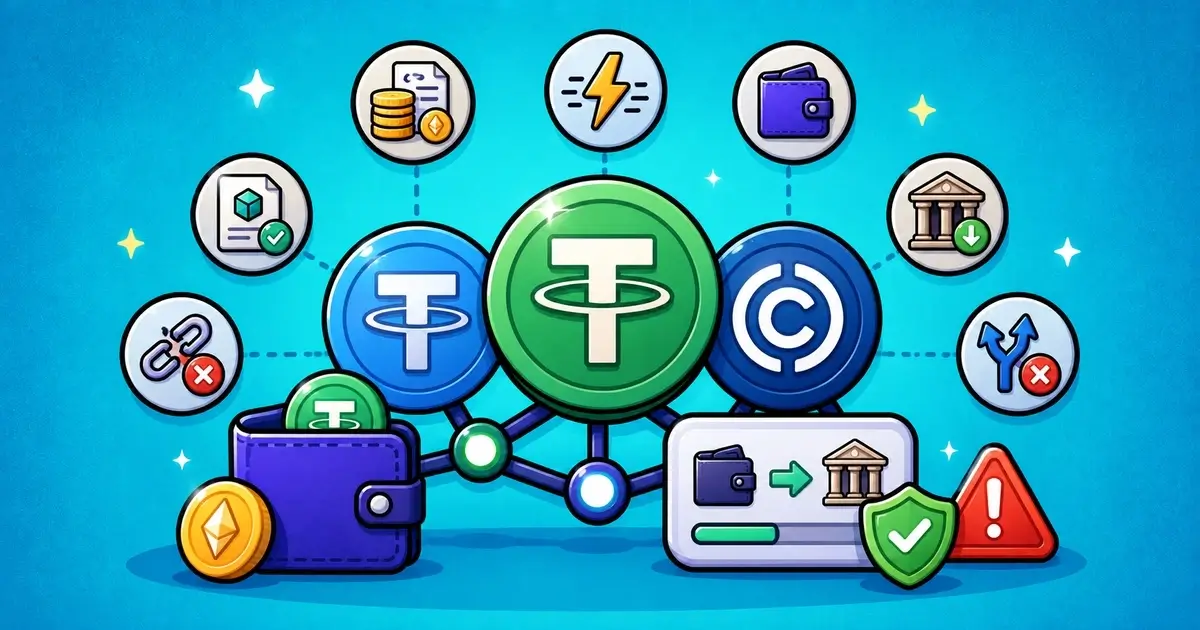
Stablecoins are not sent through one universal route.
USDT, USDC, and other stablecoins can exist on several networks. The token may look similar in a wallet, but the network changes the fee, speed, address format, token contract, wallet support, platform support, and recovery options.
That is where many stablecoin payment mistakes happen.
A user may say, “I sent USDT,” but the important question is: which USDT, on which network, to which address, using which token contract, and with which memo or tag requirements?
This guide explains how stablecoin networks differ, what to check before sending, and why the cheapest route is not always the safest route.
Related safety pages include Stablecoin Risks Explained, How to Verify a Token Contract, Crypto Deposit Not Showing? What to Check, Wrong Crypto Network Transfer, and Editorial Policy.
Key Takeaways
- Stablecoins can exist on several networks, but each route is different
- USDT on TRON is not the same payment route as USDT on Ethereum, Polygon, BNB Chain, or another network
- Lower fees do not matter if the receiving platform does not support the network
- A fast blockchain transfer can still take longer to appear inside a platform account
- Token contracts matter, especially for copied, bridged, or unsupported stablecoins
- Some deposits need a memo, tag, or payment ID
- Wrong-network recovery is not guaranteed
- Always check the current deposit page before sending stablecoins to a casino, exchange, or payment platform
What Is a Stablecoin Network?
A stablecoin network is the blockchain route used to send that stablecoin.
For example, a stablecoin may be available on several chains. Each chain may have its own wallet support, block explorer, transaction fee, confirmation behavior, and token contract.
The stablecoin symbol may look the same.
The payment route is not the same.
That is why users should not think only in symbols like USDT or USDC. They should think in full payment details:
Stablecoin + network + token contract + address + memo/tag rulesA complete example is clearer:
USDT on TRON to this deposit address, with no memo required.That is much safer than:
I sent USDT.Common Stablecoin Networks
Stablecoin support changes by platform, wallet, region, and product. Still, some networks are commonly seen in stablecoin payments.
Common Stablecoin Networks
| Network | General Pattern | Common Use Case |
|---|---|---|
| Ethereum | Widely supported and heavily used, but fees can be higher during busy periods | Larger transfers, broad platform support, DeFi use |
| TRON | Common for USDT payments because fees are often lower and transfers are familiar to many platforms | USDT deposits and withdrawals where TRON is clearly supported |
| BNB Chain | Often low-cost and widely used, but support depends on the receiving platform | Lower-fee transfers when the platform lists the exact network |
| Polygon | Low-fee network used by many wallets and apps | Payments only when the receiver clearly supports Polygon stablecoins |
| Arbitrum, Base, Optimism, Avalanche, Solana and others | Fast or lower-cost routes with different wallets, explorers, and platform support | Useful only when both sender and receiver support the same network |
This table is not a recommendation to use one network over another.
The correct network is the one the receiving platform supports for that exact stablecoin.
If the deposit page says USDT on TRON, do not send USDT on another network just because it is cheaper or faster.
Why Network Choice Matters
Network choice affects more than transaction fee.
What Changes Between Stablecoin Networks
| Factor | Why It Matters | What to Check |
|---|---|---|
| Fee | Networks charge different transaction fees | Cheap is useful only if the receiver supports that network |
| Speed | Confirmation times and platform-crediting times can differ | Fast on-chain transfer does not always mean instant platform credit |
| Wallet support | Not every wallet supports every stablecoin route well | Check that your wallet can send, receive, and show the token correctly |
| Platform support | The receiving exchange, casino, or app decides what it accepts | Follow the current deposit page, not old habits |
| Recovery options | Wrong-network recovery depends on platform custody and policy | Assume recovery is not guaranteed |
A user may choose a cheap network to save fees, then discover that the casino, exchange, or app does not support that route.
That can turn a small fee saving into a larger recovery problem.
The best stablecoin network is not always the cheapest one.
It is the network that the sender, receiver, wallet, and platform all support clearly.
TrendCrypt Research Notes: Stablecoin Network Mistakes
Stablecoin network mistakes are common because the asset name feels familiar.
TrendCrypt Research Notes
| Research Note | Why It Matters |
|---|---|
| Network choice is a payment decision | It affects fees, speed, support, recovery, and crediting, not just convenience |
| The receiving platform controls support | Your wallet may allow a transfer that the platform will not credit |
| Fast chains can still have slow crediting | A platform may wait for confirmations, manual review, KYC, or risk checks |
| Wrong-network recovery is uncertain | Some platforms can recover certain mistakes; others cannot or will not |
| Stablecoin routes change over time | Supported networks, fees, contracts, and deposit rules can change, so old instructions may be unsafe |
When TrendCrypt reviews missing-deposit complaints, the network is one of the first details to check.
A deposit can be confirmed on-chain and still not appear in the platform balance if the platform does not support that network or token contract.
That is not the same as the blockchain failing.
It is a payment-route mismatch.
USDT Across Networks
USDT is one of the most common stablecoins used for crypto payments.
It may be available on several networks, but platform support is not identical across all of them.
Before sending USDT, check:
- network selected on the sending wallet or exchange
- network selected on the receiving platform
- deposit address
- token contract, where shown
- minimum deposit
- confirmation requirement
- fees
- whether the platform supports that exact route
Do not assume USDT is universal.
A platform may support USDT on TRON but not USDT on Polygon. Another platform may support Ethereum and BNB Chain but not a bridged version. Some platforms may update supported networks over time.
The deposit page is the source that matters most.
USDC Across Networks
USDC can also exist across multiple networks.
The same warning applies: a USDC symbol does not prove the receiving platform accepts that version.
Check whether the platform supports:
- the specific USDC network
- the exact token version
- native or bridged form
- deposit address format
- confirmation count
- minimum amount
- withdrawal network options
USDC network confusion can happen when a wallet shows a stablecoin balance clearly, but the platform accepts only certain routes.
A wallet display is not the same as platform deposit support.
Native, Bridged, and Wrapped Stablecoins
Some stablecoins are native to a network.
Others are bridged or wrapped versions.
This matters because a bridged or wrapped stablecoin may depend on extra infrastructure.
Risks may include:
- bridge support
- contract support
- liquidity
- platform recognition
- redemption route
- wallet display
- withdrawal availability
- recovery limits
A receiving platform may accept native stablecoins but not bridged versions, or it may accept only one specific contract.
Do not guess from the name.
Check the token contract.
Read How to Verify a Token Contract before sending a stablecoin version you are not sure about.
The Cheapest Network Is Not Always the Best Network
Low fees are useful.
But fees are only one part of the decision.
A cheap network may still be risky if:
- the receiver does not support it
- the wallet does not show the token properly
- the token contract is not recognized
- liquidity is weak
- bridge support is unclear
- recovery is unlikely
- the platform has minimum deposit rules
- support takes longer to handle errors
For small transfers, a lower-fee network can make sense when it is clearly supported.
For meaningful transfers, support and recoverability matter more than saving a small fee.
Platform Deposit Pages Matter Most
When sending stablecoins to a casino, exchange, betting site, wallet app, or payment service, the platform deposit page is the most important source.
Check:
Stablecoin Deposit Details to Verify
| Detail | What It Means | Why It Matters |
|---|---|---|
| Stablecoin symbol | USDT, USDC, DAI, or another ticker | A symbol alone is not enough |
| Network name | The chain used for the transfer | Must match the receiver’s supported network |
| Token contract | Identifies the exact token on that network | Compare with the official source or platform page |
| Deposit address | The destination address for that network | Do not reuse addresses unless the platform says it is safe |
| Memo, tag, or payment ID | Extra routing detail used by some platforms | Missing it can prevent automatic crediting |
Never rely only on old screenshots, old withdrawal history, saved addresses, or memory.
Platforms can change deposit addresses, supported networks, minimum amounts, confirmation requirements, and memo rules.
Open the current deposit page every time.
Memos, Tags, and Payment IDs
Some platforms require extra routing details.
This may be called:
- memo
- destination tag
- payment ID
- reference
- note
- account identifier
If required and missing, the payment may reach the platform wallet but not your account balance.
Before sending, check whether the deposit page says a memo or tag is required.
If it is required, copy it carefully and verify it before sending.
Do not guess.
Do not reuse an old memo unless the platform clearly says it is still correct.
Minimum Deposits and Test Transfers
A small test transfer can reduce risk, but only when done correctly.
Check the minimum deposit first.
If the platform says the minimum stablecoin deposit is 10 USDT and you send 1 USDT as a test, it may not be credited.
A good test transfer should be:
- on the correct network
- using the supported token contract
- above the minimum deposit
- sent to the current deposit address
- sent with the required memo or tag
- tracked with a TXID
For larger transfers, a proper test transfer can be worth the extra fee.
For very small payments, the fee and minimum may make a test impractical.
Wallet Support vs Platform Support
A wallet may support more networks than a platform.
That can create confusion.
Your wallet might allow you to send USDT on a certain chain. The receiving platform may not accept that same chain. The wallet may also display a token that the platform does not recognize.
Wallet support means:
My wallet can hold or send this token.Platform support means:
The receiving platform will credit this exact token on this exact network.Those are different.
For deposits, platform support matters more.
Fast On-Chain Does Not Always Mean Fast Crediting
Some stablecoin networks confirm quickly.
But platform crediting can still take time.
A platform may wait for:
- a set number of confirmations
- payment processor confirmation
- internal risk review
- KYC review
- manual approval
- account checks
- maintenance completion
- token-contract validation
- memo or tag matching
So a transaction can be confirmed on-chain while the platform balance is still pending.
If a deposit is confirmed but not credited, save the TXID and read Crypto Deposit Not Showing? What to Check.
Wrong-Network Stablecoin Transfers
A wrong-network stablecoin transfer happens when the user sends a real stablecoin through a network the receiver does not support.
Recovery depends on many details:
- whether the receiver controls the private keys
- whether the address exists on both networks
- whether the platform supports manual recovery
- whether the token contract is recognized
- whether custody infrastructure allows access
- whether recovery is allowed by policy
- whether fees apply
- whether the amount is above recovery minimums
Do not assume recovery is possible.
Do not trust anyone who promises guaranteed recovery for an upfront payment.
For the full process, read Wrong Crypto Network Transfer.
What Support Needs If a Stablecoin Deposit Is Missing
If you contact support, give clear payment details.
Details Support Needs for Stablecoin Payment Issues
| Detail | Why It Helps | Example |
|---|---|---|
| Exact stablecoin | Shows which asset was sent | USDT, USDC, DAI, or another stablecoin |
| Network | Shows the transfer route | Ethereum, TRON, BNB Chain, Polygon, Solana, etc. |
| Token contract | Shows the exact token version | Important for copied, bridged, or unsupported tokens |
| TXID | Shows the on-chain transaction | Lets support verify transaction status |
| Deposit address and memo | Shows where funds were sent and whether routing details were included | Important for platform crediting |
A weak message is:
My USDT deposit is missing.A stronger message is:
I sent 100 USDT on TRON to the deposit address shown in my account on June 20. TXID: [hash]. The transaction is confirmed, but the casino balance has not updated.The second message gives support something they can check.
Warning Signs During Stablecoin Payment Problems
Some payment issues are honest mistakes. Others may be warning signs.
Stablecoin Payment Warning Signs
| Warning Sign | Why It Matters | Safer Response |
|---|---|---|
| Platform asks for an unlock fee | Extra payments to release funds can be a warning sign | Use official support and do not send private wallet payments |
| Support moves you to DMs | Fake support often targets payment mistakes | Return to the official website support route |
| Network not listed on deposit page | The platform may not support that route | Do not send until support confirms officially |
| Token contract differs | The token may be copied, bridged, or unsupported | Verify the contract before sending |
| Deposit page changed recently | Old saved addresses or screenshots may be outdated | Use the current deposit page |
Be especially careful when someone asks for extra crypto to release, unlock, verify, or recover a deposit.
Official platforms may charge fees under published terms, but private wallet payment demands are different.
Stablecoin Networks in Crypto Casinos
Crypto casinos often support stablecoins because they make deposits and withdrawals easier to price.
But support varies by casino.
Before using stablecoins on a casino, check:
- supported stablecoin
- supported network
- minimum deposit
- minimum withdrawal
- withdrawal fee
- confirmation requirement
- token contract
- memo or tag
- exchange rate
- KYC rules
- withdrawal review rules
- whether balances are internal or on-chain
A casino balance shown in USDT or USD may be an internal platform balance.
It does not always mean the user directly controls an on-chain stablecoin until withdrawal is processed.
Mistakes to Avoid
Stablecoin network mistakes are usually preventable.
Mistakes to Avoid With Stablecoin Networks
| Mistake | Why It Can Cause Problems |
|---|---|
| Choosing the cheapest network only | Low fees do not help if the receiving platform does not support the route |
| Assuming all USDT is the same | USDT on one network is not the same transfer route as USDT on another |
| Ignoring token contracts | Copied or unsupported stablecoin contracts can look familiar |
| Using an old deposit address | Platforms can change addresses, supported networks, or memo requirements |
| Skipping minimum deposit rules | A small test below the minimum may not be credited |
The biggest mistake is choosing a network because it is cheaper without confirming receiver support.
The second biggest mistake is assuming every token with the same symbol is the same asset.
Before Sending a Stablecoin
Use this quick checklist:
- Choose the stablecoin
- Open the current deposit page
- Select the exact network
- Copy the current address
- Check whether memo, tag, or payment ID is required
- Confirm the token contract, where available
- Check minimum deposit
- Check fees
- Compare the pasted address
- Save the TXID after sending
For larger transfers, consider a small test transfer above the platform’s minimum deposit.
Report a Stablecoin Network Issue
If you found a stablecoin network mistake, unsupported deposit, copied token contract, wrong-network transfer, suspicious support request, or repeated platform payment issue, you can send a redacted report to [[email protected]](mailto:[email protected]).
Useful details may include:
- stablecoin name
- network
- token contract
- TXID
- deposit address
- memo or tag, if used
- platform URL
- deposit or withdrawal screenshot
- support messages
- dates and times
- short timeline
Do not send seed phrases, private keys, wallet passwords, authentication codes, full identity documents, or anything that could give access to your wallet or accounts.
TrendCrypt can review patterns and publish safety warnings, but we cannot reverse blockchain transactions, recover funds, access wallets, force platforms to credit deposits, or guarantee support action.
Final Thoughts
Stablecoin network choice is not just a fee decision.
It affects whether the payment arrives, whether the platform credits it, whether support can investigate it, and whether recovery is possible if something goes wrong.
USDT is not one single route. USDC is not one single route. Every stablecoin transfer has a network, contract, address, and support policy behind it.
Before sending, check the current deposit page. Confirm the network. Verify the contract. Check the memo. Respect the minimum deposit. Save the TXID.
A stablecoin can be simple to use.
Only when the route is correct.
FAQ
Are USDT and USDC the same on every network?
No. The symbol may look the same, but the network, token contract, fees, wallet support, and platform support can differ.
Which stablecoin network is best?
There is no single best network. The best network is the one that both your wallet and the receiving platform clearly support for that exact stablecoin.
Is the cheapest stablecoin network always best?
No. A cheap network can still cause problems if the receiver does not support it or if recovery is difficult.
Why did my stablecoin transaction confirm but not show in my platform balance?
The transaction may be confirmed on-chain, but the platform may still need to credit it internally. Wrong network, unsupported token contract, missing memo, minimum deposit rules, or manual review can delay or block crediting.
Should I use a test transfer?
For larger transfers, a small test can reduce risk. Make sure the test amount is above the platform’s minimum deposit and uses the correct network, contract, address, and memo.
What details should I give support for a missing stablecoin deposit?
Send the stablecoin name, network, token contract, TXID, amount, deposit address, memo or tag, screenshot, and time of transfer.
Can a wrong-network stablecoin transfer be recovered?
Sometimes, but recovery is not guaranteed. It depends on the platform’s custody setup, policies, supported networks, token contract, and technical access.
Can TrendCrypt recover stablecoin transfers?
No. TrendCrypt can explain risks and review payment patterns, but we cannot reverse transactions, access wallets, recover funds, or force platforms to credit deposits.
Unexpected KYC During Withdrawal: What to Check
Learn what to check when a crypto platform or crypto casino asks for KYC during withdrawal, including verification timing, requested documents, privacy rules, support channels, and payout status.
Crypto Casino and Betting Scams: Warning Signs
Learn how crypto casino and betting scams use unclear ownership, fake bonuses, cloned sites, withdrawal release fees, private support messages, fake KYC links, and wallet-drainer tactics.

Fake Crypto Support Scams: Warning Signs
Learn how fake crypto support accounts target users after wallet, withdrawal, deposit, KYC, or account problems by pretending to represent platforms, exchanges, casinos, wallets, or recovery teams.