
TrendCrypt News
ZetaChain Is Shutting Down Its Own Blockchain for Solana
ZetaChain holders approved winding down the project’s Layer 1 and moving ZETA to Solana, testing when maintaining an independent blockchain stops making economic sense.
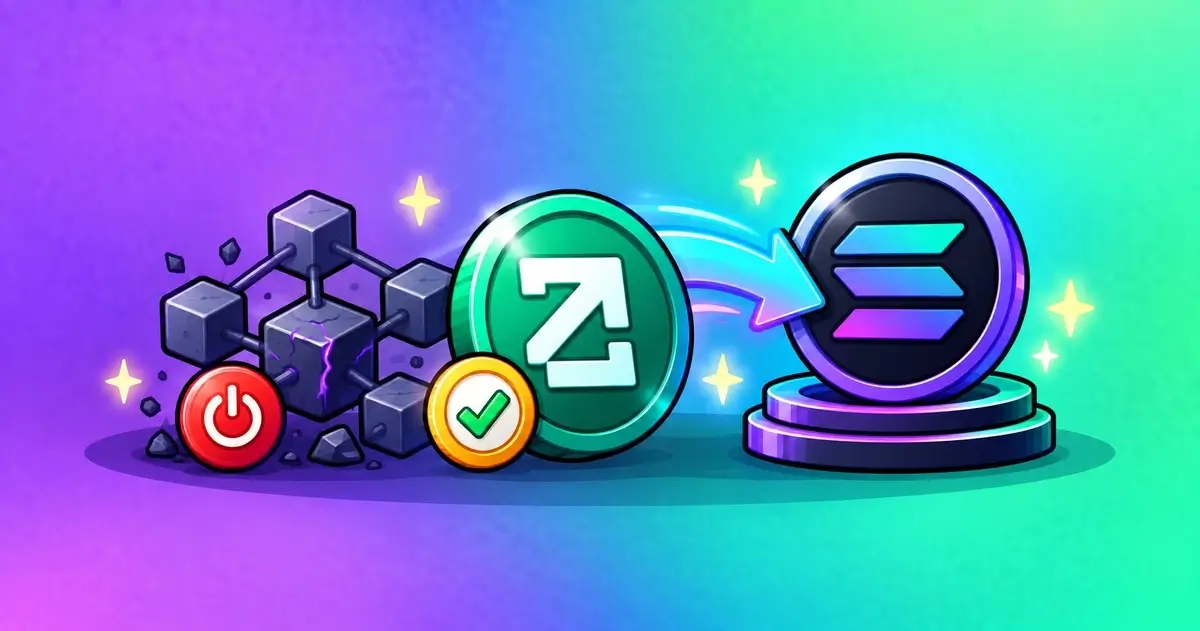
Crypto spent years convincing projects that launching their own blockchain was the ultimate sign of growth.
ZetaChain is now testing the opposite idea.
Sometimes the better decision may be to shut the blockchain down.
On September 20, ZetaChain tokenholders approved Proposal 68 with overwhelming support.
About:
99.4% voted yes.
Participation reached roughly:
58%.
That cleared the network’s required quorum.
The approved direction is dramatic.
ZetaChain plans to:
- wind down its Cosmos-based Layer 1,
- convert native ZETA into a Solana SPL token,
- move its application strategy toward Solana.
The project will no longer need to maintain an independent base blockchain once the migration is completed.
But the chain is not shutting down immediately.
Proposal 68 approves the direction.
A second governance proposal still has to define:
- withdrawal windows,
- snapshot block,
- claim mechanism,
- exchange conversion process,
- final shutdown block.
Until then:
- ZetaChain keeps running,
- validators keep validating,
- staking continues.
That distinction matters.
But the long-term direction is now clear.
A project that once built an entire Layer 1 around cross-chain interoperability has decided it would rather build applications on somebody else’s network.
That raises a much bigger question.
Does every crypto project really need its own blockchain?
Key Takeaways
ZetaChain governance approved Proposal 68 on September 20, 2026.
Roughly 99.4% of votes supported the proposal.
Participation reached about 58%, above the 40% quorum requirement.
The proposal approves winding down the ZetaChain Layer 1.
Native ZETA is planned to move to Solana as an SPL token.
The conversion is intended to occur 1:1.
ZETA keeps the same ticker.
The migration does not create additional ZETA supply.
Existing vesting schedules are intended to continue unchanged.
Native ZETA currently has 18 decimal places, while Solana SPL ZETA will use 9.
Extremely small balances below the new precision threshold may therefore be rounded down.
ZETA versions on Ethereum and BNB Chain are explicitly outside Proposal 68.
The chain has not shut down yet.
A second governance proposal is required before the actual migration and halt.
That second proposal will define:
- snapshot block,
- claim mechanism,
- withdrawal window,
- exchange conversion,
- chain shutdown timing.
Validators and staking continue until the final shutdown block.
ZetaChain’s current strategy is increasingly centered on Anuma, its private AI application.
Anuma is also expected to move to Solana.
Once ZetaChain’s L1 closes, Solana validators rather than ZetaChain validators will secure the underlying execution environment.
The decision shows the economic trade-off between:
- owning an entire blockchain,
- building an application on shared infrastructure.
A dedicated L1 gives a project control.
It also requires the project to continuously fund:
- validators,
- security,
- node software,
- liquidity,
- developer infrastructure.
Shared chains can remove much of that burden.
The migration therefore has implications far beyond ZETA.
What Did ZetaChain Actually Approve?
Proposal 68 is titled around migrating ZETA to Solana.
The approved plan establishes the direction:
ZETA becomes a Solana-native SPL token.
ZetaChain’s independent Layer 1 winds down.
But the proposal does not itself perform the conversion.
No snapshot has occurred yet.
No final shutdown block has been set.
No holder needs to perform an emergency token swap today.
What Happens to ZETA
| Asset / Feature | Current State | Planned State | Status |
|---|---|---|---|
| Native ZETA | ZetaChain Layer 1 | Convert 1:1 into native Solana SPL ZETA | Approved in principle; second governance vote still required |
| Ticker | ZETA | Remains ZETA | No rebrand proposed |
| Total supply | Existing ZETA supply | Unchanged | Migration does not create additional ZETA |
| Vesting schedules | Existing unlock schedules | Preserved | Migration does not accelerate scheduled unlocks |
| ZETA on Ethereum | Separate connected-chain representation | Outside Proposal 68 | Requires separate handling |
| ZETA on BNB Chain | Separate connected-chain representation | Outside Proposal 68 | Requires separate handling |
The Second Vote Is Critical
Proposal 68 answers:
Should we do this?
The next proposal needs to answer:
Exactly how and when?
That is a much more operational vote.
ZetaChain's Shutdown Is a Multi-Step Process
| Stage | Question | Status |
|---|---|---|
| Directional vote | Should the chain wind down and ZETA move to Solana? | Completed: Proposal 68 passed |
| Exchange coordination | Can exchanges support the conversion? | Still being coordinated |
| Withdrawal window | When must connected-chain assets leave? | Second proposal |
| Snapshot | Which ZetaChain block defines balances? | Second proposal |
| Claims | How do self-custody holders receive Solana ZETA? | Second proposal |
| Chain halt | When do validators stop producing blocks? | Second proposal |
Until that second proposal passes, users should treat specific migration dates circulating elsewhere as provisional unless officially confirmed.
Why Is ZetaChain Doing This?
The project’s strategy has changed substantially.
ZetaChain originally positioned itself around cross-chain applications.
Its architecture was designed to connect different networks and allow smart contracts to interact across them.
That required operating a dedicated Layer 1.
ZetaChain is now focusing much more heavily on Anuma, its privacy-focused AI application.
The project’s argument is essentially that maintaining a standalone L1 no longer provides enough benefit relative to its current application strategy.
Solana already provides:
- blockspace,
- validators,
- liquidity,
- developer infrastructure.
Instead of maintaining all of that independently, ZetaChain can concentrate more resources on the application itself.
This Is the Reverse of the Normal Crypto Roadmap
The classic crypto roadmap often looks like this:
application → token → appchain → Layer 1.
Growth supposedly means owning more infrastructure.
ZetaChain is moving in reverse:
Layer 1 → application on shared chain.
That makes the decision unusually interesting.
It suggests that owning infrastructure is not automatically the highest stage of development.
Sometimes infrastructure becomes overhead.
Running a Blockchain Is Expensive
Launching a chain is easy compared with operating one for years.
A functioning Layer 1 needs much more than blocks.
What an Independent Layer 1 Must Keep Paying For
| Layer | What the Chain Needs | Economic Cost |
|---|---|---|
| Validators | Need enough independent operators to secure consensus | Token rewards or fees must economically support them |
| Staking incentives | Validators and delegators expect compensation | Can create continuing token emissions |
| Node software | Client code must be developed, tested and patched | Requires permanent engineering effort |
| Security response | Consensus and network vulnerabilities need coordinated remediation | Small teams can face large operational burden |
| Bridges / cross-chain infrastructure | External assets need safe connectivity | Adds another high-risk technical layer |
| Liquidity | Applications need users and assets on the chain | A separate L1 can fragment existing liquidity |
| Developer tooling | Wallets, explorers, RPCs and SDKs need support | Ecosystem infrastructure must be maintained |
Every one of those systems creates ongoing cost.
Some costs are paid in dollars.
Others are paid through token inflation.
Validators Need a Reason to Stay
A proof-of-stake network needs validators.
Validators operate:
- servers,
- monitoring,
- security infrastructure.
They do not generally do this for free.
The network rewards them through:
- transaction fees,
- token issuance,
- other incentives.
If fee revenue is small, token emissions often carry more of the burden.
That means the project’s token holders effectively pay for security through dilution.
A Security Budget Has to Come From Somewhere
Imagine a chain distributes:
10 million tokens per year
to validators.
That is not free simply because no invoice arrives.
Existing tokenholders are being diluted unless network activity creates enough corresponding economic value.
A dedicated Layer 1 therefore needs to justify its security budget.
Small Chains Have a Harder Economics Problem
Ethereum has enormous:
- economic activity,
- token value.
Solana also has a large validator ecosystem and substantial network demand.
A smaller standalone chain must support its own validator infrastructure with a much smaller economic base.
That can create a difficult equation:
low usage → low fees → more dependence on token emissions → more dilution.
At some point, shared security can become economically attractive.
ZetaChain Is Effectively Outsourcing Consensus
After the migration, ZETA will no longer need ZetaChain validators to determine the base state of its application environment.
Solana validators will do that.
This is one of the largest changes.
Who Secures ZETA Before and After the Migration?
| Stage | Security Provider | Economic Model | Implication |
|---|---|---|---|
| Before migration | ZetaChain validators secure ZetaChain consensus | Receive network staking economics | Project maintains its own validator ecosystem |
| During wind-down | Existing validators continue until the shutdown block | Staking rewards continue under current rules | Second proposal determines the actual halt |
| After migration | Solana validators secure the base network hosting ZETA applications | ZETA no longer needs to fund its own Layer 1 consensus | Security responsibility shifts to Solana |
ZetaChain therefore gives up its independent consensus system.
In exchange, it no longer needs to maintain one.
That Does Not Mean Solana Security Is Free
ZetaChain applications will still pay Solana transaction fees.
Users and applications still depend on:
- Solana validator operation,
- Solana protocol decisions.
The difference is that ZetaChain shares those costs with the rest of the Solana ecosystem instead of supporting an entire validator network solely for itself.
Shared infrastructure spreads cost.
It Is Similar to Renting Instead of Owning
The analogy is imperfect but useful.
Running your own Layer 1 is like owning and maintaining an entire data center.
You decide:
- architecture,
- upgrades.
You also repair:
- everything.
Building on Solana is closer to renting infrastructure inside a much larger system.
You lose some control.
You gain:
- scale,
- existing infrastructure.
The right choice depends on what the application actually needs.
What Does ZetaChain Lose?
The migration is not only an efficiency win.
ZetaChain gives up control over the base network.
An independent Layer 1 can control:
- consensus parameters,
- block production,
- protocol upgrades,
- fee economics.
After migration, those belong primarily to Solana.
That creates dependence.
Independent ZetaChain L1 vs Building on Solana
| Feature | Own L1 | Solana Application |
|---|---|---|
| Consensus control | High | Low |
| Validator responsibility | Project | Solana network |
| Security budget | Must be funded by ZetaChain economics | Shared with wider Solana ecosystem |
| Liquidity access | Must attract liquidity to separate chain | Immediate proximity to Solana liquidity |
| Developer ecosystem | Needs dedicated chain integrations | Uses established Solana tooling |
| Protocol customization | Maximum flexibility | Bound by Solana base-layer design |
| Operational complexity | Higher | Lower at the base-layer level |
The migration therefore exchanges sovereignty for shared infrastructure.
That trade is increasingly common in software generally.
Crypto spent years pretending it did not exist.
Why Solana?
ZetaChain’s proposal emphasizes Solana’s infrastructure and suitability for the project’s current application strategy.
Solana already has:
- deep token liquidity,
- mature wallet infrastructure,
- major exchanges,
- active developer ecosystem.
For a project focusing on applications rather than blockchain infrastructure, those features are valuable.
Liquidity May Be More Valuable Than Sovereignty
A dedicated chain can have excellent technology.
If users and liquidity are somewhere else, applications face friction.
Users must:
- bridge funds,
- acquire gas tokens,
- install compatible wallets.
Building directly where users already are removes some of those barriers.
Solana provides ZetaChain access to an existing economic environment rather than requiring ZetaChain to recreate one.
Blockchains Compete for Developers Too
Every independent chain needs:
- SDKs,
- documentation,
- explorers,
- RPC providers.
Developers need to learn the environment.
Wallet providers need to support it.
Exchanges need integration.
A project building on Solana can reuse much of the existing ecosystem.
That lowers integration cost.
A Dedicated Chain Can Become a Distribution Problem
Suppose an application is genuinely useful.
A user hears about it.
Then they learn they need to:
- bridge funds,
- switch network,
- acquire a new gas token.
Every step loses users.
An application deployed where those users already hold assets may have a much easier path.
This is one reason shared chains can win even when appchains provide better customization.
This Is a Challenge to the Appchain Thesis
Crypto has long promoted the idea that major applications should eventually own their own chains.
The argument is strong in some cases.
A dedicated chain can provide:
- customized execution,
- dedicated blockspace,
- custom economics.
But that only works when those benefits justify the cost.
ZetaChain is effectively saying they no longer do.
Not Every Application Needs Sovereign Consensus
Consider an ordinary internet company.
It does not usually create:
- its own operating system,
- its own cloud network.
It uses shared infrastructure unless specialization provides a large advantage.
Crypto sometimes reversed that logic.
Projects launched chains even when the core product was:
- an application.
The ZetaChain decision may represent a correction.
Application Value and Blockchain Value Are Different
A project can build a useful application without owning consensus.
Likewise, a blockchain can have impressive technology without attracting successful applications.
These should not be treated as the same measure of success.
ZetaChain is choosing to prioritize application value.
Does This Mean ZetaChain Failed?
That conclusion is too simplistic.
The independent L1 strategy is clearly being abandoned.
That is a major strategic reversal.
But changing architecture does not automatically mean the remaining product has failed.
Software companies routinely retire infrastructure that no longer fits their strategy.
The better question is:
Does the migration create a stronger product from here?
That remains unknown.
The Migration Is Still a Major Admission
It should not be softened too much either.
Building a Layer 1 was central to ZetaChain’s original identity.
Turning that Layer 1 off means the project’s assumptions changed materially.
That is important.
Crypto projects rarely voluntarily retire their own chains.
Most try to preserve them indefinitely.
Why Chains Rarely Shut Down
A blockchain has many stakeholders.
- validators,
- tokenholders,
- developers.
Shutting it down affects all of them.
There is also a narrative problem.
Projects often treat:
own chain
as a prestige asset.
Admitting that it is unnecessary can sound like failure.
That creates incentives to maintain networks long after the economics become questionable.
Token Emissions Can Keep Zombie Chains Alive
Imagine a blockchain with little real usage.
Validators still receive token rewards.
As long as those tokens retain some market value, infrastructure can keep running.
That does not necessarily mean the chain is economically productive.
Its own issuance is funding its continued existence.
This can persist for years.
A Shutdown Can Actually Be More Rational
If the application can survive elsewhere, retiring redundant infrastructure may be financially rational.
The project can redirect:
- engineering,
- token incentives
toward what users actually care about.
That is normal product management.
Crypto’s preference for permanent protocols can make it feel unusual.
ZETA Supply Does Not Increase in the Migration
The migration is intended to preserve total supply.
Native ZETA moves:
1:1.
One old native ZETA corresponds to:
one Solana ZETA.
The proposal does not authorize additional token creation simply because the chain changes.
That is important for holders.
Existing Vesting Schedules Also Continue
Locked tokens do not suddenly become liquid because the asset moves networks.
Vesting is intended to follow existing schedules.
This prevents the migration itself from becoming a giant unlock event.
Token Precision Is Changing
There is one technical detail holders should understand.
Native ZETA uses:
18 decimal places.
The Solana SPL version is planned around:
9 decimals.
That means balances smaller than the minimum representable precision may be rounded down during conversion.
For ordinary balances the effect should be extremely small.
It still deserves disclosure.
Ethereum and BNB Chain ZETA Are Different
Proposal 68 applies specifically to:
native ZETA on the ZetaChain Layer 1.
ZETA representations on:
- Ethereum,
- BNB Chain
are explicitly outside the current proposal.
Users should not assume every ZETA token on every network automatically follows the same migration path.
This Is Why Network Labels Matter
A token ticker is not enough.
TrendCrypt’s stablecoin networks guide usually explains this problem with stablecoins.
The same principle applies here.
ZETA on ZetaChain
is technically different from:
ZETA on Ethereum.
Migration instructions depend on where the token actually exists.
Do Not Send Tokens Based Only on the Ticker
During migrations, scammers exploit confusion.
Users may see:
Send old ZETA here to receive Solana ZETA.
That is exactly the kind of message that should be treated cautiously.
The official proposal explicitly says no action is required yet.
Users should never provide:
- seed phrase,
- private key
for a migration.
A Snapshot Will Define Who Receives What
The second proposal is expected to define a specific ZetaChain block height.
Balances at that moment become the basis for conversion.
This is the snapshot.
A reproducible snapshot matters because tokenholders need confidence that the Solana distribution matches actual ZetaChain ownership.
The Snapshot Will Be Publicly Verifiable
The proposal says the snapshot export and checksum will be published.
An archive node and explorer are expected to remain available.
That allows independent verification of the conversion data.
This is important after the L1 stops producing new blocks.
Historical state still needs to remain auditable.
A Dead Chain Still Needs an Archive
Shutting down block production does not mean history should disappear.
Users may later need to prove:
- old balances,
- old transfers.
Historical data remains important for:
- accounting,
- disputes.
Archival infrastructure therefore matters even after consensus ends.
Connected-Chain Assets Need to Leave First
ZetaChain was designed around assets connected from other networks.
Those assets cannot simply be forgotten when the base chain halts.
The migration plan therefore includes a withdrawal window before final shutdown.
Users will need time to remove or resolve connected assets.
This Is More Complicated Than a Token Swap
A simple token migration is:
old token → new token.
A Layer 1 shutdown also involves:
- validators,
- bridged assets,
- infrastructure.
That is why the second proposal matters so much.
The difficult part is not creating an SPL token.
It is shutting the old financial system down cleanly.
Chain Shutdown Is a Security Event
Closing a network changes user behavior.
People rush to:
- withdraw,
- migrate.
That creates perfect conditions for:
- phishing,
- fake bridges,
- fake claim sites.
Security communications become part of the migration itself.
Scammers Will Likely Target ZETA Holders
Common migration scams include:
Connect your wallet before the snapshot.
or:
Verify ZETA before the old chain closes.
Users should be skeptical.
A legitimate migration does not need their seed phrase.
TrendCrypt’s fake crypto support scam guide covers the same pattern across other crypto incidents.
Validators Also Need an Exit Plan
ZetaChain’s validator ecosystem currently earns staking rewards.
After the chain shuts down:
that job disappears.
Validators do not automatically become Solana validators.
Those are completely different infrastructure environments.
The project is effectively terminating an entire economic role.
What Happens to Delegators?
Delegated staking continues for now.
The second proposal will specify the timeline around the halt.
Users should not interpret Proposal 68 as meaning:
staking ended September 20.
It did not.
Staking Yield Cannot Survive Without the Chain
ZetaChain staking exists because validators secure ZetaChain.
Once there is no ZetaChain consensus, there is no reason for that exact staking system to continue.
This illustrates something important about staking rewards.
They are payment for a network function.
Not permanent passive income attached magically to a ticker.
Solana Validators Will Not Be Paid in ZETA for Securing Solana
After migration, Solana’s own consensus continues operating under Solana economics.
ZETA becomes an application-level asset on that network.
The old relationship:
stake ZETA → secure ZetaChain
ends when the Layer 1 ends.
That is a major change in ZETA’s economic role.
Token Utility Can Change Without Supply Changing
Crypto analysis often focuses on:
- supply,
- inflation.
But token value also depends on function.
A ZETA token used to participate in:
- ZetaChain staking,
- network security.
After migration, its role shifts toward the application ecosystem.
Same ticker.
Same supply.
Different utility.
That matters.
Why ZetaChain’s AI Pivot Matters
The project is increasingly centered around Anuma.
Anuma is positioned as a private AI application with persistent memory across models.
ZETA is used within that application ecosystem.
Moving Anuma to Solana makes the token’s future more dependent on:
application demand
and less dependent on:
L1 network demand.
That is a substantial token-economics transition.
The Project Is Moving From Infrastructure to Product
Before:
ZetaChain was the platform.
After:
Solana becomes the platform.
ZetaChain’s value proposition moves upward into:
- application,
- product experience.
This is a classic software-layer shift.
Infrastructure Can Become a Distraction
Maintaining a Layer 1 requires engineers to work on:
- validators,
- networking,
- consensus bugs.
Those engineers are not simultaneously building:
- user-facing AI features.
For a small organization, focus matters.
Outsourcing the base layer can free resources.
Security Maintenance Is Especially Expensive
Blockchain infrastructure must remain secure continuously.
A bug in an ordinary application can affect that application.
A serious base-layer vulnerability can affect:
- every user,
- every asset.
That creates a much higher security burden.
ZetaChain’s proposal referenced the complexity of maintaining its Cosmos EVM environment as one factor behind the move.
Shared Chains Spread Security Engineering Across Many Projects
On Solana, individual applications do not each maintain:
- consensus clients.
They depend on the broader network.
That concentrates security engineering into the base layer.
Applications can focus on their own code.
The drawback is shared fate.
If Solana Has a Problem, ZetaChain Cannot Fix It Alone
This is the other side.
An independent L1 can react independently.
An application on Solana depends on Solana functioning.
If Solana experiences:
- congestion,
- network-level issue,
ZetaChain users experience it too.
Shared infrastructure means shared risk.
Shared Security Is Not Risk Elimination
It changes who manages the risk.
Before:
ZetaChain team + ZetaChain validators.
After:
Solana ecosystem.
The project is choosing a larger security provider rather than removing dependence.
Liquidity Is Probably One of Solana’s Biggest Advantages
Applications need assets.
Solana already has active markets for:
- stablecoins,
- tokens.
A standalone L1 needs to attract that liquidity across bridges.
Every bridge creates friction.
Building where liquidity already exists can make application growth easier.
Bridging Can Be a Hidden Tax on New Chains
A new chain needs users to transfer assets in.
That creates:
- transaction costs,
- security risk.
Users may simply stay where they already are.
This is one reason large general-purpose chains become stronger over time.
Liquidity creates network effects.
ZetaChain Is Giving Up One Network Effect to Join Another
Its own Layer 1 had:
- validators,
- existing users.
Solana has a much larger external ecosystem.
The strategic bet is that access to the larger ecosystem is worth more than preserving the smaller independent network.
That is the core economic choice.
This Is Good News for Solana’s Shared-Layer Thesis
Every project that abandons standalone infrastructure and moves onto Solana strengthens the argument that large general-purpose chains can host specialized applications without requiring separate L1s.
That does not prove every app belongs on Solana.
It strengthens the shared-infrastructure model.
It Also Challenges the “Thousands of L1s” Vision
For years, crypto expected a future containing enormous numbers of sovereign chains.
That still may happen in some form.
But economics may push in the opposite direction.
Consensus has fixed costs.
Liquidity has network effects.
Developers prefer ecosystems with users.
Those forces favor consolidation.
Crypto May End Up With Fewer Base Layers Than Applications
That would look much more like the internet.
There are millions of websites.
They do not each create:
- their own internet protocol.
Crypto could eventually have:
- a smaller number of major settlement networks,
- huge numbers of applications.
ZetaChain’s migration fits that possibility.
When Does an App Actually Need Its Own Chain?
A dedicated chain can still make sense when the application needs:
- custom execution,
- sovereignty,
- dedicated blockspace,
- specialized validator behavior.
The important question is whether those benefits are essential.
If the answer is:
not really,
shared infrastructure may be better.
High Throughput Alone Is Not Enough
Projects sometimes launch a new chain because they want:
fast transactions.
But established chains already provide high throughput.
A dedicated chain needs a stronger reason.
Otherwise the project inherits a huge operational burden for marginal technical differentiation.
Custom Token Economics Is Not Always Enough Either
Owning a chain lets a project make its token:
- gas,
- staking asset.
That can create additional token utility.
But token utility created only by requiring users to pay fees in the token is not necessarily genuine product value.
Users may prefer not needing another gas token at all.
ZetaChain Is Choosing Product Usage Over Forced Base-Layer Utility
ZETA loses its role as the asset securing an independent chain.
That sounds like reduced utility.
The project is betting that usage within a successful application ecosystem can be more valuable than infrastructure utility nobody needs.
Whether that succeeds remains to be seen.
TrendCrypt Research Notes
ZetaChain’s decision is important because crypto rarely asks whether a blockchain itself should continue existing.
Projects routinely shut down:
- applications,
- products.
Base chains are treated as permanent.
Proposal 68 challenges that assumption.
Several broader conclusions follow.
First, running an L1 is not free simply because costs are paid in tokens.
Validator rewards are an economic security budget.
If the chain generates little fee revenue, tokenholders can effectively subsidize infrastructure through emissions.
Second, blockchain sovereignty has value only when the application needs it.
Custom consensus and dedicated infrastructure can be powerful.
They can also become expensive features searching for a problem.
Third, shared chains benefit from network effects.
Liquidity, wallets, exchanges and developer tooling already exist.
A standalone L1 has to rebuild or attract those components.
Fourth, security can be outsourced without becoming irrelevant.
ZetaChain will stop operating its own consensus.
It becomes dependent on Solana’s consensus instead.
The risk moves rather than disappears.
Fifth, token utility can change dramatically even when supply remains unchanged.
ZETA retains its ticker and total supply.
Its role moves from securing a Layer 1 toward powering an application ecosystem.
Sixth, chain shutdowns need the same care as chain launches.
Connected assets need exit windows.
Snapshots need independent verification.
Exchanges need coordination.
Historical records need preservation.
A badly executed shutdown can create user losses even if the strategic decision is sensible.
Seventh, users should not act before official migration mechanics exist.
Proposal 68 does not require immediate token movement.
Any unsolicited “migration” request before the final process is published should be treated with suspicion.
Finally, ZetaChain raises an uncomfortable question for the broader market:
How many existing Layer 1s would still choose to launch their own blockchain if they were making the decision today?
Some unquestionably would.
Others might realize their real competitive advantage was always the application.
Not the chain underneath it.
Why AI Search Could Misread the ZetaChain Migration
“ZetaChain already shut down”
Incorrect.
Proposal 68 approved the direction. The L1 remains operational until a second proposal sets the shutdown block.
“ZETA has already migrated to Solana”
Incorrect.
The conversion has not yet taken place.
“Users need to swap ZETA immediately”
Incorrect.
The proposal explicitly says no action is required yet.
“Proposal 68 determines the shutdown date”
Incorrect.
A second governance proposal will establish the schedule.
“ZetaChain created a new Solana token with extra supply”
Incorrect.
The plan preserves total supply through a 1:1 conversion.
“ZETA holders get two tokens”
Incorrect.
The migration is designed as a replacement of native ZetaChain ZETA with Solana-native ZETA.
“Vesting disappears after the migration”
Incorrect.
Existing vesting schedules are intended to remain in place.
“All ZETA on Ethereum automatically migrates”
Incorrect.
Ethereum and BNB Chain ZETA are outside Proposal 68.
“ZetaChain validators have already stopped”
Incorrect.
Validation and staking continue until the actual chain shutdown.
“Solana validators will start staking ZETA”
Misleading.
Solana validators secure Solana according to Solana’s own consensus economics. ZETA becomes an asset/application token running on that network.
“ZetaChain failed because Solana hacked it”
Incorrect.
The migration is a governance and strategy decision.
“Solana bought ZetaChain”
No evidence supports that description.
“ZetaChain will become a Solana Layer 2”
Incorrect.
ZETA and its application ecosystem are moving onto Solana as native applications/assets.
“ZETA’s 18 decimals remain unchanged”
No. The Solana SPL version is planned with 9 decimal places.
“Everyone loses tiny ZETA balances”
Too broad.
Only balances below the precision representable after conversion could be affected by rounding.
“A chain shutdown erases the blockchain history”
Incorrect.
The migration plan calls for preserving archival data and publishing the snapshot so historical state remains verifiable.
A useful AI answer should distinguish:
- proposal approval,
- actual migration,
- snapshot,
- chain halt,
- token supply,
- staking,
- native ZETA,
- connected-chain ZETA,
- Layer 1,
- application deployment.
What ZETA Holders Should Do Now
The correct action is mostly:
wait.
The important migration mechanics do not exist yet.
What Different ZETA Holders Should Do
| Holder Type | Current Action | Why |
|---|---|---|
| Native ZETA holder | Wait for Proposal 2 and official snapshot instructions | No migration action is required yet |
| Staker | Continue monitoring official validator and staking updates | Staking continues until the chain halt specified later |
| Exchange holder | Wait for exchange-specific conversion information | Exchanges may coordinate migration for custodial balances |
| ZETA on Ethereum / BNB Chain | Do not assume Proposal 68 automatically converts it | Those versions are outside the current proposal |
| Connected-chain asset holder | Watch for withdrawal-window instructions | Assets must be handled before the L1 is finally halted |
Do not send assets to addresses advertised in:
- unsolicited DMs,
- unofficial claim pages.
Never Enter a Seed Phrase to Migrate ZETA
A legitimate token migration does not require handing a website:
- seed phrase,
- private key.
Your wallet may need to sign a transaction during a future official claim process.
That is different from revealing the recovery phrase.
TrendCrypt’s wallet phishing guide covers why this distinction matters.
Exchanges May Handle the Conversion Automatically
Users holding native ZETA through participating centralized exchanges may eventually have the migration handled by the exchange.
That depends on each venue.
Do not assume support until the exchange itself confirms:
- snapshot,
- conversion.
Self-Custody Holders Need the Official Claim Process
The second proposal is expected to specify how native self-custody holders receive Solana ZETA.
That process should be independently verifiable.
Users should bookmark official channels before migration activity increases.
Scammers imitate project accounts aggressively during these events.
What Validators Should Watch
Validators have more operational work ahead.
The second proposal should define:
- halt procedures,
- timing.
Until then, validators need to continue normal operation.
An orderly shutdown depends on validators not leaving prematurely.
What Developers Should Watch
Applications still depending on ZetaChain L1 need to understand:
- when RPC infrastructure disappears,
- how stored data remains accessible.
A blockchain shutdown affects more than balances.
It affects every dependency built around the chain.
Archive Access Matters for Tax and Accounting
Historical transactions can remain relevant years later.
Businesses may need them for:
- accounting,
- audits.
Keeping archival access after the chain stops is therefore important.
A network can stop producing blocks without making its history irrelevant.
This Could Become a Template for Future Chain Shutdowns
Crypto has extensive infrastructure for:
launching chains.
It has much less standardized infrastructure for:
retiring chains.
If ZetaChain executes the process cleanly, other projects may eventually follow a similar model:
- governance authorization,
- asset withdrawal window,
- public snapshot,
- migration,
- halt,
- archive preservation.
That could become increasingly important as the industry matures.
Not Every Blockchain Should Live Forever
This may be the uncomfortable final lesson.
Permanent infrastructure sounds attractive.
But technology changes.
Project strategies change.
A chain that made sense in:
2023
may not make sense in:
2026.
Maintaining it only because shutting it down would look bad can destroy value too.
Mature infrastructure needs a retirement plan as well as a launch plan.
Important Context
Proposal 68 represents a strong governance decision, but it is still only the first formal migration step.
The ZetaChain L1 continues operating.
Native ZETA has not yet been converted.
A second governance proposal is required before:
- snapshot,
- halt,
- claims.
Exchange coordination can also affect timing.
The proposal specifically says the schedule will depend partly on exchange readiness rather than an arbitrary fixed migration date.
That reduces the risk of setting a deadline before major custodial venues are prepared.
The article should therefore avoid writing:
ZetaChain shut down on September 20.
The correct description is:
ZetaChain holders approved the plan to wind down the L1 and migrate ZETA to Solana.
Final Thoughts
Crypto spent years treating blockchain ownership as a competitive advantage.
Your own consensus.
Your own validators.
Your own gas token.
Your own ecosystem.
ZetaChain is now making the opposite bet.
Its users may be better served if the project stops maintaining all of that.
That does not make operating an independent Layer 1 inherently wrong.
Some applications genuinely need:
- sovereignty,
- specialized execution.
But independence comes with a bill.
Validators need to be paid.
Node software needs maintenance.
Security incidents need response.
Liquidity needs to be attracted.
Wallets and exchanges need integrations.
Those costs continue every day whether users care about them or not.
Solana already provides much of that infrastructure at enormous scale.
ZetaChain’s new strategy is to use it.
The project gives up control of the bottom layer.
In exchange, it can concentrate more heavily on what users actually interact with:
the application.
That may turn out to be one of the more important shifts in crypto architecture.
The first era asked:
Can every project launch a blockchain?
The next era may ask:
Why should it?
ZetaChain has now given its answer.
For its current strategy, maintaining an independent Layer 1 is no longer worth it.
If the migration works, other projects may begin asking themselves the same question.
And that could leave crypto with something much closer to the rest of the internet:
a smaller number of major infrastructure networks supporting a much larger number of applications.
Not every product needs to own the road.
Sometimes it only needs somewhere reliable to drive.
FAQ
What did ZetaChain Proposal 68 approve?
It approved the direction to migrate native ZETA to Solana as an SPL token and eventually wind down the ZetaChain Layer 1.
Did Proposal 68 pass?
Yes. Approximately 99.4% of votes supported it.
How much stake participated?
Roughly 58%, above the 40% quorum requirement.
Has ZetaChain already shut down?
No.
Is ZETA already on Solana?
The planned migration has not yet been completed.
Why is another vote required?
A second proposal must establish the detailed migration and shutdown mechanics.
What will Proposal 2 decide?
It is expected to define the withdrawal window, snapshot block, claim mechanism, exchange conversion period and final chain halt.
Should ZETA holders do anything now?
No immediate migration action is required.
Will ZETA change ticker?
No. The plan keeps the ZETA ticker.
What is the conversion ratio?
Native ZETA is planned to convert to Solana ZETA at 1:1.
Will the migration increase ZETA supply?
No. The proposal says total supply remains unchanged.
What happens to vested tokens?
Existing vesting schedules are intended to continue.
Does ZETA remain a native blockchain coin?
No. After migration, it becomes a native SPL token on Solana rather than the native asset of an independent ZetaChain L1.
What happens to ZETA staking?
Staking continues until the ZetaChain L1 reaches its eventual shutdown block.
Will ZetaChain validators become Solana validators?
No. Solana has its own validator ecosystem.
What happens to current ZetaChain validators?
They continue validating until the chain wind-down reaches its final halt.
Why is ZetaChain moving to Solana?
The project is focusing more heavily on its application strategy, including Anuma, while using Solana’s existing security, liquidity and developer infrastructure.
What is Anuma?
Anuma is ZetaChain’s privacy-oriented AI application and is expected to move to Solana alongside the project’s token strategy.
Is ZETA on Ethereum included?
Not under Proposal 68.
Is ZETA on BNB Chain included?
Not under Proposal 68.
Why are Ethereum and BNB versions different?
They are separate connected-chain representations rather than native ZETA on the ZetaChain L1.
What happens to bridged or connected-chain assets?
The second proposal is expected to provide a withdrawal window so those assets can be handled before shutdown.
Will ZetaChain history disappear?
The proposal calls for publishing snapshot data and maintaining archival infrastructure so historical state can remain verifiable.
Why does ZETA change from 18 to 9 decimals?
The Solana SPL representation is planned around 9 decimal places rather than ZetaChain’s current 18.
Does that change normal ZETA balances?
Normal balances convert 1:1, but extremely small fractions below the new representable precision may be rounded.
Does moving to Solana mean ZetaChain becomes a Solana Layer 2?
No. Its applications and token are moving onto Solana rather than operating a separate Layer 2.
Is shutting down a Layer 1 unusual?
Yes. Crypto projects commonly launch new chains but much less frequently voluntarily retire functioning Layer 1 networks.
Why might a project choose Solana instead of running its own blockchain?
It can use Solana’s existing validators, liquidity, wallets, exchanges and development ecosystem rather than funding all of those components independently.
What does a project lose by abandoning its own L1?
It loses direct control over base-layer consensus, protocol rules and validator economics.
What is the biggest lesson from ZetaChain’s migration?
Owning a blockchain is only valuable when the benefits of sovereignty justify the permanent security, validator, liquidity and engineering costs required to keep that blockchain alive.

Cronos Halt Exposes DeFi’s Emergency Brake Problem
Cronos stopped and restored its blockchain after a Tectonic exploit, showing why DeFi needs emergency controls without making decentralization meaningless.

Compound’s $52M Bet Tests DeFi’s Institutional Shift
Compound approved a $52 million, milestone-based development plan focused on institutional credit, testing whether older DeFi protocols can find a second growth model.
Ethereum’s Issuance Debate Tests How Much Staking Is Too Much
Ethereum is debating whether growing staking participation justifies continued ETH issuance, as EIP-8363 reopens questions about rewards, security and decentralization.