TrendCrypt Guide
Crypto Platform Warning Signs to Check
Learn the warning signs of risky crypto platforms, including hidden ownership, changing withdrawal demands, copied documents, fake support, pressure to deposit more, and unclear contact details.
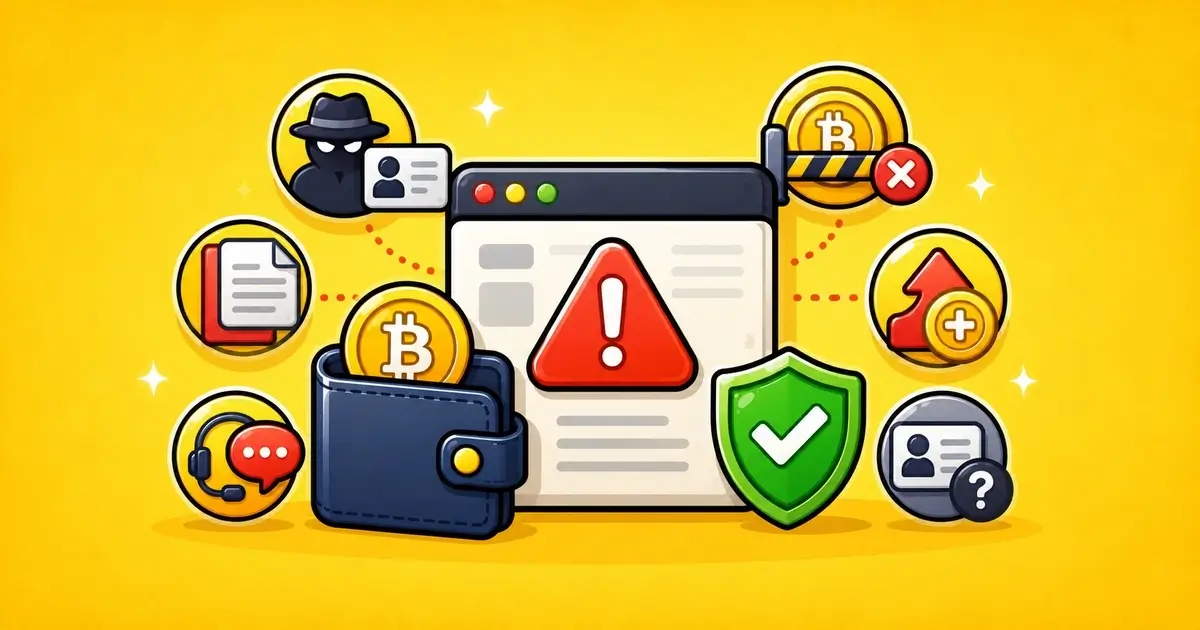
A risky crypto platform does not always look risky at first.
Some have clean dashboards, live-looking charts, copied legal pages, support chats, licence badges, user balances, and professional design. The warning signs often appear later, especially when a user tries to withdraw, asks for proof, checks the legal operator, or refuses to deposit more.
One warning sign does not always prove a platform is fake.
But several warning signs together should make you pause.
This guide explains the platform warning signs to check before depositing, increasing your balance, completing KYC, connecting a wallet, or sending more crypto to unlock funds.
Related safety pages include How to Check a Crypto Platform, Fake Crypto Platforms: Warning Signs, Crypto Platform Licence: How to Check, Crypto Platform Complaints: How to Check, and Editorial Policy.
Key Takeaways
- A polished website does not prove a crypto platform is safe
- Hidden ownership, copied documents, and unclear contact details deserve caution
- Changing withdrawal demands are one of the strongest warning signs
- Be careful when a platform asks for more crypto to unlock, verify, or release funds
- Licence badges, team photos, and legal pages should be checked, not accepted at face value
- Fake support accounts often target users after deposit or withdrawal problems
- Save TXIDs, wallet addresses, screenshots, support messages, and terms if a dispute starts
- Do not send seed phrases, private keys, passwords, or authentication codes to any platform or support agent
What Is a Crypto Platform Warning Sign?
A warning sign is a detail that suggests a platform needs closer checking.
It does not always prove fraud by itself.
For example, a new platform may have fewer public reviews. A real platform may ask for KYC before withdrawal. A support delay may happen during heavy traffic.
But warning signs become more serious when they appear together.
A platform with unclear ownership, copied documents, no verified licence, changing withdrawal demands, and pressure to deposit more is very different from a platform with one old complaint and a clear public response.
The goal is not to panic over every small issue.
The goal is to notice patterns before more money, documents, or wallet permissions are exposed.
Main Warning Signs to Check
Start with the signals that affect trust, withdrawals, and user control.
Crypto Platform Warning Signs
| Warning Sign | What It May Suggest | What to Check |
|---|---|---|
| Hidden ownership | The platform does not clearly say who operates it | Check the footer, terms, privacy policy, and licence page |
| Changing withdrawal demands | The platform keeps adding new fees, taxes, checks, or conditions | Stop sending more funds until the rule is verified |
| Copied documents | Terms, licence claims, or company details may be copied from another site | Search exact phrases and compare operator names |
| Pressure to deposit more | The platform says more crypto is needed to unlock funds | Treat this as a serious warning sign |
| Unclear contact details | Support channels are vague, changing, or only available through private chat | Use caution before sharing documents or funds |
The strongest warning signs usually appear around withdrawals.
A platform that accepts deposits easily but creates new conditions when users try to withdraw should be checked very carefully.
Hidden Ownership
A crypto platform should make it clear who operates the service.
Look for the legal company name, business address, licence or registration claim, terms and conditions, privacy policy, and contact details.
Ownership Checks
| Check | Why It Matters | What to Do |
|---|---|---|
| Legal company name | Shows who users are dealing with | Check whether it appears in terms and footer |
| Licence or registration | May show where the operator claims to be registered | Verify it from the official source |
| Domain history and brand consistency | New or shifting domains can increase uncertainty | Check whether official links match |
| Contact page | Shows how users can reach the platform | Look for real support routes, not only private messages |
| Terms and privacy policy | Explain account rules, KYC, data handling, and disputes | Be cautious if these pages are missing or copied |
Hidden ownership is not a small detail.
If a platform holds user funds, asks for KYC documents, processes deposits, or controls withdrawals, users should know which company they are dealing with.
Be cautious if the platform has:
- no legal company name
- no terms and conditions
- no privacy policy
- no clear support route
- no licence or registration details
- different operator names across pages
- a domain that does not match the claimed brand
- contact only through Telegram, WhatsApp, or private chat
A real company can still have poor support.
But a platform that hides who operates it gives users fewer options if something goes wrong.
Changing Withdrawal Demands
Changing withdrawal demands are a serious warning sign.
Some fake or risky platforms allow users to deposit, show a growing balance, then block withdrawals unless the user sends more crypto.
Withdrawal Demands That Need Caution
| Demand | Why It Is Risky | First Response |
|---|---|---|
| Tax before withdrawal | The platform says tax must be paid to release funds | Verify with official rules before sending anything |
| Unlock fee | The platform says the balance is frozen until a fee is paid | Common in fake platform scams |
| VIP upgrade | The platform says you must upgrade to withdraw | Check whether this rule existed before deposit |
| Risk review with no details | The platform gives vague reasons for holding funds | Ask for the exact rule and timeline |
| New wallet address for payment | Support gives a private wallet address for fees | Treat as high risk unless clearly verified |
Be careful with claims such as:
- pay tax before withdrawal
- pay a release fee
- upgrade to VIP
- deposit more to activate withdrawal
- pay gas to unlock account funds
- pay compliance fee
- pay account verification fee
- pay anti-money-laundering clearance fee
- send funds to a private wallet address
A legitimate platform may charge fees or request KYC, but those rules should be explained clearly in the terms before deposit.
If the reason keeps changing, stop and save evidence.
Pressure to Deposit More
Pressure is one of the clearest signs that something is wrong.
A platform may say:
- your funds will expire
- your account will be frozen
- your profit will disappear
- you must complete one final payment
- the withdrawal is ready after one more deposit
- a manager has approved a special exception
- you will lose access unless you act today
This pressure is meant to stop careful thinking.
Do not send more crypto only because support says it is the last step.
Ask for the exact rule, where it appears in the terms, why it applies to your account, and whether the payment goes through an official platform payment route.
If support gives a private wallet address for “tax,” “unlock,” “verification,” or “release,” treat that as high risk.
Copied Documents and Fake Trust Signals
Risky platforms often borrow trust from somewhere else.
They may copy legal pages, licence badges, team names, user reviews, awards, logos, or support wording.
Copied or Fake Trust Signals
| Signal | What It May Mean | How to Check |
|---|---|---|
| Copied licence badge | A logo can be reused from another operator | Check licence number, operator name, domain, and status |
| Copied terms | The site may have reused legal text without matching details | Search unique phrases from the terms |
| Fake team photos | Images may be stock photos or copied profiles | Reverse-check names and consistency |
| Copied support text | Help pages may be cloned from real services | Check whether links and contact details match |
| Fake dashboard profits | Displayed balances may not represent withdrawable funds | Test claims against withdrawal rules and evidence |
Copied documents matter because they can make a weak platform look more established than it is.
Check whether:
- the company name in the terms matches the platform
- the licence number matches the operator
- the listed domain matches the platform domain
- the privacy policy names the correct company
- the support email uses the official domain
- the same text appears on unrelated websites
- team members have consistent public profiles
- claimed awards or partnerships are verifiable
A licence logo or legal paragraph is not enough.
The details have to match.
Fake Dashboards and False Profits
Some fake platforms show a balance that looks real but is not actually withdrawable.
This can happen on fake trading sites, investment platforms, mining dashboards, staking portals, copied exchanges, and fake casino-style reward pages.
Warning signs include:
- profits appear too quickly
- balance grows without clear activity
- account manager pushes larger deposits
- withdrawal is blocked after profit appears
- tax or unlock fee is required before payout
- support refuses to deduct fees from the balance
- the platform will not explain where trades happened
- the dashboard has no real transaction evidence
A number on a dashboard is not the same as money you control.
The real test is whether withdrawal rules are clear and whether funds can be withdrawn through normal procedures.
Unclear Contact Details
Support quality is part of platform safety.
Be careful if the platform has:
- no support email
- no ticket system
- no company contact details
- support only through Telegram or WhatsApp
- changing support usernames
- support that contacts users first through DMs
- no public complaint route
- no clear privacy or KYC contact
- no official social links from the website
Private chat alone is weak for a platform that handles money.
It also creates room for impersonation.
If you need support, open the contact route from the official website directly. Do not rely on links sent by strangers, replies, comments, or social media DMs.
Fake Support After Public Complaints
Fake support often appears when users are already stressed.
If you post publicly about a missing deposit, delayed withdrawal, locked account, or platform problem, scammers may reply quickly. They may pretend to be the platform and send a link.
They may say:
- verify your wallet
- sync your account
- validate your transaction
- open a ticket here
- connect wallet to recover funds
- pay gas to release funds
- use this private support portal
Do not trust support links from DMs or comments.
For phishing and wallet risks, read Crypto Wallet Phishing Scams: Warning Signs and Crypto Phishing Websites: Warning Signs.
Licence Claims That Do Not Match
A licence can be useful, but only when it can be verified.
Be cautious if:
- only a badge is shown
- no licence number is listed
- the licence link is broken
- the regulator page does not show the platform
- the operator name does not match
- the licence belongs to another website
- the domain is not listed
- the licence is expired, suspended, or unclear
- the platform says “regulated” without naming the authority
A licence may confirm that an operator is registered somewhere, but the level of supervision and practical user protection varies.
Read Crypto Platform Licence: How to Check before treating a licence claim as a trust signal.
KYC and Privacy Warning Signs
Verification rules also matter.
Some platforms advertise easy access, then request documents only after a withdrawal is requested. That can be allowed by the terms, but it should be stated clearly.
Warning signs include:
- no privacy policy
- no clear legal operator
- KYC rules hidden in vague terms
- support asks for documents through DMs
- repeated document rejection without clear reason
- withdrawal paused with no timeline
- source-of-funds requests with no explanation
- user country restrictions discovered only after deposit
Never send full identity documents through unofficial support links or social media messages.
For a deeper checklist, read Crypto Platform KYC Rules: What to Check.
Public Complaint Patterns
Public complaints are not automatic proof.
Some are incomplete. Some are emotional. Some come from users who misunderstood terms. Large platforms naturally attract more complaints than small platforms.
But repeated patterns matter.
Look for complaints about:
- delayed withdrawals
- missing deposits
- changing fee demands
- account freezes
- KYC after withdrawal
- support not replying
- copied websites
- bonus winnings removed
- false profit dashboards
- users asked to deposit more
- licence or operator mismatch
Check the date, evidence, platform response, and whether the issue was resolved.
A repeated unresolved pattern is stronger than one isolated comment.
Read Crypto Platform Complaints: How to Check.
What to Do If You See Warning Signs
Your next step depends on your situation.
What to Do When Platform Warning Signs Appear
| Situation | First Response |
|---|---|
| You have not deposited yet | Pause and verify ownership, licence, complaints, and terms first |
| You already deposited | Save TXIDs, wallet addresses, screenshots, and support messages |
| Withdrawal is blocked | Ask for the exact rule, document request, fee basis, and timeline |
| Support asks for more crypto | Do not send more until the claim is independently verified |
| You connected a wallet | Check approvals and wallet activity on the correct network |
If you have not deposited yet, the safest move is simple: wait.
Check the operator, licence, terms, privacy policy, withdrawal rules, complaint history, and official support routes before sending funds.
If you already deposited, stay organized. Save evidence before the website changes, support messages disappear, or terms are updated.
Evidence to Save
If a platform problem starts, save records early.
Useful evidence includes:
- platform URL
- account username or ID
- legal operator name
- licence claim screenshot
- terms and withdrawal rules
- privacy or KYC policy
- deposit TXIDs
- withdrawal request screenshots
- wallet addresses
- support messages
- fee or tax demands
- public complaint links
- dates and times
- screenshots of dashboard balances
- any reason the platform gave
Do not send seed phrases, private keys, wallet passwords, authentication codes, or full identity documents to unofficial contacts.
Mistakes to Avoid
Warning signs become more dangerous when the next step is rushed.
Mistakes to Avoid With Risky Crypto Platforms
| Mistake | Why It Can Make Things Worse |
|---|---|
| Trusting profits shown on the dashboard | Fake platforms can display balances that cannot be withdrawn |
| Paying every new fee | Changing payment demands are a common warning sign |
| Ignoring operator details | A platform should make its legal entity clear |
| Using support links from DMs | Fake support often targets users with platform problems |
| Sending documents through unofficial channels | KYC data should only go through verified platform routes |
The most expensive mistake is often sending one more payment after the platform already changed the withdrawal conditions.
If the platform says one final payment will unlock everything, stop and verify before sending anything.
How TrendCrypt Reviews Platform Warning Signs
TrendCrypt treats platform warning signs as part of the trust picture.
We look at:
- operator transparency
- licence clarity
- withdrawal rules
- KYC and privacy terms
- payment handling
- public complaints
- support quality
- responsible gambling tools, where relevant
- copied or unverifiable claims
- repeated user-risk patterns
One issue does not always decide the whole review.
But repeated warning signs can affect how we describe a platform, whether we treat it as higher risk, and whether we publish safety warnings.
For more detail, read How We Review and Editorial Policy.
Report Platform Warning Signs
If you found hidden ownership, copied documents, fake licence claims, changing withdrawal demands, fake support, pressure to deposit more, or suspicious platform behavior, you can send a redacted report to [email protected].
Useful details may include:
- platform URL
- operator name shown
- licence claim
- screenshots
- support messages
- wallet addresses
- transaction hashes
- complaint links
- fee or tax demands
- a short timeline
Do not send seed phrases, private keys, wallet passwords, authentication codes, full identity documents, or anything that could give access to your wallet or accounts.
TrendCrypt can review patterns and publish safety warnings, but we cannot access accounts, reverse blockchain transactions, recover funds, approve withdrawals, complete KYC, remove websites, or guarantee that a platform will respond.
Final Thoughts
A risky crypto platform usually gives hints before the situation becomes worse.
The hints may be small at first: vague ownership, copied legal text, unclear licence details, support only through private chat, or a dashboard balance that looks too easy.
The bigger warning signs often appear at withdrawal: new fees, tax demands, unlock payments, changing explanations, or pressure to deposit more.
Do not judge a platform only by design, profit screenshots, or marketing claims.
Check who operates it, what the terms say, whether the licence matches, how withdrawals work, what complaints show, and whether support gives clear answers.
One warning sign needs context.
Several warning signs together should make you stop.
FAQ
What are the biggest crypto platform warning signs?
Hidden ownership, changing withdrawal demands, pressure to deposit more, copied licence claims, unclear contact details, fake support links, and repeated unresolved complaints are major warning signs.
Does a polished website mean a platform is safe?
No. Fake or risky platforms can copy professional designs, dashboards, legal pages, licence badges, and support layouts.
Is a licence enough to trust a crypto platform?
No. A licence can be a useful signal, but it should be checked against the operator name, domain, status, covered activity, complaints, and withdrawal history.
Why is pressure to deposit more risky?
Some fake platforms show balances or profits, then demand extra payments to unlock withdrawals. Repeated fee, tax, or upgrade demands are serious warning signs.
What should I do before depositing on a new platform?
Check the legal operator, licence claim, terms, privacy policy, withdrawal rules, KYC rules, public complaints, and official support channels.
What if I already deposited and the platform is asking for more money?
Stop and save evidence. Ask for the exact rule, payment reason, official invoice or policy, and withdrawal timeline. Be very cautious if support gives a private wallet address.
Can public complaints prove a platform is fake?
Not always. Complaints are signals. The issue, evidence, date, operator response, resolution, and repeated patterns matter.
Can TrendCrypt recover funds from a risky platform?
No. TrendCrypt can review patterns and publish safety warnings, but we cannot recover funds, reverse transactions, access accounts, approve withdrawals, or force platforms to respond.
Unexpected KYC During Withdrawal: What to Check
Learn what to check when a crypto platform or crypto casino asks for KYC during withdrawal, including verification timing, requested documents, privacy rules, support channels, and payout status.
Crypto Casino and Betting Scams: Warning Signs
Learn how crypto casino and betting scams use unclear ownership, fake bonuses, cloned sites, withdrawal release fees, private support messages, fake KYC links, and wallet-drainer tactics.

Fake Crypto Support Scams: Warning Signs
Learn how fake crypto support accounts target users after wallet, withdrawal, deposit, KYC, or account problems by pretending to represent platforms, exchanges, casinos, wallets, or recovery teams.