
TrendCrypt Guide
Crypto Recovery Scams: Warning Signs
Learn how crypto recovery scams target people after losses, including fake recovery agents, upfront fees, wallet-verification tricks, fake investigators, and guaranteed recovery claims.
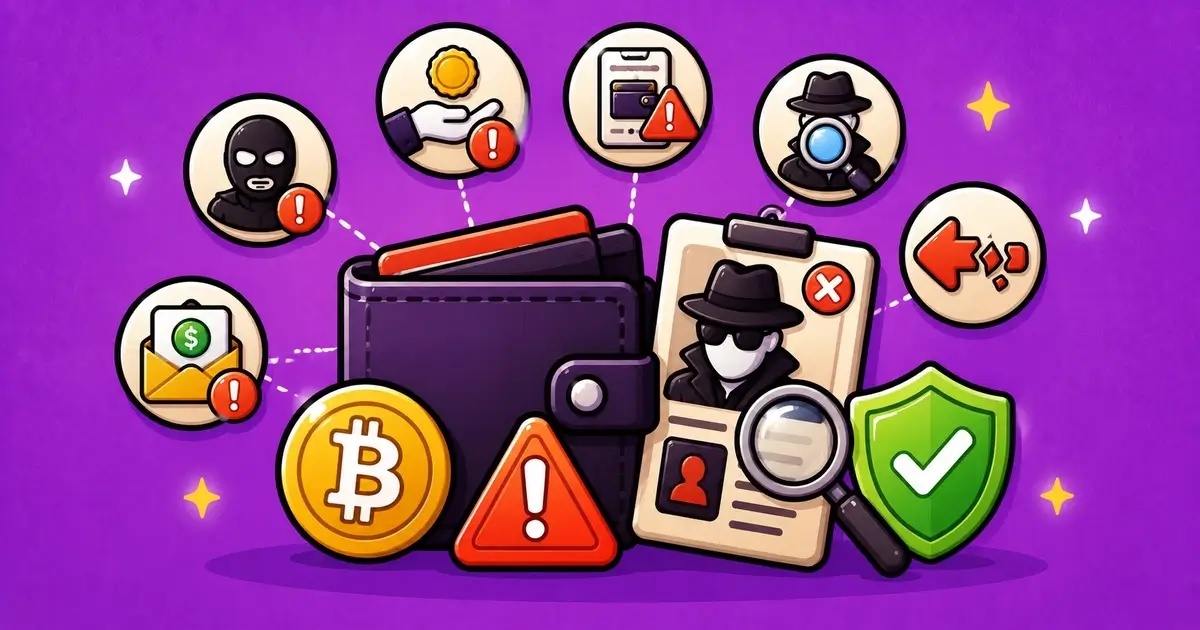
Losing crypto is stressful.
That stress is exactly what recovery scammers use.
After a wallet drain, wrong-address transfer, fake investment platform, blocked withdrawal, or missing deposit, users often look for help quickly. They may post on social media, forums, Telegram groups, Discord servers, or complaint pages.
Then someone appears with a promise:
We can recover your funds.Sometimes they claim to be a blockchain expert. Sometimes they pretend to be law enforcement, a recovery company, an investigator, a hacker, a regulator, a wallet-support agent, or a platform insider.
The pattern is usually the same: they ask for an upfront payment, wallet access, a signature, sensitive documents, or private account details.
This guide explains how crypto recovery scams work, why people who already lost funds are targeted again, and what to check before trusting anyone who promises recovery.
Related safety pages include Scams & Warnings, Compromised Crypto Wallet: What to Do, Crypto Platform Warning Signs to Check, Crypto Wallet Phishing Scams: Warning Signs, and Editorial Policy.
Key Takeaways
- Crypto recovery scams often target people after they already lost funds
- No outside service can guarantee recovery from an unknown private wallet
- Upfront recovery fees are a major warning sign
- Fake recovery agents may ask for seed phrases, private keys, wallet signatures, passwords, or authentication codes
- Scammers often contact victims through DMs, comments, forums, Telegram, Discord, or fake support pages
- Recovery is usually only realistic when an exchange, casino, wallet provider, or identifiable platform controls the receiving account
- Save TXIDs, wallet addresses, screenshots, support messages, and timelines before contacting official support
- Do not send more crypto to “unlock,” “trace,” “release,” “verify,” or “recover” lost funds
What Is a Crypto Recovery Scam?
A crypto recovery scam is a fraud where someone promises to recover lost, stolen, frozen, or blocked crypto but uses that promise to take more money or access.
The scammer may say they can:
- recover stolen crypto
- reverse a blockchain transaction
- freeze an attacker’s wallet
- hack funds back
- access a private wallet
- bypass a casino withdrawal delay
- unlock a fake platform balance
- work with law enforcement
- file a special blockchain claim
- trace funds for an upfront payment
- return funds after a tax or release fee
Some of these claims may sound technical. That does not make them real.
Most blockchain transactions cannot be reversed by a stranger online.
If a platform, exchange, casino, or custody provider controls the receiving account, there may be an official support route. If funds went to an unknown private wallet, guaranteed recovery is usually not realistic.
Common Recovery Scam Types
Recovery scams can look different, but the core promise is usually the same.
Common Crypto Recovery Scam Types
| Scam Type | How It Works | Why It Is Risky |
|---|---|---|
| Guaranteed recovery | The person claims lost crypto can definitely be recovered | No outside service can guarantee recovery from an unknown wallet |
| Upfront fee | The user must pay before any real result is shown | Often leads to more fees and no recovery |
| Fake investigator | Someone claims to trace funds, freeze wallets, or work with authorities | Ask for verifiable company and legal details |
| Wallet verification | The user is told to connect a wallet or enter a recovery phrase | This can expose remaining funds |
| Private agent address | The user is asked to send crypto to a personal wallet | Treat private payment demands as a major warning sign |
The scam does not always start with a large payment.
It may begin with a small “case opening” fee, then continue with more demands.
That is why the first payment matters.
Why Recovery Scams Work
Recovery scams work because the target is already under pressure.
A person who lost funds may feel embarrassed, angry, rushed, or desperate. They may also feel responsible for a mistake and want to fix it quietly.
Scammers understand this.
They may say:
- you still have time
- the funds are frozen
- we traced the wallet
- only gas is needed
- only tax is needed
- only court approval is needed
- you must act before the funds move
- do not contact anyone else
- support will not help you
- we have recovered funds for many users
The promise feels like relief.
But the goal is usually another payment or wallet access.
TrendCrypt Research Notes: Recovery Fraud Patterns
Recovery scams are usually second-stage scams.
The first loss creates the opening. The recovery promise creates the second loss.
TrendCrypt Research Notes
| Research Note | Why It Matters |
|---|---|
| Recovery scams often follow real losses | The victim is already stressed, so the promise of a solution becomes more persuasive |
| Public complaints attract impersonators | Scammers monitor comments, forums, and social posts for people asking for help |
| Upfront fees are the pattern | Recovery fraud usually starts with one small payment and grows into repeated demands |
| Wallet access is the second risk | Even if the original funds are gone, remaining wallets can be drained through fake recovery tools |
| Realistic recovery depends on control | Recovery is usually only possible when a platform, exchange, or identifiable service controls the receiving account |
When TrendCrypt reviews scam reports, recovery offers are one of the most common follow-up risks.
A user may lose funds to a fake platform, then be contacted by a fake recovery agent who asks for another fee. In some cases, the recovery agent may be connected to the first scam or using the same victim list.
The safest assumption is simple:
Anyone promising guaranteed crypto recovery for upfront payment should be treated with caution.
Who Recovery Scammers Target
Recovery scammers often target people who already have a public problem.
Who Recovery Scammers Often Target
| Situation | Why the User Is Targeted | What to Do |
|---|---|---|
| Wrong-address transfer | The user hopes the payment can be reversed | Recovery is usually only possible if the receiving platform controls the address |
| Wallet drained | The user wants stolen funds returned | Scammers may ask for seed phrases, signatures, or recovery fees |
| Fake platform loss | The user already paid deposits, taxes, or unlock fees | Recovery scammers may continue the same payment pattern |
| Blocked withdrawal | The user is frustrated with a platform delay | Fake support may promise a shortcut for a fee |
| Public complaint | The user posts about a loss online | Scammers often reply quickly in comments or DMs |
Posting publicly about a loss can help gather information, but it also attracts scammers.
If you post a complaint, expect fake recovery replies.
Do not trust someone only because they responded quickly.
Upfront Fees Are a Major Warning Sign
A recovery scam often begins with one payment.
It may be called:
- consultation fee
- tracing fee
- software fee
- gas fee
- tax payment
- release fee
- court fee
- wallet activation fee
- verification fee
- withdrawal unlock fee
- anti-money-laundering clearance fee
After the first payment, another fee may appear.
The scammer may say the recovery is almost finished but one final step is needed.
That pattern can continue until the user stops paying.
A real recovery path, when one exists, should be tied to an official platform, legal process, or verified service with clear terms. It should not depend on sending crypto to a private wallet controlled by an unknown agent.
Guaranteed Recovery Claims
Be careful with anyone who guarantees recovery.
No honest person can guarantee recovery in every crypto case.
Recovery depends on facts such as:
- where the funds went
- who controls the receiving wallet
- whether a platform or exchange is involved
- whether the transaction is reversible inside a platform ledger
- whether law enforcement can act
- whether the recipient can be identified
- whether the funds remain traceable
- whether the platform has a recovery policy
- whether enough evidence exists
A blockchain analysis company may help trace funds in some situations, but tracing is not the same as recovery.
Knowing where funds moved does not mean the funds can be returned.
Fake Investigators and Fake Authorities
Some scammers pretend to be official.
They may claim to be:
- law enforcement
- regulator staff
- exchange security team
- wallet support
- blockchain recovery unit
- cybercrime department
- court agent
- licensed investigator
- anti-fraud office
- casino payment team
- exchange compliance officer
They may use fake certificates, badges, seals, invoices, case numbers, or official-looking emails.
Check carefully.
Real agencies and serious companies do not usually contact random users in comments or DMs promising guaranteed recovery for crypto payment.
Do not trust authority language without verification.
Wallet Verification Traps
Some recovery scams do not start with a fee.
They start with “verification.”
The user may be asked to:
- connect wallet
- sign a message
- approve a token
- enter a seed phrase
- import wallet into a tool
- download remote-access software
- scan a QR code
- verify ownership on a portal
- submit private keys
- provide authentication codes
This can drain remaining funds.
A wallet recovery phrase is not proof to share. It is full access.
No real recovery process needs your seed phrase or private key.
If you already entered a seed phrase into a recovery site, treat the wallet as compromised and read Compromised Crypto Wallet: What to Do.
Pressure Tactics
Recovery scammers use urgency.
Recovery Scam Pressure Tactics
| Pressure Tactic | How It Works | Safer Response |
|---|---|---|
| Act now | The scammer says funds can only be recovered quickly | Real investigations and platform reviews usually take time |
| Pay one final fee | The fee is framed as tax, gas, release, court, or software cost | One fee often becomes several |
| Do not tell anyone | The scammer wants to isolate the user | A real process should survive basic verification |
| We already found your funds | The scammer creates fake progress | Ask for evidence that can be checked independently |
| Connect wallet to verify ownership | The scammer wants wallet access or signatures | Do not connect wallets to recovery portals from strangers |
Urgency helps scammers stop users from checking facts.
Slow down.
A real support process should still make sense after you take time to verify it.
What Recovery May Actually Be Possible?
Not every loss is the same.
Some cases may have an official path.
For example:
- A deposit was sent to the correct platform wallet but missed a memo
- A supported platform controls the receiving wallet
- An exchange account received funds and can review the case
- A casino can verify a missing deposit internally
- A wrong-network deposit went to an address controlled by the platform
- A withdrawal is pending inside the platform and has not been sent on-chain
- A regulated service has a formal complaint or legal process
Other cases are much harder.
For example:
- funds sent to an unknown private wallet
- seed phrase entered into a phishing site
- wallet-drainer transaction already executed
- fake investment platform balance was never real
- recovery wallet controlled by scammer
- attacker moved funds through many wallets
- private key exposed and funds swept
The key question is:
Who controls the funds now?If the answer is an unknown private wallet, guaranteed recovery claims should be treated as unrealistic.
Check Before Trusting Recovery Help
Before trusting anyone, check the basics.
Recovery Claim Checklist
| Check | Why It Matters | Safer Response |
|---|---|---|
| Who controls the receiving address? | If it is a private wallet, outside recovery is usually unlikely | Check whether an exchange or platform is involved |
| Is there a TXID? | A transaction hash helps confirm what happened on-chain | Save it before contacting anyone |
| Was a platform involved? | A casino, exchange, or wallet app may have an official support process | Use official support only |
| Is the person asking for access secrets? | Seed phrases, private keys, passwords, and codes give access to accounts | Never share them |
| Is the fee published and official? | Real platforms may have policies, but private payment demands are different | Avoid private wallet payments |
If a platform is involved, start with the platform’s official support route.
If law enforcement is involved, use official government or police contact channels.
If a professional service is involved, verify the company, registration, team, address, track record, terms, and payment model independently.
Do not rely on testimonials shown by the recovery agent.
They can be fake.
What to Save After a Crypto Loss
Save evidence before talking to anyone.
Useful records include:
- transaction hash
- sender address
- recipient address
- asset
- network
- amount
- time and date
- wallet or platform used
- website URL
- platform account details
- support messages
- screenshots
- fake profile links
- email headers, where useful
- invoices or payment requests
- complaint links
- short timeline
This helps official support or a real complaint process understand the case.
Do not send full identity documents, private keys, seed phrases, wallet passwords, or authentication codes to unofficial contacts.
Recovery Scam Warning Signs
Some warning signs are strong enough to stop immediately.
Crypto Recovery Scam Warning Signs
| Warning Sign | Why It Matters |
|---|---|
| Guaranteed recovery claim | No honest service can guarantee every crypto recovery |
| Fee before proof | The user pays before any verifiable result exists |
| More fees after first payment | Tax, gas, unlock, software, or court fees may keep appearing |
| Request for seed phrase or private key | This gives full wallet access |
| DM-only communication | Fake agents often avoid public verification |
| Fake law enforcement or regulator claim | Scammers may use official-looking names or documents |
| Recovery portal asks for wallet signature | A signature or approval can expose remaining tokens |
| They contacted you first | Real investigators usually do not randomly find users in comments |
The clearest warning signs are guaranteed recovery, upfront crypto payments, and requests for wallet access.
Any one of those should make you stop.
Several together are serious.
Fake Recovery Comments and DMs
Recovery scammers often appear in public threads.
You may see replies like:
Contact @RecoveryExpert, they helped me get my funds back.Or:
I had the same issue. This hacker recovered everything for me.These comments may be posted by fake accounts or bots.
They may appear under:
- X/Twitter posts
- Reddit threads
- Bitcointalk topics
- YouTube comments
- Trustpilot reviews
- Telegram groups
- Discord servers
- casino complaints
- wallet-support discussions
Do not treat comments as proof.
If someone contacts you first after you post about lost funds, be careful.
Recovery Scams After Fake Platforms
Fake platforms often lead to recovery scams.
A user may already have paid:
- deposit
- trading fee
- tax
- verification fee
- withdrawal unlock fee
- account upgrade
- liquidity fee
- release fee
Then a “recovery” agent appears and says the funds can be returned if another fee is paid.
This may be the same scam continuing under a new identity.
If the original platform showed fake profits or demanded extra payments before withdrawal, do not trust another person who repeats the same fee pattern.
Read Fake Crypto Platforms: Warning Signs for the first-stage scam pattern.
Recovery Scams After Wallet Drainers
After a wallet drainer, scammers may claim they can reverse the drain.
They may ask the user to:
- connect the same wallet
- sign a recovery transaction
- approve a token
- import the wallet into a recovery app
- share seed phrase
- pay gas
- move remaining funds through their tool
This can expose any assets still left in the wallet or connected addresses.
If your wallet was drained, focus first on protecting remaining funds, revoking risky approvals where appropriate, securing devices, and moving unaffected assets to a clean wallet.
Read Crypto Wallet Drainers Explained and Wallet Approvals: How to Check and Revoke.
Recovery Scams Around Casino Complaints
Crypto casino complaints also attract fake recovery claims.
A user may post about:
- delayed withdrawal
- restricted account
- missing deposit
- KYC delay
- bonus dispute
- blocked payout
Then someone replies with a “solution.”
They may claim they can:
- unlock the withdrawal
- approve KYC
- bypass account review
- connect to the casino payment system
- recover blocked winnings
- release funds from the casino wallet
Do not use unofficial support links.
If the issue is with a casino, use the casino’s official support route and document the complaint carefully.
Read How to Document a Crypto Casino Complaint.
Mistakes to Avoid
Recovery scams often work because the user wants the first loss to be undone quickly.
Mistakes to Avoid With Crypto Recovery Claims
| Mistake | Why It Is Risky |
|---|---|
| Paying because the first fee is small | Small payments are often used to start a longer scam |
| Believing screenshots of “recovered funds” | Fake dashboards and edited images are easy to create |
| Sharing seed phrases to prove ownership | Seed phrases should never be shared with anyone |
| Trusting comments under your complaint | Scammers often target public posts about lost funds |
| Ignoring official support routes | If a platform is involved, use the platform’s real support process |
The hardest but safest move is to slow down.
A second loss will not fix the first one.
What to Do Instead
If you lost funds, take practical steps.
- Save the evidence
- Stop sending more crypto
- Secure wallets and accounts
- Check whether a platform controls the receiving address
- Contact official support only
- Report fake profiles or websites
- Watch for recovery DMs
- Ask for help from trusted people before paying anyone
- Document the timeline
- Avoid sharing private access details
If the case involves a platform, the official platform process is usually the only realistic route.
If it involves an unknown private wallet, be very careful with anyone promising guaranteed recovery.
How TrendCrypt Reviews Recovery Scam Reports
TrendCrypt treats recovery scams as a high-risk follow-up pattern.
When reviewing reports, we look at:
- original loss type
- recovery promise
- upfront fee request
- wallet-access request
- fake support links
- impersonation signs
- private wallet payment demands
- screenshots
- TXIDs
- fake company or authority claims
- whether the same recovery service appears in other complaints
- whether victims were contacted after public posts
We do not treat recovery claims as credible just because the person uses technical language.
The strongest warning sign is still simple: guaranteed recovery in exchange for upfront payment.
For more detail, read Editorial Policy and Scams & Warnings.
Report a Recovery Scam
If you found a fake recovery agent, upfront-fee recovery service, wallet-verification scam, fake investigator, fake support portal, or repeated recovery fraud pattern, you can send a redacted report to [[email protected]](mailto:[email protected]).
Useful details may include:
- recovery service name
- website URL
- social profile
- wallet address used for payment
- requested fee
- TXID, if you paid
- screenshots
- messages
- original scam or loss type
- fake documents or invoices
- dates and times
- short timeline
Do not send seed phrases, private keys, wallet passwords, authentication codes, full identity documents, or anything that could give access to your wallet, platform account, email, or other services.
TrendCrypt can review patterns and publish safety warnings, but we cannot recover funds, reverse blockchain transactions, freeze wallets, access accounts, approve KYC, force withdrawals, or guarantee action from platforms, authorities, or investigators.
Final Thoughts
A recovery scam often begins with hope.
That is what makes it dangerous.
After a crypto loss, it is natural to want a fast solution. But anyone promising guaranteed recovery for an upfront payment should be treated with caution. Anyone asking for a seed phrase, private key, wallet signature, password, authentication code, or private-wallet payment should be avoided.
Real recovery, when possible, usually depends on who controls the receiving account, whether an official platform is involved, and whether there is a real support or legal process.
Save the evidence. Secure your wallets. Use official routes. Do not rush into another payment.
Losing funds once is painful.
Do not let a fake recovery promise turn it into a second loss.
FAQ
What is a crypto recovery scam?
A crypto recovery scam is when someone promises to recover lost or stolen crypto but uses that promise to collect fees, wallet access, personal data, or more crypto.
Can stolen crypto always be recovered?
No. Recovery depends on where the funds went, who controls the receiving address, whether a platform is involved, and whether official action is possible.
Are upfront recovery fees a red flag?
Yes. Upfront crypto payments for guaranteed recovery are one of the strongest warning signs.
Can a blockchain transaction be reversed?
Usually no. Public blockchain transactions are generally not reversible by outside recovery agents.
Is tracing the same as recovery?
No. Tracing may show where funds moved, but it does not mean the funds can be returned.
Should I share my seed phrase to prove wallet ownership?
No. Never share seed phrases, private keys, wallet passwords, or authentication codes. They can give full access to your wallet or account.
What should I do after losing crypto?
Save TXIDs, wallet addresses, screenshots, messages, and a timeline. Secure remaining wallets and accounts. Contact official platform support if a platform controls the receiving address.
Can TrendCrypt recover lost crypto?
No. TrendCrypt can explain risks and review scam patterns, but we cannot recover funds, reverse transactions, freeze wallets, access accounts, or guarantee action from any platform or authority.

Unexpected KYC During Withdrawal: What to Check
Learn what to check when a crypto platform or crypto casino asks for KYC during withdrawal, including verification timing, requested documents, privacy rules, support channels, and payout status.

Crypto Casino and Betting Scams: Warning Signs
Learn how crypto casino and betting scams use unclear ownership, fake bonuses, cloned sites, withdrawal release fees, private support messages, fake KYC links, and wallet-drainer tactics.

Fake Crypto Support Scams: Warning Signs
Learn how fake crypto support accounts target users after wallet, withdrawal, deposit, KYC, or account problems by pretending to represent platforms, exchanges, casinos, wallets, or recovery teams.